
Vandaag of morgen in huis

Kwaliteit gegarandeerd

Welkomstaanbiedingen ontgrendelen: GRATIS bezorging | Tot 80% korting | Gratis 30 dagen JoyPlus-proefperiode
Download de app
A kitchen dish rack may seem like a simple product, but small differences can make a big difference to how well it works day to day. A rack that’s too low, leaves water on the worktop or starts to rust after a few weeks can mean more cleaning. For households, students and small kitchens, the most important things to consider are the space available, drainage and load capacity.
A worktop dish rack may look compact on paper, but a protruding cutlery holder or glass holder can take up quite a lot of space. So measure not only the length and width of the rack, but also the space beside the sink and the clearance beneath your kitchen cupboards.
For a dish rack that sits over the sink, also check that the adjustable parts rest securely on the edges. A telescopic model that doesn’t fit properly could shift when you put plates or pans on it.
Not every dish rack comes with effective water drainage. A separate or shallow drip tray can collect water, meaning you’ll need to empty and clean it often. A dish rack with a drip tray is especially useful when water can’t drain straight into the sink. If so, check that the tray is deep enough and easy to remove.
A rack with an integrated drain that directs water into the sink helps prevent water from pooling on the worktop. Check the angle, though, and make sure the rack is stable so the water doesn’t run the wrong way.
Wet dishes weigh more than empty plates or glasses. A plate rack should therefore have enough slots and remain stable when you load several items at once. Check the stated maximum load. For example, the 5five model has a stated maximum load of 1.3 kg. This is a useful figure to bear in mind if you wash a lot of dishes every day.
First, think about what you usually need to dry:
A two-tier dish rack offers more capacity without taking up the whole worktop. The top tier is usually suitable for plates, while mugs, bowls and cutlery can go on the lower tier.
A stainless steel dish rack is a good choice if moisture resistance is important to you. Check the exact material description, though: “metal” doesn’t mean the same thing as stainless steel. A chrome-plated steel frame can also be practical, but it needs to be dried thoroughly and cleaned regularly.
If a rack has plastic parts, the quality of the drip tray and fixing points matters. Polypropylene is often used for trays and cutlery holders. Check whether the metal parts have a coating, and avoid abrasive cleaning products that could damage the finish.
A dish rack for the worktop needs a flat, stable surface. Some models require assembly. Before use, check that all the joints are secure and distribute heavy items evenly.
An adjustable dish rack that sits over the sink saves worktop space, but it needs to fit the width of your sink. Measure the inside or outside dimensions as specified in the product instructions. A model that extends from 29 to 44 cm, such as the MAXCOOK rack below, will fit sinks of different widths within that range.
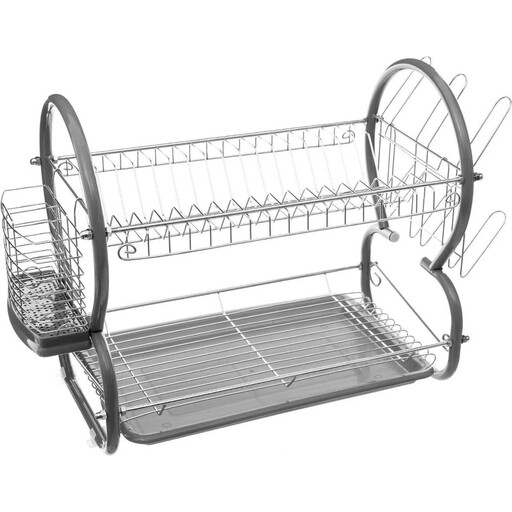
Why it suits this type of buyer: This two-tier dish rack keeps everyday dishes neatly organised and, at 44 x 24 x 38 cm, is suitable for an average-sized worktop.
The separate cutlery basket and glass holders stop dishes from being piled up haphazardly. The stated maximum load of 1.3 kg makes it easy to check the weight limit.
Two tiers, space for up to 17 listed crockery and cutlery items, separate holders and an assembly kit included.
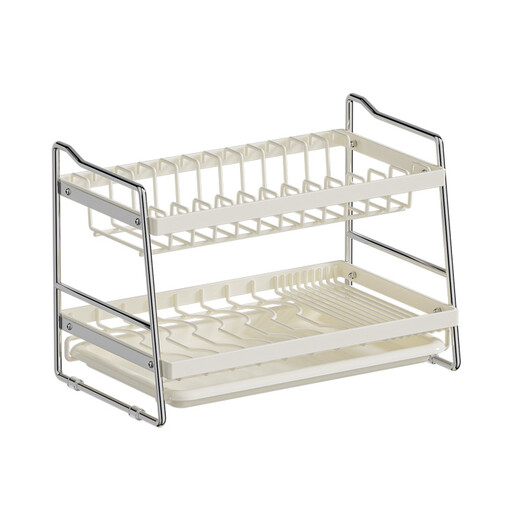
Why it suits this type of buyer: This freestanding dish rack has two tiers and integrated draining boards, making it suitable for households that need to dry lots of washing up on a limited worktop.
The integrated draining boards are designed to direct water into the sink or a designated collection area. The rack stands on the worktop and doesn’t need to be mounted on a wall.
Measures approximately 40 x 23.6 x 28.7 cm, with two drying tiers and a design for plates, cups, cutlery and kitchen utensils.

Why it suits this type of buyer: This over-sink dish rack is designed for anyone who wants to keep the worktop clear and regularly drain dishes, vegetables or kitchen utensils straight over the sink.
The length adjusts from 29 to 44 cm. Measure your sink beforehand and make sure the rack is fully supported by the edges to help prevent it from shifting.
According to the product information, it’s made from 304 stainless steel and has a fine mesh rack, a width of 21.2 cm and a height of 10.5 cm.
We’ve put together a complete, up-to-date list of products that meet these strict selection criteria and current European safety regulations.
Place a freestanding rack as close to the sink as possible, while leaving enough room to use the tap. A model with a drip tray is suitable when water can’t drain straight into the sink. In a small kitchen, an over-sink dish rack can free up extra worktop space.
Remove food scraps regularly and rinse the drip tray with warm water and a mild cleaning product. Dry metal parts thoroughly after cleaning. Don’t use an abrasive sponge on a coating or chrome finish. With a stainless steel model, wiping it dry can help reduce visible limescale marks.
Its lifespan depends on the material, load, moisture and maintenance. Don’t overload the rack, check the fixing points and don’t leave water sitting in the drip tray for long periods. A model with a clearly stated load limit and suitable dimensions is generally easier to use properly than one that’s regularly overloaded.
