
Vandaag of morgen in huis

Kwaliteit gegarandeerd

Welkomstaanbiedingen ontgrendelen: GRATIS bezorging | Tot 80% korting | Gratis 30 dagen JoyPlus-proefperiode
Download de app
A kitchen dish drainer may seem like a simple household item, but small design choices can make all the difference to how well it works day to day. If the drip tray is too small, water can still end up on your worktop. An unstable frame could topple when it holds a heavy pan or several glasses. And a drainer without a sensible layout can make it difficult to dry plates, cutlery and kitchen utensils neatly.
Space matters even more if you have a small kitchen, a caravan or a camping kitchen. Below, we cover the main things to consider, followed by product recommendations for different needs.
A product may look spacious in a photo, but its dimensions might not fit on your worktop. Always check the length, width and height. A two-tier dish drainer makes use of vertical space, but may not fit beneath your kitchen cupboards.
Pay attention to the layout, too. A well-designed plate rack holds plates upright, while glasses, mugs and cutlery need their own space. Without separate compartments, crockery is more likely to knock against itself.
A dish drainer with a drip tray should collect water or channel it towards the sink. Check that the tray sits fully underneath the drainer and is easy to remove. A fixed drip tray that’s difficult to reach can lead to standing water and limescale marks.
Empty and clean the drip tray regularly. This stops water from collecting and makes a plastic dish drainer easier to keep clean.
Words such as “premium”, “extra sturdy” or “hygienic drying” don’t tell you much on their own. Instead, look for details you can verify:
According to the manufacturer’s product information, an open design promotes airflow around crockery. This is a design feature, not a guarantee of a particular drying result in every kitchen.
Measure the section of worktop next to your sink before buying a dish drainer. Remember to allow for the tap, kitchen cupboards and the space you’ll need to remove the drip tray.
For a small kitchen or temporary accommodation, a compact dish drainer may be more practical than a large model. A lightweight plastic version is also easier to move. That’s handy if you’re looking for a dish drainer for a caravan or camping.
A two-tier drainer gives you more drying space without taking over the whole worktop. Just check that you can still reach the lower tier when there are plates on top.
Look out for these features:
Treat the stated capacity as a guide. Heavy pans and large bowls take up more room than standard plates.
A plastic dish drainer is lightweight, is less likely to scratch your worktop when moved and is usually easy to clean with warm water and mild washing-up liquid. Check the drainer regularly for cracks. According to the product safety information for various models, you should replace the product if it becomes damaged.
Metal can feel sturdy, but check the finish and care instructions. With a model made from chrome-plated steel and powder-coated metal, it’s best to wipe away water and dirt regularly. Place any drainer on a flat, stable surface and don’t exceed its stated load capacity.
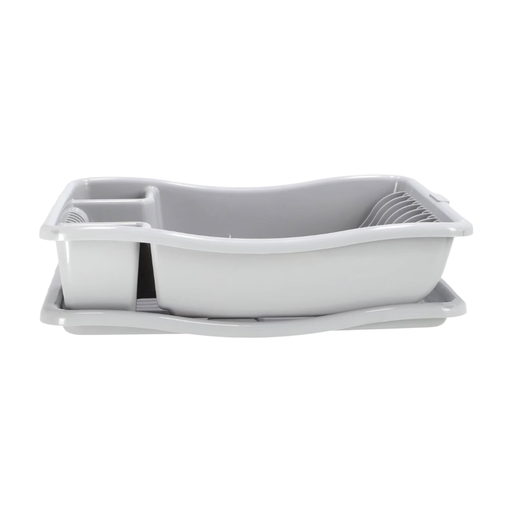
Why it suits this profile: This light grey dish drainer has a practical size and is designed for everyday use without assembly. The product information states that it holds up to 12 plates and has two built-in cutlery compartments.
The included drip tray collects draining water. Its dimensions of 38 x 29 x 8.5 cm make it easy to check whether it will fit before you buy.
Durable plastic construction according to the product description, two cutlery compartments and a stackable design for compact storage.
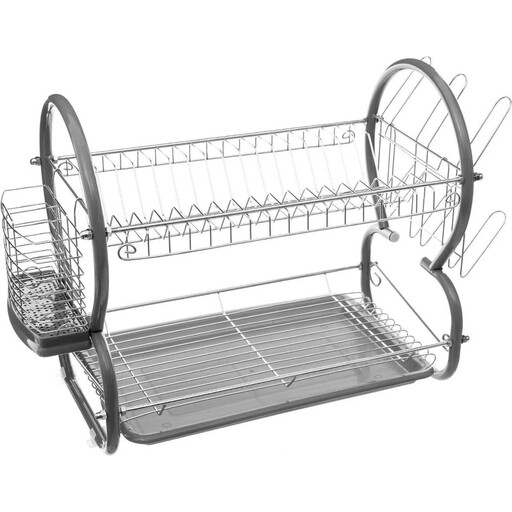
Why it suits this profile: The two-tier design is ideal for households that want to dry plates, bowls, mugs, glasses and cutlery at the same time.
The product specifications list a separate cutlery basket, glass holders and space for up to 17 pieces of crockery and cutlery. The load capacity is stated as 1,3 kg.
A combination of chrome-plated steel, powder coating and a polypropylene drip tray; dimensions are 44 x 24 x 38 cm.
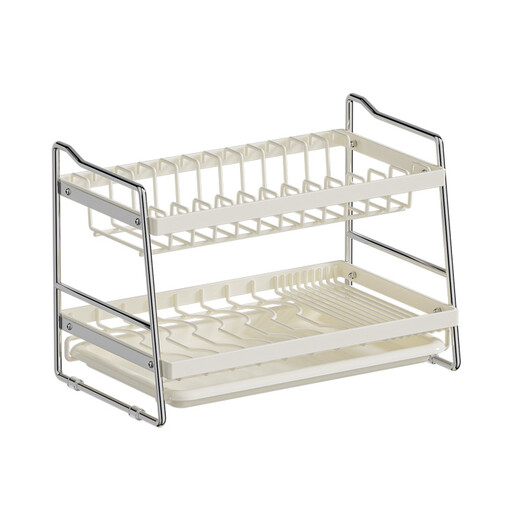
Why it suits this profile: The two tiers are designed for households that need more drying space but want to keep the worktop footprint to a minimum.
The integrated drainage boards are designed to direct water towards the sink or a collection point. Assembly is required, so check the instructions and available space beforehand.
Two tiers, freestanding design and dimensions of approximately 40 x 23,6 x 28,7 cm. According to the product information, the construction combines composite plastic with metal components.
We’ve put together a complete, up-to-date list of products that meet these strict selection criteria and the applicable European safety requirements.
Place the drainer on a flat surface and check that the drip tray sits correctly beneath the whole drainer. Empty the tray regularly. On models with a drainage channel, make sure it points towards the sink.
Its lifespan depends on the material, load and care. Clean it regularly with a mild cleaning product, dry metal parts thoroughly and don’t use it beyond its stated capacity. Replace it if it develops cracks, bent parts or an unstable structure.
It can be, as long as the model is lightweight, compact and stable. Measure the available space first and check that the surface is level. A plastic model that doesn’t require assembly is often practical for temporary use, while a two-tier drainer offers more drying space if your caravan or camping kitchen can accommodate it.
