
Vandaag of morgen in huis

Kwaliteit gegarandeerd

Welkomstaanbiedingen ontgrendelen: GRATIS bezorging | Tot 80% korting | Gratis 30 dagen JoyPlus-proefperiode
Download de app
Do you ever feel like your kitchen is just a few square feet short on space? A lack of countertop or storage space is a common problem, especially in modern homes. A kitchen cart seems like the perfect, flexible solution. However, the market is saturated with models that look great at first glance but quickly disappoint in practice.
Before you make a purchase, it's wise to be aware of a few common pitfalls. Many kitchen carts suffer from design flaws that render them useless after just a few months. These are the three main points to watch out for:
To avoid a bad buy, it's helpful to check a few specifications. These determine whether a kitchen cart will be a valuable addition or just get in the way.
The material determines not only the look but also the durability and ease of use. A wooden kitchen cart, often made of bamboo or paulownia wood, provides a warm, natural look. Bamboo is naturally hard and moisture-resistant, making it a popular choice for kitchens. Metal and steel offer a more industrial aesthetic and are often easy to keep clean.
Always pay attention to the maximum load capacity. This indicates how much total weight the cart can support. A lighter model might be suitable for tea towels and spices, but if you plan to place a microwave or heavy pans on it, you'll need a model that can handle at least 25 kg. A sturdy rolling kitchen island can sometimes support up to 60 kg.
Measure the available space in your kitchen accurately before making a choice. Consider not only the width and depth but also the height. The standard work height of a countertop is about 90-95 cm. If you want to use the cart as an extra work surface, choose a model with a similar height. A lower kitchen utility cart can serve perfectly as a serving cart or for storage, but it's uncomfortable for chopping vegetables.
Also, think about its function. Are you looking for a compact solution with drawers for cutlery and small utensils, or a larger kitchen island with storage that also has shelves for bigger appliances?
The wheels are crucial. Check if they are made of sturdy material, such as polypropylene or steel. An important detail is the presence of a brake on one or two of the wheels. This ensures the cart stays firmly in place when you're using it as a work surface. Nothing is more annoying than a serving cart that slides away while you're working.
To help you with your choice, we have selected a number of models that suit different needs and interior styles.
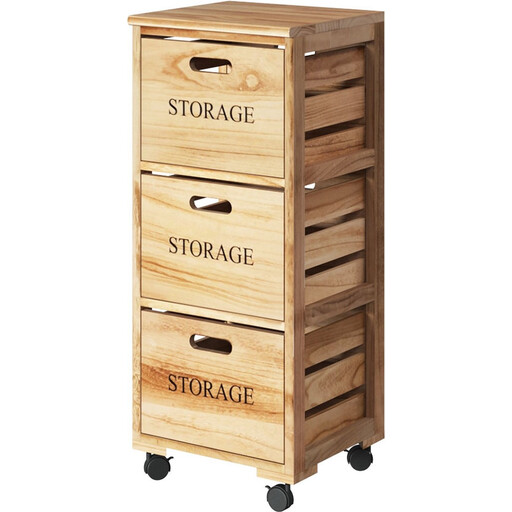
Why This Fits Their Persona: Ideal for those living in an apartment or studio who want to utilise a narrow, unused corner. This cart focuses purely on vertical storage without taking up much floor space.
This model is designed for storage, not as a worktop. The focus is on the three spacious drawers, which avoids the pitfall of an impractically small work surface.
Lightweight and portable: Made from paulownia wood, it's easy to move around. Quick assembly: According to the manufacturer, it can be assembled in about 10 minutes.
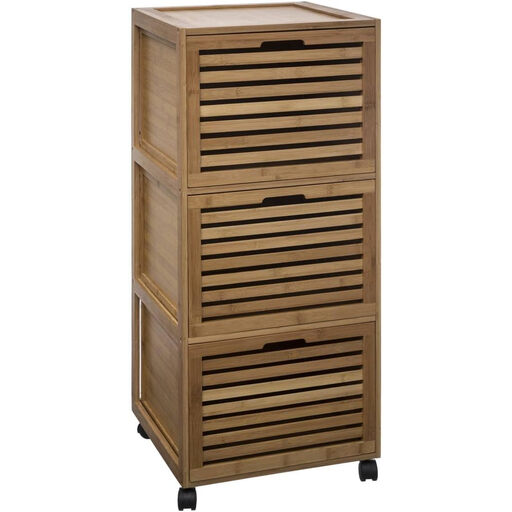
Why This Fits Their Persona: For those who need extra, multifunctional work and storage space. This cart can be used in the kitchen, pantry, or even the bathroom.
The bamboo frame and worktop are sturdier and more moisture-resistant than cheaper alternatives. With a height of 91 cm, it offers a comfortable working height.
Durable material: Bamboo is an eco-friendly and robust choice. Good load capacity: Can support up to 35 kg, suitable for most kitchen essentials.
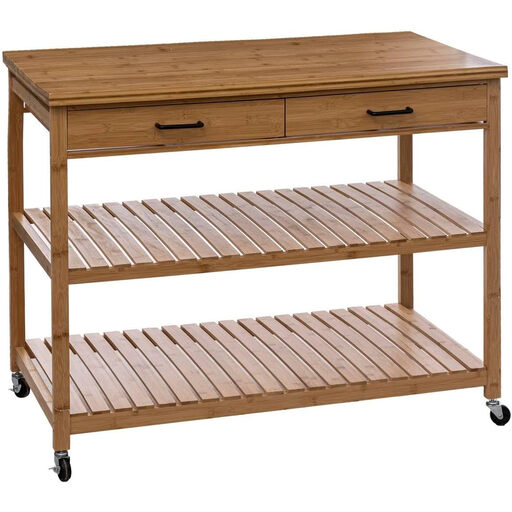
Why This Fits Their Persona: For those looking for a substantial, mobile kitchen island that functions as a fully-fledged extension of the kitchen, with plenty of work and storage space.
This model tackles all the pitfalls: a large bamboo worktop (108x60 cm), a very high load capacity of 60 kg, and a stable construction designed for intensive use.
Maximum capacity: With 2 drawers, 2 shelves, and a 60 kg load capacity, this is a powerhouse. A true workstation: Its dimensions and sturdiness make it a genuine rolling kitchen island.
We have compiled a complete, up-to-date list of products that meet these strict selection criteria and practical requirements.
This varies greatly by model. It is essential to check the manufacturer's specifications for the maximum load capacity. Simple models may be limited to 15-25 kg, which is sufficient for light items. A more robust rolling kitchen island made of bamboo or steel can often support 35 kg to 60 kg or more, making it suitable for heavier appliances and supplies.
A wooden kitchen cart, particularly one made of bamboo, can be suitable. Bamboo naturally has a dense structure. However, it is always advisable to check if the worktop has been treated with a food-safe finish. To be safe and to keep the surface looking its best, using a separate cutting board is always the best practice.
Yes, most kitchen carts are delivered flat-packed to reduce shipping costs. The assembly time depends on the complexity. A simple kitchen utility cart can be ready in 10-15 minutes according to the manufacturer, while a larger kitchen island with storage and multiple drawers could take up to an hour. The product information usually states an estimated assembly time and whether you can do it alone or with two people.
