
Vandaag of morgen in huis

Kwaliteit gegarandeerd

Welkomstaanbiedingen ontgrendelen: GRATIS bezorging | Tot 80% korting | Gratis 30 dagen JoyPlus-proefperiode
Download de app
A kitchen blender can quickly turn smoothies, soups, sauces and baby food into a smooth consistency. However, not every appliance is suitable for the same tasks. A large jug blender takes up more space, a hand blender works directly in a pan, and a food chopper is more practical for onions, herbs or nuts.
The right choice therefore depends on more than just wattage. Pay particular attention to how you plan to use it, the capacity, the accessories and how easy the appliance is to clean.
High power sounds appealing, but it does not tell you everything about the result. The shape of the blades, the capacity of the bowl and the recommended operating time also matter. A blender for soup and sauces, for example, does not necessarily need the same features as a model for ice and frozen fruit.
So check:
For example, the ROUNY hand blender is listed with a maximum power of 1200 watts, but also has an operating limit of one minute followed by one minute of rest. This is relevant if you want to process larger quantities one after another.
A 2-litre jug does not always mean that you can fill it with 2 litres at once. The maximum fill line and the space needed for circulation determine how many ingredients can be processed in practice.
For a family, a jug blender with a capacity of 1.2 to 2.1 litres can be useful. For a single smoothie, a 600 to 700 ml measuring cup is often sufficient. If you mainly chop small quantities, a 350 to 600 ml food chopper may be more suitable.
Also consider the material. A blender with a glass bowl is generally heavier than a plastic model. Glass can be useful for dealing with odours and stains, but always check that the bowl can withstand changes in temperature. For example, the Bear QSJ-D03Q1 product information states that the glass bowls must not be used in a microwave or exposed to sudden temperature differences of more than 50 °C.
A blender with accessories may seem versatile, but extra parts take up space and need to be washed. Decide in advance whether you really need a whisk, food chopper or food processor attachment.
A stick blender or hand blender is suitable for puréeing food directly in a bowl or pan. An electric food chopper works more efficiently with hard or solid ingredients such as nuts, carrots, meat and onions. A multifunctional blender combines several functions, but usually also requires more storage space.
For light tasks such as soft vegetables, fruit and sauces, a lower power rating may be sufficient. For ice, nuts or larger quantities, a more powerful motor with a suitable blade design is more practical.
Multiple speeds give you greater control over the texture. A low setting is useful for coarse chopping or gentle mixing, while a higher setting helps with puréeing. A pulse function works in short intervals and can prevent ingredients from being processed for longer than necessary.
Bear in mind that performance claims in marketing materials may come from the brand itself. According to Ninja’s product information, BlendSense technology automatically adjusts the time and speed based on the ingredients and quantity. Treat this as a product feature, not a guaranteed result for every recipe.
Choose the capacity based on your usual portions:
Also measure the available space on your worktop and in a kitchen cupboard. A tall blender jug can be difficult to position beneath wall cupboards.
Removable parts make cleaning easier, but not every component is automatically dishwasher-safe. Check the instructions before placing blades, lids or plastic parts in the dishwasher.
The motor unit must not be immersed in water. With every kitchen blender, stick blender or food chopper, unplug the appliance before assembling, disassembling or cleaning it. Blades are sharp, so use a brush when cleaning and do not touch the cutting edges directly.
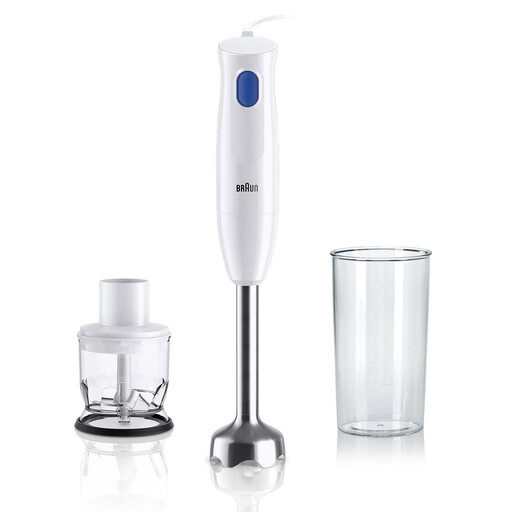
Why it suits this profile: Simple one-speed operation is suitable for making smoothies, desserts and sauces without a complicated control panel.
The product information lists 450 watts, a metal blending foot and clear one-button operation. The measuring cup has a capacity of 600 ml.
EasyTwist system, 350 ml food chopper and BPA-free measuring cup according to the product listing. Check the instructions for dishwasher details.

Why it suits this profile: This model is ideal for households that want to prepare large portions, smoothies and iced drinks using both automatic programmes and manual settings.
The specifications list a 2.1-litre jug, 1200 watts, 14 manual speeds and four programmes. Check the maximum fill line for each recipe.
Large jug, 700 ml cup and, according to the product information, an ice-crushing function with automatic adjustment.

Why it suits this profile: A suitable choice if you want to use one hand blender for mixing, whisking, chopping and puréeing everyday preparations.
The set includes a 700 ml cup, 500 ml food processor, whisk and variable speed control. The one-minute operating time prevents you from using the motor continuously.
Four accessories, stainless steel shaft and, according to the product information, dishwasher-safe accessories below 60 °C.
We have put together a complete, up-to-date list of products that fully meet these strict selection criteria and the applicable European safety regulations.
Choose a kitchen blender when you want to make larger quantities of smoothies, soup or iced drinks. A stick blender is more compact and convenient for blending soup directly in the pan. A food chopper is better suited to small quantities of solid ingredients. For a wide range of preparations, a blender with accessories can be useful, provided you actually use the attachments.
A blender with a glass bowl is worth considering if the material and visibility of the ingredients are important to you. Check the temperature limits and weight of each model before ordering.
This depends on the model and the jug. Only use a blender if the instructions state that hot ingredients are allowed. A stick blender is often more practical for soup in a pan, but you should still avoid splashes and hot steam.
The lifespan depends on how the appliance is used and maintained, as well as whether you follow the specified operating time. Overloading, using too little liquid and running the appliance continuously for too long can put strain on the motor. Clean the blades and accessories after use and store the appliance in a dry place.
Consumption depends on the power rating and operating time. An appliance rated at 1200 watts uses approximately 0.02 kWh in theory when running for one minute. In practice, programmes, pauses and the selected speed determine total consumption. A lower wattage does not automatically mean lower costs if you need to run the appliance for much longer.
