
Vandaag of morgen in huis

Kwaliteit gegarandeerd

Welkomstaanbiedingen ontgrendelen: GRATIS bezorging | Tot 80% korting | Gratis 30 dagen JoyPlus-proefperiode
Download de app
A kitchen bin needs to do more than collect rubbish. It should fit the available space, have enough capacity and be easy to use while you’re cooking. Yet many households choose a kitchen bin based only on its colour, shape or promising product name. This can lead to a wobbly bin, a lid that quickly becomes noisy or not enough room for everyday waste.
This buying guide compares the key features of a pedal bin, a bin with a lid, a recycling bin and compact solutions for small kitchens.
A 60-litre bin sounds spacious, but its external dimensions determine whether it will actually fit in your kitchen. So check not only the total capacity, but also its width, depth and height. Remember to allow space for the lid when it opens, too.
A large 50-litre bin or a 60-litre bin can be practical for a family. In a flat with a narrow walkway, a tall, compact bin or a wall-mounted bin may be a better choice.
A soft-close bin shuts smoothly and is generally quieter than a lid without a closing mechanism. However, that doesn’t automatically mean every hinge or pedal will last just as long. Check the construction, warranty and how the lid opens.
Some models’ product descriptions state that their pedals have been tested for a large number of uses. Treat this as a manufacturer’s product specification, not a guarantee of performance in every home. Don’t force a soft-close lid shut by hand, and keep waste away from the mechanism.
A double or triple-compartment bin is only useful if you can use the compartments consistently. Check in advance which types of waste your council collects separately. These might include general waste, plastic packaging, paper, glass or food waste.
A recycling bin with three equal compartments is easy to organise, but takes up more floor space. For a small kitchen, a built-in bin or a compact kitchen bin with one larger and one smaller compartment may make more sense.
Choose a capacity based on the number of people in your household and how often you take the rubbish out:
With a double bin, check the capacity of each compartment. A 2 x 30-litre model has a different layout from a 2 x 15-litre model, even if both are described as “double”.
A pedal bin lets you open the lid without touching it. That’s handy when you’re cooking and your hands are full. A sensor bin opens automatically, but needs batteries or a power supply. So check the battery life, sensor position and whether you can open it manually.
A bin with a lid keeps waste out of sight. With a soft-close mechanism, the lid should move smoothly. Place the bin on a stable surface and make sure the wall or a cupboard won’t block the lid.
A stainless-steel bin has a sturdy look and is easy to wipe clean. Check whether the product description states that the surface resists fingerprints and rust. Use a soft cloth and avoid wire wool or abrasive cleaners.
Plastic models are often lighter and easier to move. Some Curver models list recycled plastic as one of their materials. Always check the exact product specifications, though, as models within the same product range can differ.
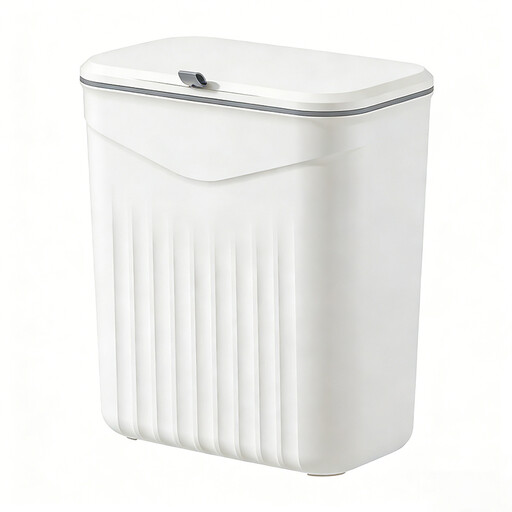
Why it suits this type of user: This compact wall-mounted bin is ideal for small kitchens and can be attached to a cupboard door. It measures 25 x 16 x 23,5 cm.
Its fixed dimensions make it easy to check whether it will fit beforehand. The design means you don’t need to set aside valuable floor space for a large bin.
PP plastic, flip-top lid with handle and hooks for fitting to a cupboard door.
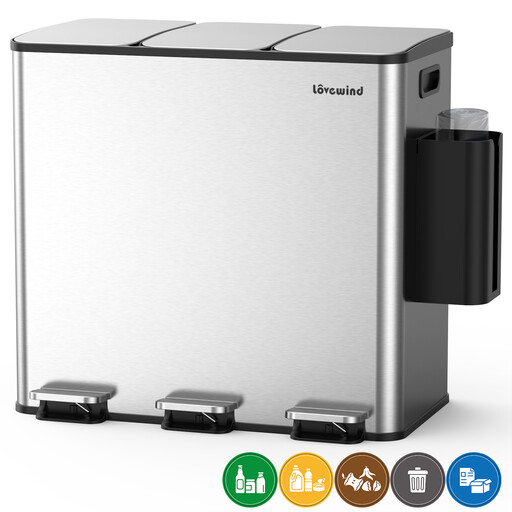
Why it suits this type of user: With three 20-litre compartments, this bin is ideal for households that want to make waste sorting a priority.
The separate lids and inner bins make the layout easy to check. Make sure the 60-litre capacity and external dimensions will fit in your kitchen before buying.
Stainless-steel housing, soft-close lids, 90° open position and three removable inner bins.
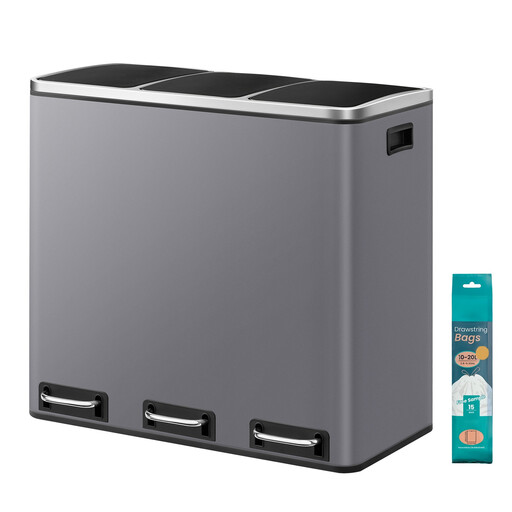
Why it suits this type of user: This model has three separate compartments for general waste, recycling and food scraps, depending on how you sort waste at home.
The capacity of each compartment is clearly stated as 18 litres. This lets you compare the actual layout rather than looking only at the total capacity.
Steel housing, three pedal-operated soft-close lids and removable inner bins.
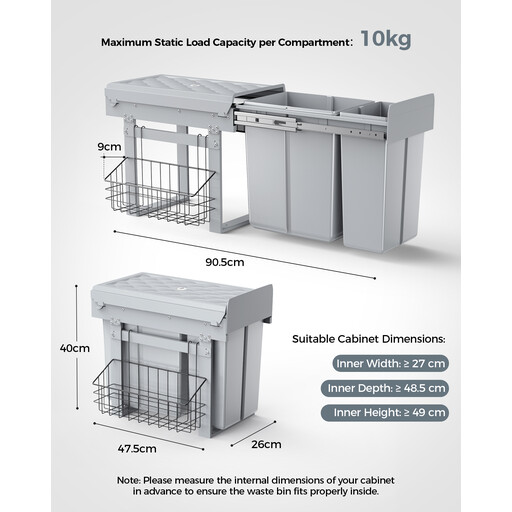
Why it suits this type of user: This built-in bin is designed for base units at least 30 cm wide, making use of cupboard space instead of floor space.
You can check the minimum cupboard width and the dimensions of 48 x 26 x 41 cm in advance, helping you avoid buying a bin that won’t fit.
Fully extending pull-out rail, two bins with capacities of 10 and 20 litres, and two hanging baskets.
We’ve put together a complete, up-to-date list of products that meet these strict selection criteria and the applicable European safety regulations.
Place the bin on a flat, stable surface. For a wall-mounted model, check that the cupboard door or mounting surface is suitable for the hooks. A built-in system should be securely fixed to the bottom of the cupboard; check that the rail moves smoothly once installed.
Clean the inner bin regularly with lukewarm water and a mild cleaning product. Wipe the stainless-steel exterior with a soft, damp cloth. Don’t use an abrasive sponge. Don’t leave damp food scraps in a standard kitchen bin for longer than necessary. A separate kitchen compost bin, perhaps with a 5-litre capacity, can be handy for organic waste, provided this fits with your local collection arrangements.
For a household with several people, a capacity of around 40 to 60 litres is often a good choice. If you sort your waste, the capacity of each compartment matters more than the total. For example, a 3 x 20-litre model offers a different practical layout from a single 60-litre bin.
Not necessarily. A sensor bin uses batteries and has electronic components. A pedal bin doesn’t need batteries, but you’ll need space for the pedal and a stable spot for the bin. Choose the opening mechanism that best suits your kitchen routine.
Its lifespan depends on the material, hinges, pedal mechanism, how heavily it’s used and how well it’s maintained. Check the warranty terms and don’t exceed the stated capacity. A soft-close lid will generally last longer if you don’t force it and keep dirt away from the mechanism.
