
Vandaag of morgen in huis

Kwaliteit gegarandeerd

Welkomstaanbiedingen ontgrendelen: GRATIS bezorging | Tot 80% korting | Gratis 30 dagen JoyPlus-proefperiode
Download de app
A kitchen bin needs to do more than just hold rubbish. In a Dutch household, size, waste separation, odour control and ease of use all matter. Yet many shoppers focus mainly on appearance or capacity. As a result, a new kitchen bin can turn out to be too big for the space, too small for the household or awkward to clean.
A 60-litre bin sounds spacious, but with a dual-compartment bin or triple-compartment bin, the capacity is divided between several sections. So a 3 x 20-litre model doesn’t have a single 60-litre compartment. That’s useful for separating waste, but less suitable if one type of rubbish tends to build up quickly.
So check:
A sensor bin opens automatically when you bring your hand near it. This can be handy while you’re cooking, but first check that there’s enough clear space above and in front of the bin. For example, a lid that stays open could get in the way of a kitchen cupboard, windowsill or walkway.
Also consider the batteries, the height of the open lid and whether the inner bin can be removed. Hands-free operation is useful, but it isn’t always necessary if a pedal bin better suits your kitchen routine.
A stainless steel bin can complement modern kitchen appliances. However, fingerprints, moisture and food residue will show if the surface isn’t wiped down regularly. Check whether the inner bin is removable and whether the pedal mechanism needs to be kept dry.
Avoid abrasive cleaners and steel wool on metal surfaces, as these can damage the finish. For a plastic bin, check that the material is suitable for the spot where you plan to use it and whether the product is intended for indoor use only.
A compact bin may be enough for a one-person household or a small kitchen. A 30-litre bin is often easier to fit beside a kitchen cupboard and won’t take up unnecessary floor space. For families, a 60-litre bin may be more practical, especially if you want to empty it less often.
A larger bin isn’t automatically more convenient. Measure the available width, depth and height. For models with a lid, allow for its height when open.
A waste-sorting bin is useful if you want to separate general waste, packaging, paper or food scraps as you go. Two compartments make everyday sorting straightforward. Three compartments offer more ways to organise your waste, but usually take up more space and have smaller inner bins.
Check whether each compartment has its own lid and inner bin. That way, you won’t have to use the same opening for every type of waste. Magnetic labels, such as those included with some 3 x 20-litre models, can help you identify each compartment. The right arrangement will depend on your local council’s waste collection rules.
A pedal bin keeps your hands free while you cook. According to the product description, a bin with a soft-close lid closes more slowly and quietly than a standard lid. This is especially handy in an open-plan kitchen or if the bin is near the dining table.
A removable inner bin with a handle makes emptying easier. Also check whether it fits a standard bin bag. For a built-in bin, the cupboard width, fixing points and slide-out distance are also key considerations.
The recommendations below are based on verifiable details in the product descriptions, such as capacity, dimensions, materials and operation.
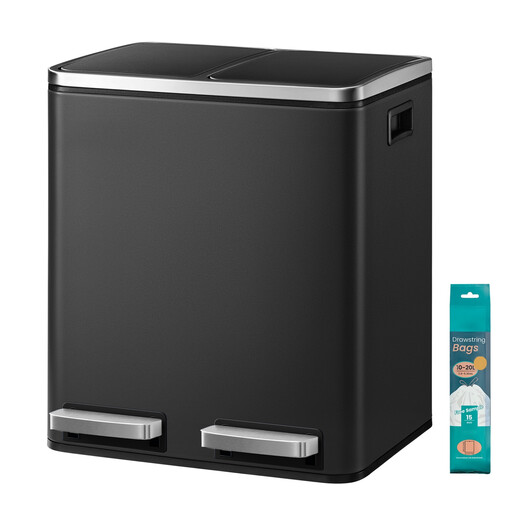
Why it suits this type of shopper: Two 15-litre compartments offer a straightforward introduction to waste separation in a compact kitchen.
Separate pedals and removable inner bins make the layout clear. The total capacity is split into compartments, so you won’t expect the 30 litres to be in one large section.
2 x 15 litres, steel outer body, soft-close lids and handles. Dimensions are approximately 41.8 x 35.9 x 44.5 cm.
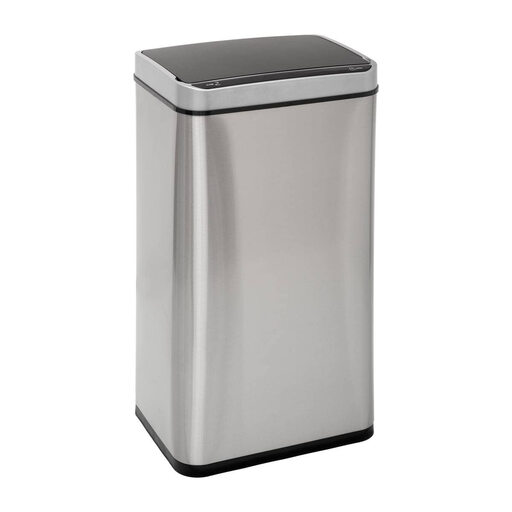
Why it suits this type of shopper: The automatic opening is ideal if you want to avoid touching the lid as much as possible while cooking.
The product details list both the capacity and the open height of 85.6 cm. This lets you check in advance whether the sensor operation will work in your space.
40-litre capacity, stainless steel body according to the product description, removable inner bin and soft-close mechanism.
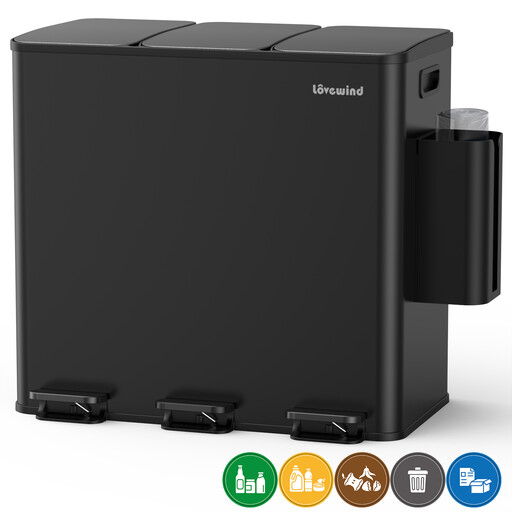
Why it suits this type of shopper: Three separate compartments are ideal for families who want to sort general waste, recycling and, for example, food scraps as they go.
The capacity is listed as 20 litres per compartment. The lids and inner bins are also separate, so sorting is more than just a marketing claim.
60 litres in total, three compartments, soft-close lids, 90° open position and a surface described as fingerprint-resistant.
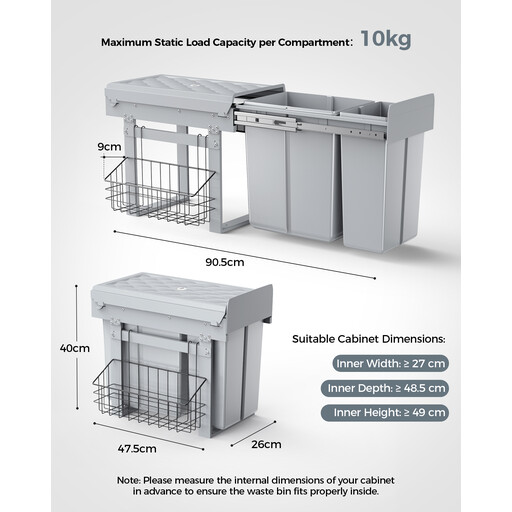
Why it suits this type of shopper: This built-in bin is designed for base units at least 30 cm wide, making use of cupboard space instead of floor space.
The minimum cupboard width and product dimensions are provided in advance. Measure your cupboard and check that it can be fitted using four screws.
Two bins of 10 and 20 litres, a fully extendable slide and two hanging baskets for items such as cleaning products.
We’ve put together a complete, up-to-date list of products that meet these strict selection criteria and the applicable European safety regulations.
A small kitchen compost bin, for example one with a 5-litre capacity, is useful for temporarily collecting food scraps before you empty it. If your council collects food waste, check which materials are accepted. A lid can help contain odours and reduce contact with waste, but it’s no substitute for regular cleaning.
Larger models sometimes come with odour filters. According to the product descriptions for certain models, activated carbon filters can help control odours. This is a manufacturer’s product claim, not a guarantee for every kitchen or type of waste.
That depends on how many people live in your household, how you sort your waste and how often you empty the bin. A 30-litre bin can be a practical choice for a small kitchen. Families often choose 40 to 60 litres; if the bin has several compartments, always check the capacity of each one.
Both systems reduce the need to touch the lid. A pedal bin works without batteries and is ready to use straight away. A sensor bin opens automatically, but needs space, batteries and a clear sensor range. Choose the option that suits your kitchen layout and daily routine.
Its lifespan depends on the material, how heavily it’s used, how it’s cleaned and how often the hinges or pedal are operated. Don’t close a soft-close lid by hand or overload the inner bins. Check the warranty terms when you buy; many consumer products in the European Union are covered by a minimum legal guarantee under the applicable rules.
