
Vandaag of morgen in huis

Kwaliteit gegarandeerd

Welkomstaanbiedingen ontgrendelen: GRATIS bezorging | Tot 80% korting | Gratis 30 dagen JoyPlus-proefperiode
Download de app
A new food processor, air fryer or knife set can quickly seem versatile on paper. Yet many purchases disappoint because of three recurring pitfalls: stated power means little without information about capacity, accessories are barely used, and the appliance turns out to be too large or difficult to clean.
Terms such as “multifunctional” also deserve careful consideration. A stand mixer with a meat grinder and blender can be useful, but only if you genuinely use those functions and can store the components easily. When choosing kitchen appliances, it is therefore not just the number of programmes that matters, but capacity, materials, safety and everyday ease of use.
A high wattage sounds appealing, but it is not a complete measure of performance. Also consider the motor technology, speed control, maximum quantity of dough or food, and recommended operating time.
For example, a stand mixer for bread dough has different requirements from a mini chopper for herbs. Also check whether the stated power is nominal or maximum. The Monsga SM100, for example, specifies 1000W peak power and 600W rated power. This difference is relevant if you regularly prepare heavy dough.
A 6-litre bowl is not automatically suitable for every quantity. Manufacturers often recommend a lower practical filling capacity to prevent splashing, overloading and uneven mixing. The Monsga mixer specifies a 6-litre bowl, but recommends a capacity of 5 litres.
The same applies to an air fryer. A larger capacity takes up more space and may use more electricity, while a small basket can be inconvenient for a family. Measure the available worktop space beforehand and check that the baskets or door can open fully.
An appliance with lots of loose parts after every use may end up staying in the cupboard more often. Look for dishwasher-safe accessories, a removable bowl, smooth surfaces and parts that must not be immersed in water.
Hygienic cleaning is particularly important for a meat slicer or meat grinder. Sharp blades, cutting plates and food residue require careful cleaning in accordance with the instructions. For example, a wooden mortar and pestle must be washed by hand, while certain ceramic models are dishwasher-safe.
For a stand mixer, speed settings and low-speed torque are at least as important as wattage. Low speeds are useful for kneading and gentle mixing, while higher settings are intended for whisking or beating. A pulse function can provide short, powerful bursts, but it does not replace a suitable continuous setting.
Also check the safety instructions. The AUCMA ASM1559 recommends running the appliance continuously for no more than six minutes, after which it must be allowed to rest. Overheating and overload protection are useful features, but they do not make prolonged use above the recommended capacity suitable.
A stainless-steel bowl, such as SUS304 or 304, is practical for everyday use and generally easy to clean. Also check what the whisks, hooks, blades and internal surfaces are made from. A non-stick coating can reduce cleaning time, but follow the instructions regarding scratches, heat and dishwasher use.
For an oil bottle or herb shaker, the closure and dispensing opening are more important than appearance alone. A well-sealed oil bottle helps reduce spills. With a knife set, factors such as handle ergonomics, block stability and the ability to clean the components safely are just as important as the number of knives.
Compare the external dimensions with the space available in your kitchen. The AUCMA stand mixer measures approximately 40.7 × 26.8 × 33.2 cm. This will not fit on every worktop if the head needs to be raised.
A stated noise level is usually measured under specific conditions. AUCMA specifies 68–72 dB at one metre, while Monsga states a level below 75 dB. Treat this as technical product information, not a guarantee of a quiet experience in every kitchen.
To estimate energy consumption, multiply the power by the operating time. An 1800W appliance running for twenty minutes theoretically uses around 0.6 kWh. In practice, an air fryer or oven regularly switches off, so actual consumption may vary.

Why it suits this profile: The combination of a 6L stainless-steel bowl, six settings and three basic accessories is ideal for home baking without having to buy several appliances straight away.
The product description states the precise dimensions, a noise level of 68–72 dB and a six-minute operating limit without a break. This allows you to assess the available space and usage pattern in advance.
450W copper DC motor, pulse function, tilting head, plus whisk, dough hook and beater included.
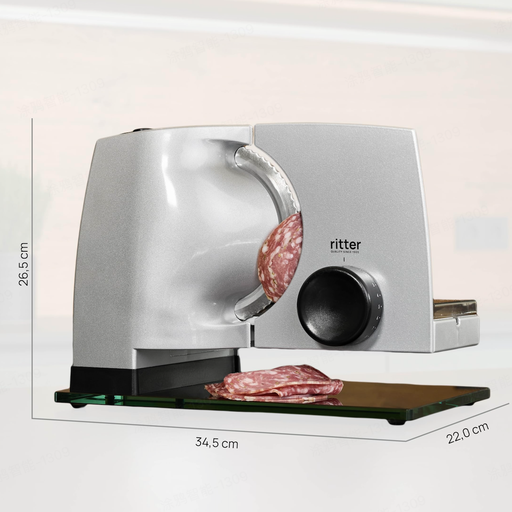
Why it suits this profile: Ideal if you regularly slice bread, vegetables, fruit or deli meats and value adjustable cutting thickness and a design focused on easy maintenance.
The product specification lists a removable carriage, an 18 cm cutting path and an adjustable thickness ranging from wafer-thin to 20 mm. This gives you control over everyday operation.
Serrated blade, safety switches, glass base plate and metal suspension construction according to the product information.

Why it suits this profile: This food processor is designed for households that want to use a meat grinder and blender as well as mixing and kneading functions.
The product information clearly identifies the accessories and intended uses. However, check the maximum quantities and use approved components only.
6QT stainless-steel bowl, eight speeds plus pulse function, and accessories for mixing, blending and grinding.
A dual-basket air fryer is useful when you want to prepare different dishes at the same time. According to its product name, the Bear Dual Chamber Air Fryer has a capacity of 9 litres, two independently adjustable baskets and a power rating of 2400W. Take the connected load and required ventilation space into account.
An air fryer oven offers greater flexibility. The OIMIS Smart Stainless Steel Air Fryer Oven specifies 30 litres capacity, 1800W, 21 programmes and a temperature range of 30–230 °C. The product description also mentions accessories for functions including rotisserie and dehydrating. Check whether you will use these features; otherwise, a simpler model may be more practical.
For smaller preparations, a mini chopper, meat grinder or mortar and pestle is often sufficient. A 10 cm ceramic Alpina mortar has a pouring spout and, according to the product information, is dishwasher-safe. The 5Five bamboo version is 13 cm in size but must be washed by hand. This difference in maintenance may determine your choice.
We have put together a complete, up-to-date list of products that fully meet these strict selection criteria and the applicable European safety regulations.
That depends on your cooking routine. A stand mixer and food processor are useful for baking. An air fryer may be ideal for quick meals. A mini chopper, herb shaker, oil bottle and knife set take up less space and support a wide range of everyday preparations.
Lifespan depends on the materials, maintenance, workload and frequency of use. Always follow the maximum quantities and rest times stated in the instructions. Clean accessories immediately after use and store knives, whisks and cutting plates dry. In the EU, many consumer products come with a minimum two-year legal guarantee; additional rights may apply.
Look at the power rating in watts and the operating time. A 1000W appliance running for half an hour theoretically uses 0.5 kWh. Actual consumption may be lower if a thermostat or programme switches off intermittently. Therefore, compare not only purchase prices, but also capacity, programmes and operating time.
