
Vandaag of morgen in huis

Kwaliteit gegarandeerd

Welkomstaanbiedingen ontgrendelen: GRATIS bezorging | Tot 80% korting | Gratis 30 dagen JoyPlus-proefperiode
Download de app
Choosing a new stand mixer, blender or food processor may seem straightforward. Yet many buyers fall for the same marketing tricks: a high wattage with no clear information about how long the appliance can be used, a large bowl with a lower practical capacity, or a multifunctional appliance with accessories that end up unused in a drawer.
For home bakers, keen cooks and families, a good purchase is about more than price or appearance. Above all, check that the appliance suits your recipes, available space and cleaning routine. Below, we explain which specifications matter and which kitchen appliances are suited to different needs.
Motor power is sometimes prominently displayed as peak power. That’s not the same as the rated power during normal use. The type of preparation matters too: kneading dough takes more power than whipping cream. So look at the combination of motor power, speed settings, recommended quantity and maximum running time.
A 6-litre mixing bowl may look spacious, but you can’t always fill it to the brim. The Monsga SM100, for example, is described as having a 6-litre bowl with a recommended capacity of 5 litres. When making bread dough, take the amount of flour and liquid into account too, not just the total volume.
A stand mixer with a blender, meat mincer and several attachments may save space, but every accessory needs to be stored, assembled and maintained. Check in advance whether the parts are dishwasher-safe and whether the blades, discs and couplings can be taken apart easily. For everyday use, a simpler appliance may be more practical than a model with features you rarely use.
A 500 ml blender may be enough for one or two people. A family may benefit more from a blender with a larger jug or a stand mixer with a bowl of around 5 to 6 litres. Also measure the clearance beneath your kitchen cupboards and check the weight. A heavier appliance often stays more stable, but is harder to store away.
Don’t compare wattages alone. A pulse function is handy for short bursts, while multiple speeds give you more control when mixing batter, cream and sauces. Also check the maximum continuous running time. The AUCMA ASM1559, for example, states that the appliance should not be used for more than 6 minutes at a time without a break. With a food processor, working in short pulses may be particularly important.
A stainless steel bowl, such as one made from 304 stainless steel, is sturdy and won’t absorb food odours. Silicone heads on kitchen utensils are useful for pans with a non-stick coating, provided the temperature limit is clearly stated. Check dishwasher-safe claims for each part; the motor unit should never go in water or the dishwasher.
Also look for:
The following selection is based on the listed product specifications, capacity, functions and care requirements. Before buying, always check the current product page, price, delivery details and included accessories.

Why it suits this profile: The 500 ml capacity is a handy size for smoothies, shakes and small portions. Its compact design takes up little room on a kitchen worktop.
The product specifications clearly state its 500 ml capacity and single speed, so its function and limitations are easy to understand. There’s no excess of unused accessories.
250 W, Tritan cup, drinking lid, stainless steel blades and removable dishwasher-safe parts, according to the product information.

Why it suits this profile: The 2-litre jug, with a stated working capacity of 1.5 litres, is a good fit for families preparing several portions at once.
The product information distinguishes between the jug’s total capacity and its working capacity. This helps you avoid overfilling the jug.
1000 W, three speeds plus pulse, removable blades and removable dishwasher-safe parts, according to Philips.
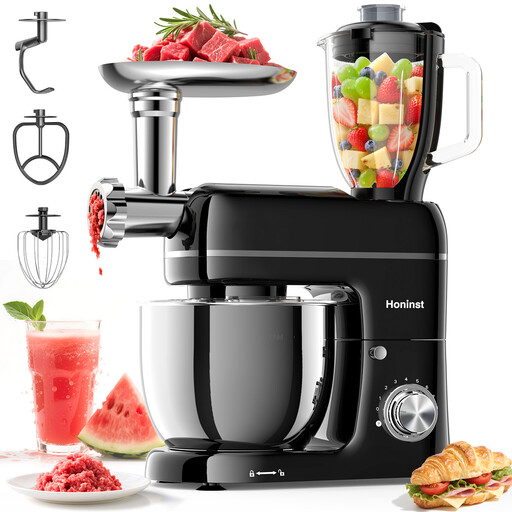
Why it suits this profile: If you bake, grind and blend regularly, this appliance can combine several kitchen gadgets in one.
The listed functions are specific: mixing, kneading, whisking, grinding and blending. However, check whether you’ll use these accessories often enough to make the extra cleaning worthwhile.
1300 W maximum power, 6-quart stainless steel bowl, eight speeds and a safety lock, according to the product description.

Why it suits this profile: Ideal if you regularly want to slice bread, vegetables, fruit or cold meats to an even thickness.
According to the product description, the slicing thickness can be adjusted from very thin to 20 mm. The carriage is removable for cleaning.
18 cm cutting path, removable carriage, safety switches and a glass base plate, according to the product information.
We’ve put together a full, up-to-date list of products that meet these strict selection criteria and the applicable European safety regulations.
Start with one appliance that handles several tasks you do often. A compact blender is ideal for smoothies and sauces. If you mainly bake, you’ll get more use out of a stand mixer with a mixing bowl, whisk and dough hook. Check the storage dimensions; a multifunctional appliance won’t necessarily save space if you have to store its accessories separately.
Lifespan depends on motor load, cleaning and how often you use the appliance. Let the motor cool down as instructed in the manual, don’t exceed the recommended quantities and remove food residue straight away. Blades and moving parts wear out faster with heavy use. Keep the manual and proof of purchase in case you need to make a warranty claim or ask about servicing.
Energy use depends on the appliance’s power and how long it runs. A 1000 W appliance theoretically uses 1 kWh if it runs continuously for one hour, but many kitchen appliances only run for a few minutes per preparation. So don’t choose based on lower wattage alone: an appliance that works faster and is suited to the task may be more efficient in practice.
