
Hosts with guests who enjoy different types of bread
Serve a white roll and a clearly labelled wholemeal roll separately, so guests can choose for themselves.


For a King’s Day gathering with guests who have different preferences, serve white rolls alongside a clearly labelled wholemeal option. Compare the fibre per 100 g on the packaging, and check the ingredients, allergens and any baking instructions for each variety.
Serve a white roll and a clearly labelled wholemeal roll separately, so guests can choose for themselves.
A dark colour or the name ‘multigrain’ isn’t enough to tell you what’s in a roll. Check the ingredients and fibre per 100 g.
Choose bake-at-home rolls with instructions that suit your oven or air fryer and the time you have just before serving.
First decide which types of bread you want to serve. Then check the packaging of each variety for its ingredients, number of rolls and preparation instructions.
| What to consider | What to check when buying | Who it matters to |
|---|---|---|
| Choosing between white and wholemeal | Choose a white variety and one explicitly labelled wholemeal; check the ingredients for both. | I want to offer something for guests with different bread preferences, rather than choosing just one type for everyone. This choice is a priority for around 36% of consumers. |
| Fibre and wholemeal flour | Look for the wholemeal label and compare fibre per 100 g; don’t assume multigrain means wholemeal. | If fibre is my main priority, I want to be able to compare the ingredients in the rolls. This is a priority for around 29% of consumers. |
| Serving warm | Check the cooking time, temperature and suitable appliance on the packaging of your chosen product. | I want to bake the rolls just before breakfast or lunch on King’s Day, but I’ll need enough time and space in my appliance. Serving them warm is the main priority for around 21% of consumers. |
| Number of rolls | Count the rolls in each pack and adjust the quantities of each type to suit your guests. | I want to put out enough of both types without having lots left over. Planning portions is a priority for around 14% of consumers. |
Multigrain refers to the types of grain used, but doesn’t tell you how much wholemeal flour a roll contains.
Read the product description and ingredients. If a wholemeal base matters to you, choose a product that is explicitly labelled wholemeal.
Ingredients and allergens can vary between white, wholemeal and multigrain rolls, even within the same brand.
Before serving, check the packaging for the exact variety, especially if any guests need to avoid certain allergens.
Cooking times and temperatures vary by product. If all the rolls won’t fit in your oven or air fryer at once, you’ll need to bake them in batches.
Read the preparation instructions and work out how many rolls will fit in each batch before you plan when to serve them.
According to the Netherlands Nutrition Centre (Voedingscentrum), bread doesn’t have to be made with baker’s salt. So the type of bread alone won’t tell you whether iodised salt has been used.
Check the ingredients on the packaging, or ask which salt has been used if the bread is sold loose.
These brands offer options for comparing white, wholemeal, multigrain and bake-at-home rolls. Always check the exact variety you’re thinking of buying.
A useful option for comparing white and wholemeal rolls.
A useful option if you want to bake white rolls at home.
A useful option for comparing white and wholemeal multigrain bake-at-home rolls.
A useful option if you’re looking for an individual white roll.
A useful option for a pack of four multigrain bake-at-home rolls.
A useful option for white rolls to bake at home.
This product selection is for guests who want white rolls. If you’d also like to offer a wholemeal option, assess it separately by checking the label.
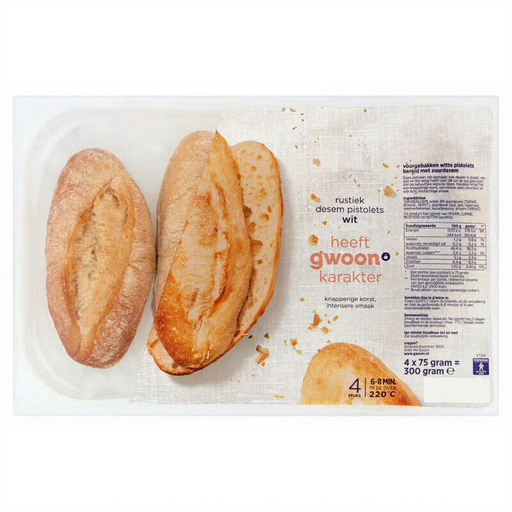 No image available
A white option for guests who don’t want a wholemeal roll; the pack contains four.
Check the packaging for allergens and preparation instructions if you want to serve the rolls warm.
No. ‘Multigrain’ doesn’t tell you how much wholemeal flour a roll contains. Read the ingredients and, if fibre matters to you, compare the nutritional information per 100 g. For example, PLUS states that its wholemeal multigrain rolls contain 56% wholemeal wheat flour.
If your guests have different bread preferences, it can be helpful to offer both. Put them out separately so guests can see which type they’re choosing.
No. According to the Netherlands Nutrition Centre (Voedingscentrum), bread doesn’t have to be made with baker’s salt. Check the ingredients list or, if the bread is sold loose, ask which salt has been used.
Follow the instructions on the packaging of your chosen product and allow for the number of rolls that fit in your appliance at once. PLUS gives instructions for its white and wholemeal multigrain rolls of 8–10 minutes in the oven at 220°C or 4 minutes in a preheated air fryer at 200°C; Jumbo gives an oven time of 10–12 minutes at 200°C for its white bake-at-home rolls.
Read the allergen information on the current packaging for each exact roll variety. Don’t assume that white, wholemeal and multigrain varieties contain the same ingredients or may contain the same traces.