
Hosts serving a mix of toppings
For a King’s Day breakfast with sweet and savoury toppings, plain rusks make a practical base. Albert Heijn and Jumbo also list wholemeal and seeded varieties for anyone who wants to offer a choice.


Choose plain rusks if you want a neutral base to pair with a variety of toppings at your King’s Day breakfast. Compare wholemeal and seeded options if ingredients and fibre are your priorities, or choose a baker’s variety if you’re looking for an extra-crisp rusk. Check the current packaging for ingredients and allergens for every variety, especially if you’re serving guests.
For a King’s Day breakfast with sweet and savoury toppings, plain rusks make a practical base. Albert Heijn and Jumbo also list wholemeal and seeded varieties for anyone who wants to offer a choice.
If you eat rusks regularly, compare the fibre content per 100 g alongside the ingredients. For the Bolletje varieties checked, PLUS lists 10 g of fibre per 100 g for both the dark wholemeal and multiseed options.
If you have an allergy or other dietary requirements, the specific variety matters. PLUS product information for the Bolletje rusks checked lists ingredients including cereals containing gluten, egg or sesame, depending on the product.
First decide which type of rusk you want to serve, then compare the packaging and nutritional information for the specific variety.
Choose these if: you want a neutral base for a range of sweet and savoury toppings.
Bear in mind: plain doesn’t mean allergen-free; the Bolletje Echte Beschuit at PLUS contains ingredients including wheat, rye and egg.
Choose these if: wholemeal ingredients, seeds or the stated fibre content are what matter to you.
Bear in mind: seeds and wholemeal ingredients vary by variety; the Bolletje dark wholemeal and multiseed rusks at PLUS also list sesame as an allergen.
Choose these if: you’re looking for a particularly crisp variety for your celebration table.
Bear in mind: Bolletje describes its Bakkers Beschuit as extra crisp; the PLUS product information lists egg and wheat.
| What to consider | What to check when buying | Who it matters to |
|---|---|---|
| Toppings and crispness | Choose between plain rusks and a variety with a more distinctive recipe; check the product description if you’re looking for an extra-crisp option. | If I’m serving both sweet and savoury toppings, I want rusks that go with both. Around 40% of consumers prioritise versatility and crispness. |
| Pack size | Compare the number of rusks per roll and the pack weight with the number of guests. | For a larger gathering, I want to be able to work out how many rolls I’ll need. Around 30% of consumers prioritise the number of rusks per pack. |
| Wholemeal and fibre | Check the ingredients and compare fibre on the same basis, preferably per 100 g. | If rusks are a regular part of my breakfast, I pay attention to wholemeal ingredients and fibre. Around 20% of consumers give this nutritional information top priority. |
| Ingredients and allergens | Check the current packaging for ingredients including cereals containing gluten, egg and sesame; check separately for baker’s salt if that’s relevant. | If guests need to avoid certain ingredients, I want to be able to check the exact variety. For around 10% of consumers, checking ingredients comes first. |
PLUS product information lists 4 g of fibre per 100 g for Bolletje Echte Beschuit and 10 g per 100 g for the Bolletje dark wholemeal and multiseed varieties checked.
Compare the values per 100 g and check which grains are actually listed in the ingredients.
The varieties checked have different ingredients: some contain sesame as well as cereals containing gluten, while PLUS says Bolletje Bakkers Beschuit contains egg.
Read the allergen declaration on the current packaging before choosing rusks for guests.
The Netherlands Nutrition Centre says that baking with baker’s salt isn’t compulsory. So the name ‘rusk’ doesn’t tell you whether a product is made with it.
Check the ingredients on the packaging if the use of baker’s salt matters to your choice.
The Bolletje product information checked includes standard rusks, Bakkers Beschuit and varieties made with wholemeal grains or seeds.
Albert Heijn’s range includes its own rusk varieties, including plain and wholemeal options, alongside Bolletje products.
Jumbo’s rusk category features its own varieties and Bolletje rusks, including plain and wholemeal options.
These Joybuy products include plain rusks and wholemeal or seeded varieties for your King’s Day table. As well as the recipe, check the number of rusks per pack, and always check the current packaging if you have specific ingredient requirements.
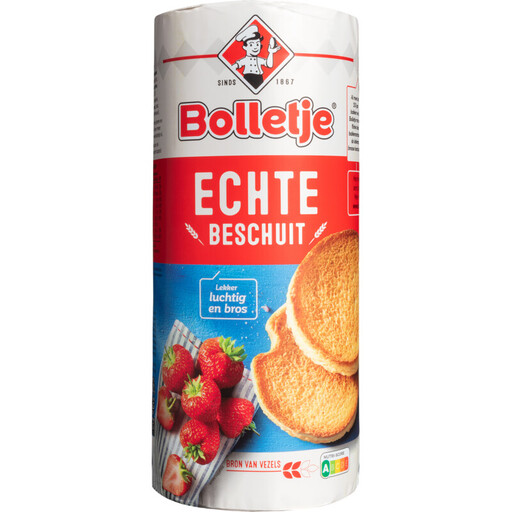 Image unavailable
A plain rusk for a table with a variety of toppings.
The product name states that the pack contains 13 pieces. If you have allergies, check the packaging for wheat, rye, egg and possible traces of sesame.
 Image unavailable
A wholemeal option for anyone who wants to choose their grain at breakfast.
The product name states that the pack contains 13 pieces. Before comparing fibre values, check whether they’re given per 100 g or per serving on the packaging; if you have allergies, also check for wheat, egg and possible traces of sesame.
 Image unavailable
A dark wholemeal variety for anyone who wants to compare wholemeal ingredients and fibre.
The product information lists 10 g of fibre per 100 g, and the product name states that the pack contains 10 pieces. The ingredients include wheat, oats, barley and sesame; check the current packaging if you have allergies.
 Image unavailable
A seeded option for anyone looking for something different from plain rusks.
The product information lists ingredients including sunflower seeds, linseed, pumpkin seeds and sesame seeds, and states that it contains 10 g of fibre per 100 g. The product name states that the pack contains 10 pieces; if you have allergies, check the packaging for wheat and sesame.
No. Slice thickness isn’t a usual factor when choosing rusks, unlike sliced bread. Jumbo explains that a rusk roll is cut in half and the halves are baked again. For your King’s Day breakfast, it’s better to choose based on the recipe, ingredients and number of pieces.
No. Don’t assume a product contains baker’s salt based on its name. The Netherlands Nutrition Centre says using baker’s salt in bread isn’t compulsory; if this matters to your choice, check the ingredients on the packaging of the rusks you buy.
Check the current packaging of every rusk you choose for any allergens relevant to your guests. PLUS product information for the Bolletje products checked lists wheat and other cereals containing gluten, egg or sesame in different varieties; the ingredients aren’t the same for every variety.
Store opened rusks in a well-sealed container in a cool, dry, dark place. The Netherlands Nutrition Centre recommends keeping opened wholemeal rusks in a kitchen cupboard for up to one month; check the packaging for storage instructions for other varieties too.