What should you compare for a lighter spread?
Coated snack with a reduced-fat claim
A good fit if: you’re specifically looking for a seasoned, crunchy coating and want to assess the claim against the comparison product named.
Bear in mind: Albert Heijn stated that Duyvis Oven Roasted Borrelnoten Sweet Paprika had 30% less fat than regular peanuts in a crunchy coating on average, but also contained 21 g of fat and 2 g of salt per 100 g. The product page stated that this variant had been discontinued.
Nuts roasted without added fat
A good fit if: you’re looking for roasted nuts whose manufacturer describes them as prepared without adding oil or fat.
Bear in mind: Duyvis describes Oven Baked Peanuts Original as roasted without adding oil or fat. That alone says nothing about the naturally occurring fat in the nut; Albert Heijn lists 50 g of fat per 100 g for the separate Duyvis Oven roasted almonds product.
Unsalted nuts with a portion of your choice
A good fit if: you want unsalted nuts without a crunchy coating and prefer to decide how much to serve.
Bear in mind: Albert Heijn lists 0 g of salt and 64 g of fat per 100 g for AH Walnootmix ongebrand. Unsalted doesn’t mean lower in fat.
First decide which quality matters most for your get-together. Then compare the labels per 100 g and, if needed, convert the portion sizes so you’re comparing the same amount.
| What to consider |
What should you check? |
Who is this relevant to? |
| Assessing a reduced-fat claim |
Read the exact claim, the comparison product and the fat content per 100 g. For a ‘low fat’ claim on solid foods, the European Commission sets a maximum of 3 g of fat per 100 g. |
If I choose seasoned party nuts, I want to know whether the claim applies to that exact variant and what it is being compared with. Around 36% of consumers prioritise a verifiable reduction in fat. |
| Energy and portion size |
Compare kcal per 100 g, then use the same portion size for both; different portion sizes are not a like-for-like basis for comparison. |
If I want to consume less energy, I look at both the kcal and the amount I actually serve. Around 29% of consumers prioritise energy and portion size. |
| Salt and ingredients |
Check the salt content per 100 g, the ingredients and whether it’s a plain nut or a coated snack. For example, Albert Heijn lists 0 g of salt per 100 g for AH Walnootmix ongebrand. |
If I’m looking for unsalted nuts without a crunchy coating, I want to assess salt and ingredients separately from fat content. Around 21% of consumers prioritise salt and ingredients. |
| Packaging and allergens |
Check the pack size and keep the ingredients and allergen information. The NVWA states that allergen information for prepacked products must appear on the label. |
For a shared spread, I want to know how much I can serve and be able to check the packaging for guests. Around 14% of consumers prioritise practical shopping and serving. |
Nuts and snack options at Joybuy
These product options range from peeled chestnuts with stated nutritional values to unsalted peanuts, almonds, cashews and nut mixes. Compare fat, energy, salt and ingredients for each product; unsalted nuts aren’t automatically low in fat.
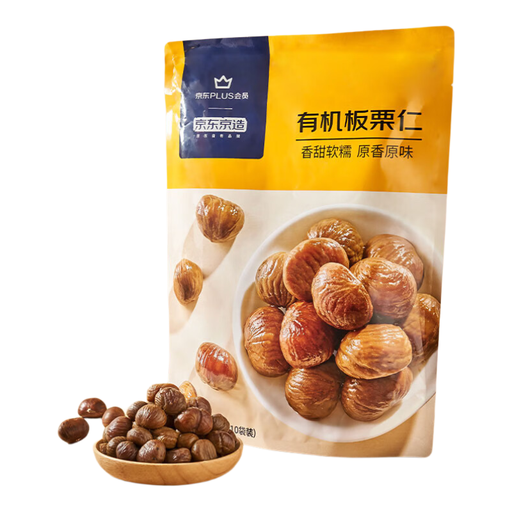 Image unavailable
J.ZAO S++ Grade Whole Chestnuts, 1 kg (10 sachets)
An option if you want to compare fat content per 100 g: the product description lists 1.7 g of fat per 100 g, but makes no reduced-fat claim.
Peeled and ready to eat; 10 sachets of 100 g. The stated nutritional values are 191 kcal and 0 g of salt per 100 g.
View at Joybuy
 Image unavailable
g'woon unsalted peanuts, 250 g
Suitable if you’re looking for unsalted peanuts, but not if you want a low-fat option: the description lists 50 g of fat per 100 g.
The description lists 99% peanuts, sunflower oil and 0.02 g of salt per 100 g. May contain cashews.
View at Joybuy
 Image unavailable
Anatolia Badem Natural (Almond), 500 g
An option if you’re choosing almonds and want to assess the salt separately; the product description lists 0.00 g of salt per 100 g.
The description lists 100% almonds, 50 g of fat and 578 kcal per 100 g. Contains almonds.
View at Joybuy
 Image unavailable
g'woon Cashew Nuts Roasted & Unsalted, 200 g
Suitable if you’re looking for roasted cashews with no added salt; the stated values are 46.67 g of fat and 0.067 g of salt per 100 g.
The product description lists 596 kcal per 100 g. Contains cashews.
View at Joybuy
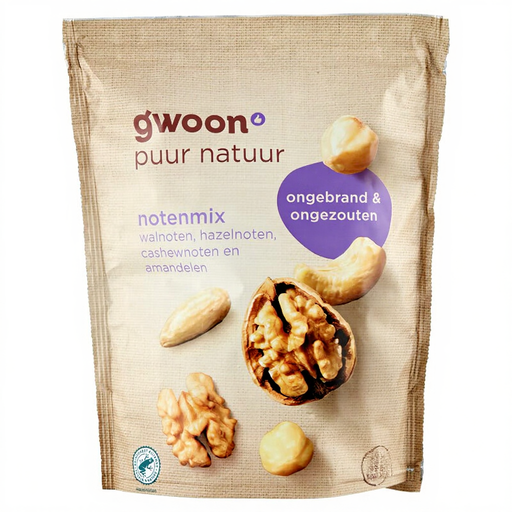 Image unavailable
g'woon Unroasted Mixed Nuts, 500 g
An option if you’re looking for an unroasted, unsalted mix; the product description lists 0 g of salt per 100 g, but also 58.7 g of fat per 100 g.
The mix contains hazelnuts, walnuts, almonds and cashews. May also contain peanuts and other nuts.
View at Joybuy
Frequently asked questions about nuts for King’s Day
When can a solid snack be called ‘low fat’?
For solid foods, the European Commission sets a maximum of 3 g of fat per 100 g for a ‘low fat’ claim. A smaller portion doesn’t change that limit per 100 g; a comparative reduced-fat claim is something different.
How do I compare nuts with different portion sizes?
First compare the nutritional values per 100 g, then work out the values for the same chosen portion size for both products. Portion sizes on packaging can differ, so they don’t automatically provide a like-for-like basis for comparison.
Are nuts with a reduced-fat claim suitable for guests with an allergy?
A fat claim doesn’t provide information about allergens, so check the label for the exact variant. The NVWA states that allergen information for prepacked products must appear on the label; Albert Heijn listed peanuts and wheat among the allergens for Duyvis Oven Roasted Borrelnoten Sweet Paprika.
How should I store opened nuts?
Follow the instructions on the packaging for your variant. For Duyvis Oven roasted almonds, Albert Heijn advises storing them in a cool, dry place and using a lightproof, airtight container after opening. For AH Walnootmix ongebrand, the advice is to store in a cool, dark, dry place and reseal the pack securely.
What should I look out for in a nut recall notice?
Always check the exact product name, packaging, barcode and best-before date, and follow the instructions in the relevant notice. The NVWA recall notice of 20 May 2026 concerned Trader Joe’s unsalted cashews, 170 g, with barcode 2003020120930 and best-before date 23-09-2026. A separate notice from Albert Heijn concerned AH Pinda’s extra groot gezouten in a tub, with a best-before date of 04-11-2026; Albert Heijn advised customers to return the product for a full refund. These notices apply to the products and batches named, not to all nuts sold by those retailers.


