For long nature essays, a familiar layout with easy-to-reach navigation and function keys is a sensible starting point. Extra programmable keys are mainly useful if you want to set up actions you perform regularly. Choose a more compact keyboard if desk space matters more and you can do without the missing keys, or a model with separate keyboard halves if hand positioning is a priority. Check the physical layout, connection and any software requirements too. Microsoft Support explains that you can customise keyboard shortcuts in Word for Windows, while Logitech offers Smart Actions through Logi Options+ as an additional feature.
Who are these keyboards for?
Writers who rearrange their work frequently
You write chapters and move or edit passages using familiar keyboard shortcuts. Microsoft Support explains how you can assign shortcuts to commands or styles in Word for Windows, so a layout with easy-to-reach navigation keys may be worth considering.
Writers who spend long periods typing
You want to assess your hand position and workstation set-up as you write. Arboportaal describes repetitive actions and static strain when working at a screen. A split keyboard is one possible design choice, but it doesn’t replace considering your workstation as a whole.
Writers using a shared desk
You’re weighing up keyboard noise and space for a mouse or reference materials against the usefulness of a number pad. RTINGS.com explains that TKL keyboards omit the number pad; manufacturers such as CHERRY and Trust use their own descriptions of the sound their keys make.
What should you look for when choosing?
Start with the keys you use when writing and editing. Then consider whether customisable functions, hand position, desk space or switching between devices matters most to you.
| What to consider |
What to look for |
Who is this important for? |
| Keyboard shortcuts and navigation |
Check the physical layout and how easy it is to reach the arrow, navigation and function keys. Also check which shortcuts your writing software uses. |
If I often rearrange passages, I want editing and navigation keys close to hand; around 36% of consumers consider keyboard shortcuts their main priority. |
| Hand position |
Assess the position of the keyboard halves alongside your chair, screen and mouse. If possible, try the key action too. |
During long typing sessions, I want to adjust the distance and position of my hands to suit my workstation; around 29% of consumers prioritise hand position. |
| Noise and desk space |
Decide whether you need a number pad, measure the available space and, if possible, try the keyboard for yourself. |
At a shared or small desk, I want to leave room for my mouse and reference materials without giving up keys I need; around 21% of consumers focus mainly on a quiet, uncluttered set-up. |
| Connections and devices |
Count the devices you write on and check the connection, layout and any software requirements. |
If I switch between devices to work on my essays, I want to know whether the keyboard will suit my set-up; around 14% of consumers prioritise switching between devices. |
Common mistakes when choosing
-
Assuming extra macro keys are essential for your word processor
In Word for Windows, you can assign keyboard shortcuts to commands and styles yourself, as Microsoft Support explains. Customisable keys on a keyboard are an extra option, not a requirement for using standard keyboard shortcuts.
First, try the commands and styles you use in your writing software. Then decide whether you want to set up your own key actions, and check which software and operating systems are supported.
Setting up extra features can take time and may depend on compatible software.
-
Choosing a compact keyboard without checking which keys are missing
A TKL layout leaves out the number pad; smaller layouts may omit other keys too. This can be inconvenient if you rely on specific navigation or function keys when editing.
Compare the layout with the shortcuts you use every day. Also consider whether you need a number pad, for example if you expect to enter a lot of figures later.
If you find you need a number pad later, a separate one can take up extra space.
-
Assuming a split keyboard is a complete solution to workstation problems
Changing the position of the keyboard halves alters your set-up, but working at a screen also involves repetitive actions and static strain. Arboportaal stresses that your workstation as a whole and varying your tasks remain important.
Assess the position of your keyboard, screen, chair and mouse together, and take breaks from prolonged screen work.
-
Confusing a keyboard and mouse set with a standalone keyboard
Trust describes both a standalone Ody II and a separate keyboard and mouse set. These are different products.
Check the full product name and which items are included in the version you’re choosing.
A set may include an accessory you don’t need.
Brands worth comparing
Logitech
The MX Keys S is worth considering if you’re looking for a familiar, low-profile layout with customisable keys and device switching.
- Logitech describes Smart Actions through Logi Options+ and switching between up to three devices.
- Check the version you choose and its software compatibility. A full-size keyboard doesn’t omit the number pad to save space.
CHERRY
The STREAM KEYBOARD TKL is an option to compare if you’re looking for a compact, wired main keyboard.
- CHERRY specifies SX scissor technology and a version without a number pad.
- ‘Whisper-quiet’ is CHERRY’s own description, not an independent comparison with other keyboards.
Keychron
The K8 Pro ISO is worth considering if you’re looking at a mechanical TKL layout with customisable keys or macros.
- Keychron describes customising keys through Launcher and offers several ISO versions.
- Check the exact layout and switches. The versions mentioned don’t confirm a Dutch ISO variant.
R-Go Tools
The Split Break is an alternative if separately positionable keyboard halves matter more to you than a conventional design.
- The Dutch product description specifies two separate parts and a wired US QWERTY version.
- The break indicator uses software. A different keyboard layout doesn’t replace a suitable workstation or varying your tasks.
Trust
The standalone Ody II is a straightforward wireless option to compare if you’re looking for standard keys and media shortcuts.
- Trust describes low-profile keys and a stowable USB receiver.
- This description doesn’t confirm customisable macros or a comparable noise rating against other models. Also check whether you’re looking at the standalone version or a set.
Joybuy keyboards for writing and editing
This selection includes keyboards for writing and editing, with options for full-size or more compact layouts, as well as different connections and key layouts.
 No image available
Wired QWERTY keyboard with number pad
The full-size layout may suit you if you want to keep arrow, navigation and function keys within easy reach while writing and editing.
QWERTY layout, number pad and plug-and-play wired connection.
View at Joybuy
 No image available
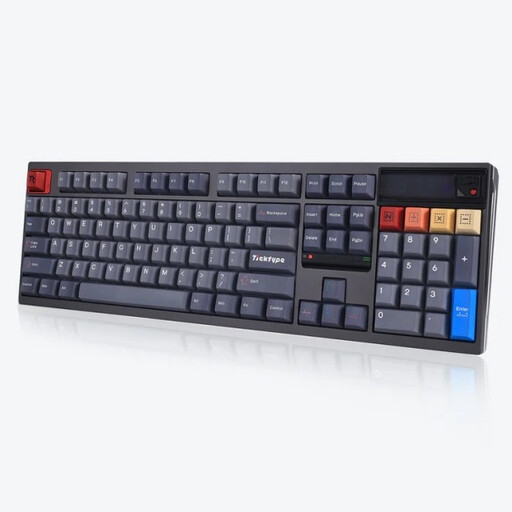
Ticktype DP104 Tri-Mode Wireless Mechanical Keyboard, 108 Keys, US Layout
The full-size layout is worth considering if you want to keep an extended set of keys for long writing sessions.
108 keys, US layout, tri-mode wireless connection and hot-swappable design.
View at Joybuy
 No image available
Ajazz AK820 Pro 75% Mechanical Tri-Mode Keyboard, US Layout
The 75% layout is an option if you’re looking for a more compact keyboard and its exact key layout suits your editing work.
Mechanical keyboard with US QWERTY layout and wired, Bluetooth and 2.4G connections.
View at Joybuy
 No image available
Trust Vaiya Wireless Keyboard, Full-Size, QWERTY US
This full-size model may suit you if you want a number pad with a wireless set-up.
US QWERTY layout with number pad and scissor keys. The product information doesn’t mention programmable keys.
View at Joybuy
 No image available
Razer Huntsman Mini RZ03-03390200-R3M1
A 60% layout is mainly worth considering if a compact size matters more than having a full set of navigation keys.
The product information specifies a 60% layout and customisable keys. The function row and arrow keys are missing from the layout described.
View at Joybuy
Frequently asked questions
Do you need programmable keys to use keyboard shortcuts in Word?
No. In Word for Windows, you can assign keyboard shortcuts to commands and styles directly in Word. A programmable keyboard is a separate option for setting up your own key actions; the steps may differ in Word for Mac and Word for the web.
How can you navigate between essays or headings without a special keyboard?
In Word for Windows, Ctrl+F opens the Navigation pane. Headings appear there when you’ve applied heading styles to the headings in the main text; according to Microsoft Support, how this works differs on Mac and in Word for the web.
How do you set up a split keyboard for long typing sessions?
According to R-Go Tools, the R-Go Split Break has two separately positionable parts. Assess the placement alongside the rest of your workstation and take breaks from prolonged screen work; using a different keyboard alone doesn’t guarantee a comfortable working posture.
Does Dutch health and safety law prescribe a particular keyboard?
No. The rules mentioned don’t mean that every writer has to choose a split or mechanical keyboard. For employees, Arboportaal states, among other things, that if you work at a screen for more than two hours a day, the screen and keyboard must not be attached to each other. This isn’t a general requirement for every individual buyer.


