
Writers who edit a lot
If you write long passages and regularly look up quotations or earlier text, familiar keys and easy-to-reach navigation and editing keys matter. Logitech and CHERRY models let you compare wireless and wired options.


Start by choosing a layout you’re comfortable using to write, select text and navigate; you don’t need a special keyboard to use a reference window on the same screen. A compact model can leave more room for your mouse, while a split keyboard is worth considering if you want to adjust your hand position. Also check the physical key layout, connection, any software features and the space available on your desk.
If you write long passages and regularly look up quotations or earlier text, familiar keys and easy-to-reach navigation and editing keys matter. Logitech and CHERRY models let you compare wireless and wired options.
If you want to change the position of your keyboard, hands and mouse during long sessions, compare a compact model with a fixed split keyboard or one whose halves can be positioned separately. Arboportaal points out that screen-based work also involves repetitive actions and a static posture; a keyboard’s shape alone won’t guarantee relief from discomfort.
A compact keyboard can leave more room for a mouse, laptop or notes. Compare the R-Go Compact Break and CHERRY KW 7100 MINI BT too, paying attention to the position of the navigation keys and the connection that suits your computer.
A good fit if: you want to keep familiar key positions and possibly a numeric keypad while writing and editing.
Bear in mind: it takes up more desk space; a full-size keyboard doesn’t give you built-in control of your reference window.
A good fit if: you want to leave room for your mouse or have limited desk space.
Bear in mind: check which navigation and function keys are missing or positioned differently; according to R-Go, the break indicator on the R-Go Compact Break is controlled by separate software.
A good fit if: hand position is an important factor for you during long typing sessions.
Bear in mind: you may need time to get used to it, and the model you choose will take up space; manufacturers’ ergonomic claims don’t guarantee individual health benefits.
| What to consider | What to look for | Who should pay particular attention? |
|---|---|---|
| Layout and text navigation | Compare Enter, Shift, the arrow keys and frequently used editing keys with your current keyboard. Check the exact country and model version, not just the QWERTY designation. | I don’t want to have to search for keys while writing, selecting text and looking things up. That’s why around 31% of consumers give layout and text navigation top priority. |
| Hand position during long sessions | Compare a straight keyboard with a fixed split model or one whose halves can be positioned separately. Consider the space available and the time it may take to get used to it. | During long writing sessions, I want to position my keyboard and mouse to suit my workspace. Around 25% of consumers prioritise hand position. |
| Workspace | Measure the space available for your keyboard and mouse, and decide whether you need a numeric keypad. With compact models, check where the navigation and function keys are positioned. | I want to leave room beside my keyboard for a mouse, laptop or physical reference notes. Workspace is the top priority for around 19% of consumers. |
| Key noise | Try the keyboard for yourself if possible. A description of the key mechanism or key stability isn’t a comparable measurement of noise levels in your workspace. | If I’m typing near other people, I want to be considerate of the need for a quiet shared space. Around 13% of consumers put key noise at the top of their list. |
| Connection and switching between devices | Check that your computer supports the required USB connection or Bluetooth, and that any software is compatible with your operating system. Switching between devices is different from switching between windows on one computer. | I want a connection that works with my computer, or one keyboard for several devices. For around 12% of consumers, connectivity is the main buying priority. |
Keys such as Enter, Shift and special characters can vary between physical layouts. You’ll notice this particularly when editing a lot of text.
Compare an image of the keyboard and the exact country version with the layout you’re used to.
The space you save is less useful if frequently used keys are then awkward to reach.
Make a note of the keys you use while editing and check where they’re positioned on the version you’re considering.
If you later find you need a numeric keypad, you may have to buy one separately.
Screen-based work involves more than the shape of your keyboard; your mouse position and workspace setup matter too.
Consider your whole workspace and choose a split design based on the positioning that suits you, not on a promise of guaranteed health benefits.
A shared brand or product family doesn’t confirm that the layout, connection or version is identical.
Check the full model name, key layout and specifications of the version you want to buy.
The MX Keys S and ERGO K860 for Business differ in layout and shape; compare the full-size design with the split keyboard frame.
The Compact Break is a compact option for anyone who wants to leave room beside their keyboard.
The KC 6000 SLIM is a wired full-size model; the KW 7100 MINI BT is a compact Bluetooth version.
The Freestyle2 International for Windows is a split model with halves that can be positioned separately.
This selection includes a full-size keyboard with a numeric keypad and more compact keyboards for anyone who wants to leave room beside their keyboard.
 No image available
The full-size layout with numeric keypad suits anyone who wants to keep those keys for writing and editing.
The product name specifies QWERTY and plug-and-play.
 No image available
The compact 75% layout is worth considering if you want to free up desk space; check that the layout suits the way you type.
The product name specifies QWERTY US and wired, Bluetooth and 2.4G connection options.
 No image available
This wired version is worth considering if you’re looking for a keyboard with a phone stand and wrist rest.
The product name specifies 94 keys and a metal casing.
 No image available
The compact 82-key layout is an option to compare if you want to free up desk space.
The product name specifies a wired version with magnetic axis.
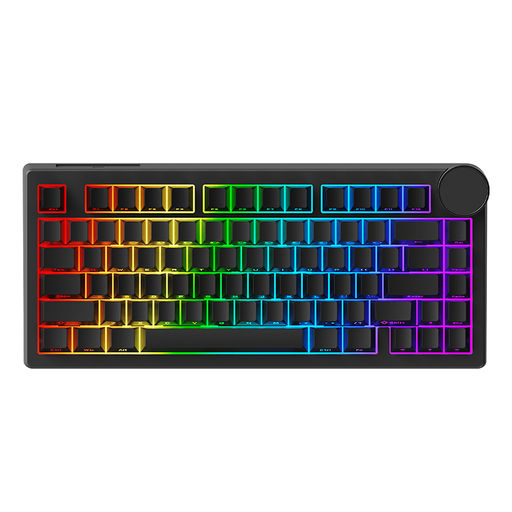 No image available
The compact 75% layout is worth considering if you want to leave room beside your keyboard; check that the key layout suits the way you work.
The product name specifies QWERTY US, with wired, Bluetooth and 2.4G connections.
No. Focus on a physical layout and editing keys that make writing and navigation comfortable for you. Switching between devices is designed for using multiple devices; it isn’t necessary to use two windows on one computer.
It depends on the model and the connections available on your laptop. CHERRY specifies USB-A for the KC 6000 SLIM and Bluetooth for the KW 7100 MINI BT; check that your laptop supports the relevant connection and pay attention to the exact model version.
No. An indicator is no substitute for a suitable workspace setup. R-Go says the Compact Break’s indicator is controlled by Break software; Arboportaal also describes repetitive actions and static strain as part of screen-based work.
According to Arboportaal, if an employee works at a screen for more than two hours a day, the screen and keyboard must not be attached to each other. When using a laptop, it must be possible to use a separate screen or keyboard. This requirement applies to that working situation and isn’t a product specification for every buyer.
Online purchases are often covered by a statutory cooling-off period; ACM ConsuWijzer says this is usually 14 days after delivery, although exceptions may apply. If the product breaks sooner during normal use, the seller must provide the applicable statutory guarantee, according to ACM ConsuWijzer; an additional manufacturer’s guarantee doesn’t replace it.