Start with the shortcuts and characters you actually use. Many commands are already built into your writing app or operating system, so you don’t automatically need a programmable keyboard. Then choose between a familiar full-size layout, a compact model with customisable keys or a split design. Always check the exact key layout, software compatibility and how much desk space you have.
Who this choice is relevant for
Writers who edit frequently
You regularly edit chapters, references or notes. First, check which commands your writing app already offers; then decide whether custom key actions would be useful. Apple Support and Microsoft Support explain keyboard shortcuts for Mac and Windows respectively.
Writers who work for long sessions
You want to weigh up the position of your hands, keyboard and mouse against the familiarity of a traditional layout. Keyboard shape is just one part of your workspace; varying your activities and taking breaks still matter.
Writers who use lots of names and special characters
You type accents, unusual punctuation or names from different languages, and want the keys to match your chosen input layout. Microsoft Support explains how to manage language and keyboard layouts in Windows.
What should you look for?
First, note down the commands and characters you use most often. Then compare the layout and your workspace, and only after that decide whether programmable keys would help with your editing.
| What to consider |
What to look for |
Who is this most important for? |
| Shortcuts and editing |
First check the commands available in your writing app and operating system; then see whether the configuration software works with your computer. |
If I revise chapters often, I want to carry out recurring commands quickly; around 36% of consumers prioritise shortcuts. |
| Hand position during long sessions |
Consider the desk space available, the position of your keyboard and mouse, and whether a split design would suit your setup. |
For long writing sessions, I want to weigh up the distance and angle of my hands against a familiar layout; around 29% of consumers prioritise their workspace. |
| Layout and special characters |
Compare the labels on the exact model with the keys you usually use, and check your selected input layout. |
When I type names, accents and punctuation, I want the keys to match my input settings; around 21% of consumers prioritise characters and layout. |
| Key feel and devices |
Check the key mechanism and connection options for the model; also consider whether you need to switch between devices. |
If I work in a shared space or switch between devices, I want to assess the key feel and connection options in advance; around 14% of consumers prioritise quiet operation or switching between devices. |
Common buying mistakes
-
Assuming different key labels mean the same input layout
The physical keys and the selected keyboard layout are two separate things. This means the characters you type may not match what you expect from the labels on the keys.
Compare the image and exact model with your current keyboard, and check the input layout on your computer.
-
Assuming every version has the same features
A feature listed for one version doesn’t automatically apply to every variant in the same model range. Keychron only lists hot-swap for the RGB hot-swappable version of the K3 Max.
Read the full variant name and check the relevant specifications before choosing.
-
Expecting an ergonomic shape to resolve discomfort
A different keyboard won’t automatically change your whole workspace or posture. The distance between your hands is just one part of your setup.
Assess your workspace as a whole, and don’t draw medical conclusions about yourself from a design or brand claim.
Brands worth considering
Logitech
The MX Keys S is a low-profile, full-size keyboard option for those looking for familiar key positions and customisable editing actions.
- Logitech describes Smart Actions through Logi Options+ and switching between up to three devices.
- Check that Logi Options+ works on your computer. Logitech’s claims about typing comfort are no guarantee of a particular personal experience.
Keychron
The K3 Max is a compact 75% option for those who want to customise key functions or macros.
- Keychron describes customising keys through Keychron Launcher, as well as several connection options.
- Hot-swap is only available on the RGB hot-swappable version; check the physical layout too.
Kinesis
The European Freestyle2 versions are designed for those looking for an adjustable split keyboard.
- Kinesis describes independently positionable halves and European ISO versions with country-specific key labels.
- Check the country-specific keys, whether it’s the PC or Mac version, and whether you need any accessories. A split design doesn’t guarantee that discomfort will go away.
CHERRY
The KW 9100 SLIM combines a low-profile scissor mechanism with programmable keys.
- For the standard version, CHERRY describes programming through CHERRY KEYS and Bluetooth or 2.4GHz connectivity.
- The Mac version is a separate model with function keys described differently. Check which version is right for your computer.
Joybuy products for writing and editing
These keyboards range from full-size to compact layouts, with some versions featuring macros or customisable keys. Check the physical layout of each model: the variants described below have a US or US International layout.
 No image available
Ticktype DP104, full-size, US layout
A full-size layout for writers who like having every key close at hand.
108 keys; US layout; connects via 2.4GHz, Bluetooth or USB-C; product information mentions macros via a custom driver.
Check that the US layout matches the characters you use.
Joybuy
 No image available
Ticktype EVO75, 75%, US layout
A compact mechanical layout for those who want customisable keys or macros in a smaller keyboard setup.
75% layout; US layout; product information states VIA compatibility for macro control.
Check the key positions on the compact layout and the US layout before choosing.
Joybuy
 No image available
AJAZZ AK980 V2, 98% QWERTY
A 98% layout to consider if you’re looking for a QWERTY keyboard that’s less wide than a standard full-size layout.
QWERTY; connects via Bluetooth, 2.4 GHz or USB-C; product information mentions a volume dial and TFT screen.
Check that the exact key layout suits the characters you need.
Joybuy
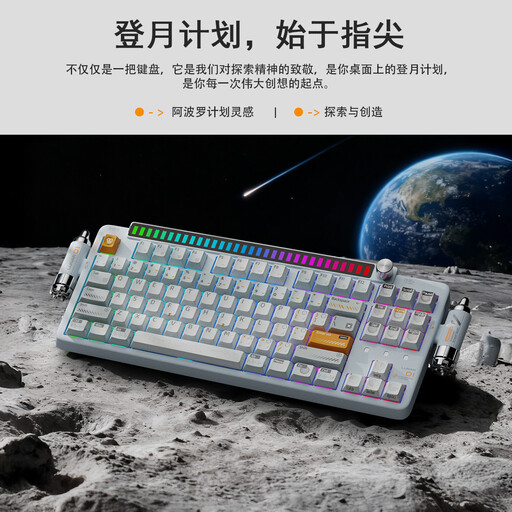 No image available
KEYSME Lunar 01, 80%, US layout
A compact layout for those who want to use programmable macros without choosing a full-size keyboard.
80% layout; QWERTY US layout; programmable knob and hot-swap switches according to the product name and information.
Check that the US layout matches your input settings.
Joybuy
 No image available
Razer Huntsman Mini, RZ03-03390200-R3M1
A compact option for those who value key remapping and macros and want to save desk space.
60% layout; US International layout; product information states that key remapping and macros are available through Razer Synapse 3.
Check that the US International layout suits your needs.
Joybuy
Frequently asked questions
Do I need programmable keys for shortcuts in my writing app?
Not necessarily: apps and operating systems often have their own shortcuts. First, check the commands available in your writing app. If you want to carry out recurring steps with a single key, configuration software such as Logi Options+ or Keychron Launcher may be useful.
How can I enter special punctuation without a numeric keypad?
In Windows, open the symbols panel by pressing the Windows key and the full stop key. Microsoft Support notes that the Alt codes described require a numeric keypad and won’t work with the number row alone; check your selected input layout too.
What should I check before connecting and setting up a keyboard?
Check the connection options, physical key layout and selected input language. Then test the shortcuts in your writing app, as Apple Support notes that keyboard shortcuts can vary between apps.


