If you mainly write long passages at a permanent workstation, start with a layout that suits your working posture and leaves enough room for your screen and mouse. If you often edit text and images, make sure the navigation and shortcut keys you need work with your software and device. A compact keyboard can save space, but some functions may be less accessible.
Who is this relevant to?
Long-form writer
You write a lot of continuous text for your field guide and want a practical typing posture and a familiar layout. Your workstation setup matters too: Arboportaal describes the repetitive movements and static strain that can come with screen-based work.
Frequent editor
You switch between text, illustrations and notes while editing. The keys you need should suit your chosen layout and software; Microsoft Support notes that key positions can vary between layouts.
Mobile field writer
You work in different places or on different devices, and weigh up the size and connection options against the keys you want close to hand. Keychron and JLab describe models with multiple connection options, though these vary by version.
What should you look for?
Start with the keys you use most when writing and editing. Then compare the layout and size with your workstation, software and devices.
| What to consider |
What should you check? |
Who is this important for? |
| Extended typing and working posture |
Check whether the size suits the space available for your screen and mouse, and whether the physical layout works for you. |
If I write long passages, I want a layout that suits my entire workstation. Around 36% of consumers prioritise extended typing and working posture. |
| Navigation and editing keys |
Check that the keys and shortcuts you need are accessible in your software. |
When editing text and illustrations, I want to use the keys I need without having to change my workflow. Around 29% of consumers prioritise editing and illustration work. |
| Size and connection |
Check the dimensions and whether your device supports the Bluetooth connection or USB receiver you need. |
If I work in different places or on different devices, I want a keyboard that’s easy to carry and connect. Around 21% of consumers prioritise working on the move. |
| Typing noise |
Check the type of keys and, if possible, try them out in a similar space. |
In a shared workspace, I want to avoid keystrokes becoming unnecessarily distracting. Around 14% of consumers prioritise quiet typing. |
What to check before buying
-
Choosing a compact keyboard without checking the editing keys
Keyboard shortcuts vary between programmes, and a different physical layout can change where keys are positioned. As a result, frequently used actions may be less accessible while editing.
Before you buy, check the navigation and shortcut keys you use for text, images and notes on your device and operating system.
A different layout may take extra steps or some getting used to.
-
Assuming ‘ergonomic’ means you won’t experience discomfort
The position of your screen, mouse and other equipment all contribute to your workstation setup. The shape of the keyboard alone is no guarantee against physical discomfort.
Assess your whole workstation. If discomfort persists, seek appropriate professional advice rather than treating a product description as a remedy.
-
Assuming different versions in a product range are the same
A product range may include different physical layouts or packages. For example, the Trust Ody II is available as a standalone keyboard as well as a keyboard-and-mouse set.
Before buying, compare the full model name, physical layout, connections and contents of the specific version.
Relevant brands to consider
Logitech
The MX Keys S is an option if you’re looking for a full-size keyboard and the ability to switch between devices.
- Logitech lists programmable keys and switching between up to three devices.
- Check the exact layout and version. The manufacturer’s description of ‘comfortable typing’ is not an independently verified measurement.
Keychron
The K3 Max may be worth considering if you’re looking for a compact mechanical keyboard with customisable keys.
- Keychron lists a 75% layout, wired and wireless connections, and key programming for the K3 Max.
- The product page shows different language layouts and versions, so check which one you’re choosing.
JLab
The GO Wireless Keyboard is designed for a compact setup and use with multiple devices.
- JLab lists storage for up to three device connections and an ultra-compact design.
- Check that the physical keys and connections suit your software and devices. A compact model won’t necessarily feel the same to type on as a larger keyboard.
Trust
The standalone Ody II Silent Wireless Keyboard may suit you if you’re looking for a full-size keyboard with a USB receiver.
- Trust lists low-profile keys, an adjustable typing angle and a stowable USB receiver.
- ‘Quiet’ is the manufacturer’s description, not the result of comparative sound testing. Also check whether you’re looking at the standalone keyboard or a set.
Perixx
The PERIBOARD-817 is a full-size wireless scissor-switch keyboard.
- Perixx lists Bluetooth and a USB-A receiver, a full-size layout and X-type scissor keys.
- The manufacturer describes the keystrokes as quiet, but doesn’t provide comparable sound measurements. Check the exact model variant.
Keyboards at Joybuy
This selection includes keyboards for writing and document navigation, with full-size options and wired or wireless connections.
 No image available
Wired full-size keyboard with numeric keypad, QWERTY
The full-size layout may suit you if you want direct access to navigation and function keys while working on documents.
Wired plug-and-play connection; QWERTY layout and numeric keypad.
View at Joybuy
 No image available
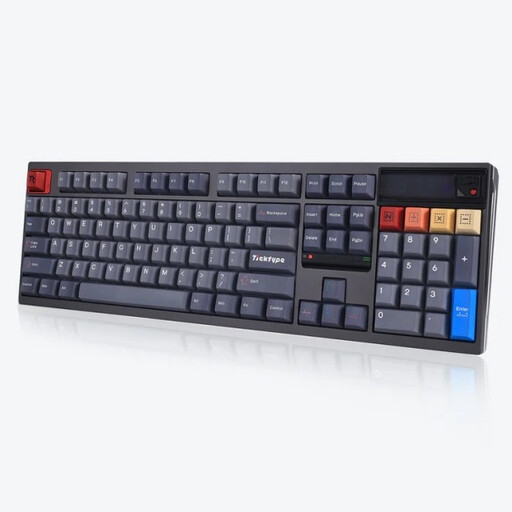
Ticktype DP104 mechanical keyboard, 108 keys
The full-size layout may be a good fit for long writing sessions at a permanent workstation.
108 keys and US layout. The product information lists Bluetooth, 2.4 GHz and USB-C; the title mentions Silent Tactile Switches and an 8000mAh capacity.
View at Joybuy
 No image available
HP 725 wireless keyboard for multiple devices
This model may suit you if you want a full-size keyboard and the ability to switch between devices.
The product information lists a full-size layout, low-profile keys and programmable keys. Connect to up to three devices via Bluetooth and a USB receiver.
View at Joybuy
 No image available
Trust Vaiya full-size keyboard with numeric keypad
The full-size layout and multiple connection options may suit you if you write and switch between devices.
US QWERTY layout with scissor keys. The product information lists one USB receiver and three Bluetooth channels. Check that the physical layout suits your language settings.
View at Joybuy
 No image available
Apple Magic Keyboard, Dutch QWERTY layout
This model may suit you if you’re looking for Dutch QWERTY keys and direct access to document navigation.
The product information lists Bluetooth, a rechargeable battery, scissor keys, navigation keys and a numeric keypad.
View at Joybuy
Frequently asked questions
Do I need a programmable keyboard for editing notes?
No, not necessarily. First check which shortcuts your writing and image-editing software uses, and whether you can access them with the physical layout you’ve chosen. Keychron lists programmable keys for the K3 Max; whether they’re useful depends on your software and workflow.
How do I connect a wireless keyboard?
It varies by model. Trust lists a USB receiver for the Ody II Silent Wireless Keyboard; JLab lists Bluetooth or USB for the GO Wireless Keyboard. Before buying, check which connections your laptop or tablet supports.
How can I reduce physical strain during long writing sessions?
Assess your whole workstation and vary your tasks. Arboportaal describes the risks of repetitive movements and static strain; a keyboard alone is not a proven treatment for discomfort.
What workstation rule applies if I spend a long time writing on a laptop for work?
According to Arboportaal, for employees who spend more than 2 hours a day working with a screen, the screen and keyboard must not be attached to each other. When using a laptop, it must be possible to use a separate screen or keyboard. This is a conditional workstation rule, not a general purchase requirement for personal users.
What are my return and warranty rights when buying online in the Netherlands?
According to the Dutch government, online distance purchases from a business often come with a 14-day cooling-off period. You’re also entitled to a product that conforms to the agreement; there is no fixed statutory two-year warranty period in the Netherlands. Check the terms of your specific purchase and report faulty products to the seller.


