
Writer of long passages
You regularly write entire episodes and want a familiar layout, a key feel that suits you and punctuation that’s easy to reach.


Start by choosing a keyboard layout and key feel that work well for long passages, with punctuation in the places you expect. Then check whether the navigation keys and programmable features suit your writing software. A compact or split keyboard may work better with a different desk setup, but it won’t guarantee faster typing or fewer aches and pains.
You regularly write entire episodes and want a familiar layout, a key feel that suits you and punctuation that’s easy to reach.
You often switch between chapter text and section outlines, and want to know whether navigation keys or configurable shortcuts fit the way you work.
During long sessions, you pay attention to the position of your hands, keyboard and mouse. A compact or split keyboard could be worth considering alongside regular breaks and a suitable workspace setup.
Start with the physical layout and feel of the keys to make sure they suit you for long stretches of typing and punctuation. Then assess the navigation and any shortcuts based on the tasks you carry out in your section outlines.
| What to consider | What to look for | Who should prioritise it? |
|---|---|---|
| Key feel and punctuation | Compare the physical layout with your computer’s language settings, and consider the feel and sound of the keys you choose. | When I write long fantasy episodes, I want to type comfortably and find my usual punctuation easily. Around 31% of consumers put most emphasis on this. |
| Working posture | Consider whether the size and positioning suit your hands, desk and mouse, and remember to take breaks. | During long sessions, I want to position my keyboard and mouse to suit my workspace. Around 25% of consumers prioritise working posture. |
| Navigating outlines | Check where the navigation keys are and whether any macro software is compatible with your computer and writing programme. | When I often switch between text and section outlines, I want the keys for my regular tasks to be easy to use. Around 25% of consumers put navigation first. |
| Multiple devices | Check that the connection and any receiver are suitable for the devices you write on. | If I work on different writing devices, I want to switch between them easily. Around 19% of consumers name this as their main consideration. |
The physical position of the keys varies between layouts, and your selected keyboard language also determines which characters appear. Coolblue explains the differences between ANSI and ISO layouts.
Check the exact version and, before you choose, type a piece of dialogue using your usual punctuation and accents.
A 75% layout positions the navigation keys differently from a full-size keyboard. This can matter if you often move between text and section outlines.
Compare the key positions with the tasks you perform most often.
A split layout can take time to get used to and is not a proven treatment for discomfort. For screen work, Arboportaal also recommends varying your posture and taking micro-breaks.
Assess your keyboard setup alongside your screen, desk and mouse, and remember to take breaks.
Smart Actions and macros need to be configured. Whether they help depends on your software and the tasks you set them up to perform; configuration may take extra time.
Check software compatibility in advance and try setting up one frequently used task.
The MX Keys S and MX Mechanical Mini offer different keyboard types for long passages and recurring tasks.
The Split Break Version 2 is an option if you want to position the two keyboard halves separately.
According to Keychron, the K3 Max has a compact 75% layout and supports configurable keys and macros via Keychron Launcher.
The KC 6000 SLIM is a wired, full-size keyboard with a scissor mechanism; the Mac version is a separate model.
These keyboards for extended typing include both full-size and more compact layouts. In particular, check the physical key layout and which features your writing software supports.
 No image available
The full-size layout may suit you if you want a full keyboard for long passages.
The product name specifies 108 keys and Silent Tactile Switches. The physical layout is US; check that it matches the characters you type.
 No image available
This model may suit you if you switch between devices while writing or want to set up programmable keys.
The product description lists Bluetooth, a 2.4GHz receiver and programmable keys. Check that the features work with your devices and writing software.
 No image available
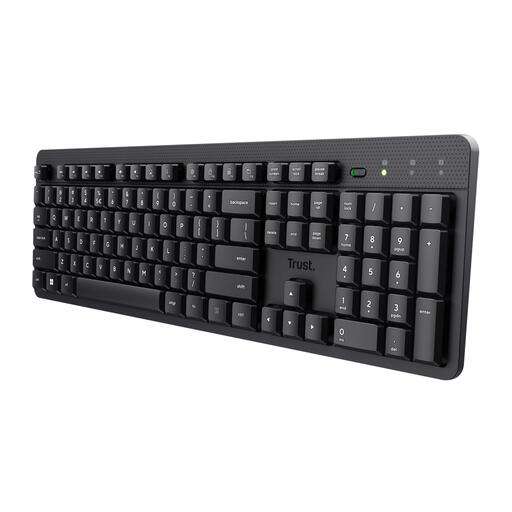
This full-size model may suit you if you want a numeric keypad and a quiet, low-profile typing feel.
The product description mentions membrane keys and a USB receiver. The layout is US QWERTY; check the position of punctuation and accents.
 No image available
This full-size keyboard may suit you if you want a light scissor-key feel and connectivity with multiple devices.
The product description states that it connects to up to four devices via Bluetooth and a USB receiver. The US QWERTY layout may differ from the characters you expect to type.
 No image available
The compact 75% layout may suit you if you want to save desk space, but check that the key positions work for navigating your section outlines.
The product description lists hot-swappable linear switches. The layout is US QWERTY.
No, start with the navigation keys and shortcuts in your writing programme. If you repeat a task often, you could consider keyboard macros. Logitech describes Smart Actions via Logi Options+, while Keychron offers macros via Launcher.
Check the connection, the physical keyboard layout and your computer’s selected keyboard language. Then set up any shortcuts and test that they perform the tasks you want in your own writing programme.
No, a keyboard is just one part of your workspace. Arboportaal recommends varying screen-based work, taking micro-breaks and adjusting the workspace to suit the user.
According to Arboportaal, an employee who works at a screen for more than 2 hours a day must be able to position the screen separately from the keyboard. For laptop use, a separate screen or keyboard must be available; this is not a general legal requirement to buy one for every writer using a computer at home.
According to ACM ConsuWijzer, online consumer purchases generally come with a statutory cooling-off period of up to 14 days after delivery, with some exceptions. You also have a statutory guarantee if a product does not meet the reasonable expectations you’re entitled to have under normal use; in the Netherlands, there is no fixed two-year period that applies to all keyboards.