
Tileset creator who likes a quiet workspace
Creates tilesets alongside colleagues and wants to avoid keyboard noise dominating the shared desk. Logitech describes the MX Keys Mini as compact and says its improved key stability reduces noise.


Start with the sound your colleagues will hear and the shortcuts your art software needs. Then choose between a compact wireless keyboard, a wired TKL model or a programmable mechanical one. A smaller keyboard frees up space for your mouse, but the connection, layout and noise level of the specific version are all important considerations.
Creates tilesets alongside colleagues and wants to avoid keyboard noise dominating the shared desk. Logitech describes the MX Keys Mini as compact and says its improved key stability reduces noise.
Frequently switches between tools and repeated actions, and wants shortcuts to be easy to reach or customise. Aseprite documents customisable shortcuts; check the options available in your own art software too.
Wants to leave room for a mouse and may need to switch between computers. Check that the connection and keyboard layout suit each workstation; Rapoo and Microsoft describe keyboards with features for switching between devices.
First, decide what matters most for your work: quiet typing, customisable shortcuts, saving desk space or connecting to different computers without a fuss.
Choose this when: Quiet work alongside colleagues and room to move your mouse are top priorities.
Consider: Check that the layout and available keys suit your shortcuts. A model without a number pad is less suitable if you use one frequently.
Choose this when: You use a fixed computer and want to keep the main keyboard block without a number pad.
Consider: The cable needs to work with your setup. CHERRY describes the keystrokes on the STREAM KEYBOARD TKL as quiet; this is not a direct comparison of sound levels.
Choose this when: You want to customise keys or macros for repeated actions.
Consider: Check the switches and physical layout. If your art software already lets you set up the shortcuts you need, you may not need a programmable keyboard.
Choose this when: You want to switch between shared computers and bring your own keyboard.
Consider: Check which connections are permitted on each computer. Some models also have a number pad, so they are not as compact as TKL models.
| Factor to consider | What should you check? | Who is this important for? |
|---|---|---|
| Noise around colleagues | Check the exact mechanism and switch version; don’t treat a manufacturer’s claim that a keyboard is quiet as a comparative measurement. | If I work alongside colleagues, I don’t want my keystrokes to be intrusive. Around 36% of consumers say noise is their top priority. |
| Shortcuts | Check which keys you use and whether you can customise them in the application or on the keyboard. | When I repeat lots of actions, I want to be able to use or set up shortcuts easily. Around 29% of consumers put this need first. |
| Room for your mouse and equipment | Measure the available desk space and decide whether you need a number pad. | At a small shared desk, I want enough room for my mouse. Around 21% of consumers say saving space is their top priority. |
| Connection and keyboard layout | Check whether USB, Bluetooth or a receiver is permitted, and whether the physical keyboard layout matches the computer settings. | If I switch between computers, I want the connection and keyboard layout to work straight away. Around 14% of consumers start by checking compatibility. |
Different switch types can sound different. A manufacturer’s description is not a direct comparison with other models.
Check the mechanism and exact version before choosing. Keep manufacturer claims separate from independent sound measurements.
A smaller keyboard saves space, but how easy keys are to reach depends on the layout and the software you use.
Make a note of the commands you use often and check whether you can set them up comfortably on the keyboard or in your art software.
Multiple connection options are only useful if the computer supports them and their use is permitted at your workstation.
Check the connection and physical keyboard layout on the computers you use. A wired model may be a good fit if wireless connections are not available.
The MX Keys Mini is a compact option; the MX Keys S is a larger alternative for anyone who wants a full-size keyboard.
The STREAM KEYBOARD TKL is a wired option without a number pad.
The K3 Max is designed for anyone looking for a compact 75% layout and customisable keys or macros.
The E9500M is an option for hot desks where switching between devices and having a number pad are useful.
The Designer Compact Keyboard is designed for a Windows workstation with suitable Bluetooth support.
This selection includes wired TKL and compact mechanical keyboards, as well as wireless models for different needs. Check the layout of each model and whether a number pad suits the space you have available.
 No image available
A wired TKL option for a fixed workstation where you want to save space without losing the main keyboard block.
The product information lists quiet membrane keys, customisable keys via iCUE and a USB connection. The US QWERTY layout may differ from the settings on a shared computer.
 No image available
A wireless option for a shared workstation where you want to be able to switch between devices.
The product information lists scissor-style keys, a compact TKL size and connection to up to three devices via a USB receiver or Bluetooth. Check that the US QWERTY layout suits the computer you use.
 No image available
A compact wired option for anyone looking to save desk space and try a mechanical keyboard.
The product name specifies a 75% layout, hot-swappable linear switches and a US layout. The product information lists a Type-C connection; check the layout and switch version before choosing.
 No image available
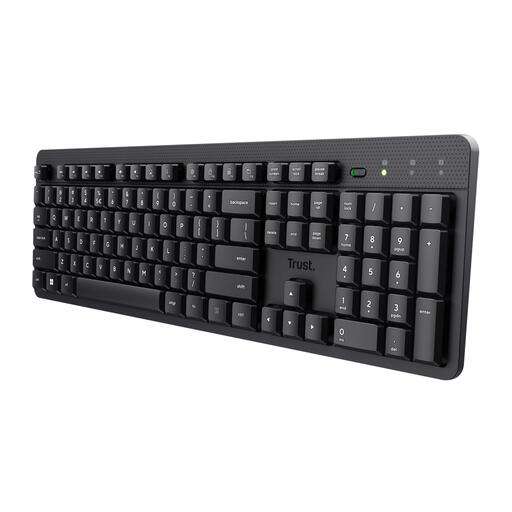
A wireless option for anyone who wants a full-size keyboard with a number pad.
The product information lists quiet keys and a USB receiver. The number pad takes up more desk space than a compact model, and the US QWERTY layout may differ from the computer settings.
 No image available
A wireless option for a hot desk where you want to switch between multiple devices.
The product information lists scissor keys and a number pad. Its full-size design takes up more desk space than a compact keyboard; also check that the US QWERTY layout suits the computer settings.
No, not if your art software lets you set up the shortcuts you need. Aseprite documents customisable shortcuts; first check which commands you use often and what your software lets you do.
Compare the physical key labels with the active Windows input layout. Microsoft explains how to add and change input layouts; also check whether the computer allows the Bluetooth connection or USB receiver you want to use.
For a consumer purchase in the Netherlands, you are entitled to a product that works as it should, and the seller must offer a solution. The Dutch government states that there is no fixed statutory warranty period. For online purchases from a business, you will also usually have a 14-day cooling-off period. This is separate from your right to a product that works as it should.
Not simply because a desk is shared. According to Arboportaal, for employees who work at a screen for more than 2 hours a day, the screen and keyboard must not be attached to each other. When using a laptop, it must be possible to use a separate screen or keyboard; whether this applies depends on the working situation.