Start with the feel of the keys: a low-profile scissor mechanism can be a quiet option, but the sound of mechanical keyboards also depends on the exact version. Then decide whether you need more room for your mouse or a numeric keypad, and whether you prefer a wired or wireless connection. Always check the physical keyboard layout and the model’s connection options.
Who is this buying guide for?
Writing in a quiet space
You’re writing student feedback and don’t want your keystrokes to distract you or anyone else. Compare the feel of the exact version you’re considering: the word ‘quiet’ on the packaging isn’t a sound measurement. CHERRY describes its STREAM models as quiet to type on.
Writing feedback for long periods
You spend a long time writing at a screen and want the key feel, hand position and mouse placement to suit your workspace. A keyboard is no substitute for a suitable set-up or taking breaks and varying your tasks. Arboportaal also highlights repetitive hand movements and static strain when working at a screen.
Writing in different locations
You move your keyboard around or work across several devices, so you’re weighing up a cable against wireless connectivity, power and compatibility. Check how the version you choose connects and whether it works with your devices.
What should you look for?
First, consider how the keys feel and sound in a quiet space. Then think about hand position and layout, and finally check that the connection suits your workspace.
| What to consider |
What should you check? |
Who is this important for? |
| Quiet keystrokes |
Check the exact switch or key mechanism and, where possible, compare a sound test of the same version. |
If I’m writing feedback in a quiet space, I don’t want my keystrokes to distract others. Around 36% of consumers say quiet keystrokes are their top priority. |
| Key feel and hand position |
Try out the key feel and positioning. Also consider where your mouse, screen and arms are placed, and vary your tasks. |
When I’m writing for long periods, I want the key feel and hand position to suit my workspace. Around 29% of consumers prioritise comfortable typing and hand position. |
| Layout and desk space |
Think about how often you use numbers, measure the space available and check the physical layout of the version. |
If I enter numbers regularly, I want a numeric keypad. If I rarely need one, more room for my mouse may be more important. Around 21% of consumers say layout and desk space are their top priority. |
| Connectivity and portability |
Check your devices’ connections, whether you need a receiver and how the exact version is powered. |
When I move my keyboard around or work across different devices, I want a connection that suits my needs. Around 14% of consumers choose connectivity and portability as their main consideration. |
Common mistakes
-
Assuming ‘quiet’ means a comparable sound level
A manufacturer’s claim isn’t a measurement you can use to compare different versions directly. RTINGS explains that the sound of mechanical switches can vary depending on factors such as the switch and the keyboard’s construction.
Where possible, compare tests of the same version and try out the key feel. Don’t treat a claim about quiet operation as a guarantee of silent keystrokes.
-
Choosing a compact model without considering how often you enter numbers
The CHERRY STREAM KEYBOARD TKL doesn’t have a numeric keypad. It saves space, but entering numbers may be less convenient if you use a keypad frequently.
Before you buy, consider how often you enter numbers and how much space you want for your mouse. Choose a version with a numeric keypad if it suits the way you write.
-
Going wireless without considering the receiver and power supply
A wireless model may need a USB receiver and a suitable power source. The exact connectivity options vary by version.
Check your device’s connections, what’s included with the version you’ve chosen, and whether the keyboard needs batteries or charging.
-
Overlooking the physical keyboard layout
A different physical layout can change where letters or punctuation marks appear, which can make a difference when you do a lot of writing.
Check the keys shown in the product images and the language and physical layout of the version you’re ordering.
Brands to consider
CHERRY
CHERRY offers the wired STREAM KEYBOARD and STREAM KEYBOARD TKL, both with a low-profile SX scissor mechanism.
- CHERRY describes both models as quiet to type on. The TKL omits the numeric keypad, freeing up more desk space.
- The TKL has no numeric keypad, and CHERRY’s description of its quiet operation isn’t an independent sound comparison.
Logitech
The wireless MX Keys S is worth considering if you’re looking for a low-profile keyboard and want to switch between devices.
- According to Logitech, you can switch between up to three devices with the MX Keys S. Logitech also mentions key stability designed to reduce noise.
- Check the physical layout and compatibility of the version you choose. Features of the MX Keys S won’t necessarily apply to other Logitech models.
Trust
The Trust Ody II is a wireless keyboard with a USB receiver, while the Trezo Comfort is a separate keyboard and mouse set.
- Trust describes the Ody II as having low-profile keys and a stowable receiver. The Trezo set also includes a mouse and wrist rest.
- The Trezo is a different purchase from a keyboard on its own. Claims about quiet operation are manufacturers’ descriptions, not directly comparable measurements.
Perixx
According to Perixx, the PERIBOARD-636 combines a compact, split design with an integrated numeric keypad.
- Perixx mentions a 2.4 GHz receiver and describes the keystrokes as quiet.
- The unusual shape may take some getting used to. A manufacturer’s comfort claim doesn’t prove that discomfort will go away, so try the layout if you can.
NuPhy
The Air75 V3 is a compact mechanical option available with different switches and physical layouts.
- The different versions give you a choice of switches and layouts.
- RTINGS notes that mechanical switches can be loud or quiet, depending on their design and construction. Assess the exact version: features of one model won’t automatically apply to every version.
Keyboards at Joybuy
These product picks are designed for writing in a quiet workspace. Each has a different keyboard layout and connectivity to consider.
 No image available
Ticktype DP104 Tri-Mode, 108 keys, US layout
An option if you’re looking for a mechanical keyboard with a numeric keypad. The product title mentions Silent Tactile switches, but this isn’t an independent sound measurement.
108 keys; US layout; tri-mode wireless connection; 8000 mAh; Silent Tactile switches.
View at Joybuy
 No image available
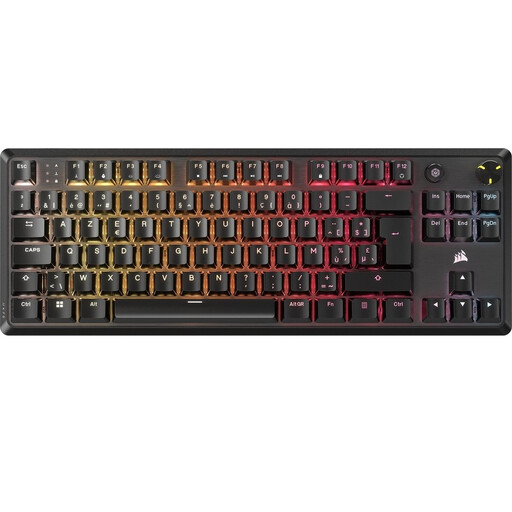
Corsair K70 CORE TKL, BE AZERTY, MLX Red
A good fit if you’re looking for a wired TKL keyboard that leaves more room beside it. Check that the BE AZERTY layout suits the way you write.
Wired via USB-C; BE AZERTY layout; MLX Red v2 linear switches. The product description mentions sound-dampening foam and stabilisers.
View at Joybuy
 No image available
Trust Vaiya, full-size, US QWERTY
An option if you want to work wirelessly and need a numeric keypad. Check that the US/QWERTY layout suits you before buying.
Low-profile scissor keys; USB receiver and Bluetooth; rechargeable battery. Trust says you can switch between up to four devices and describes the keys as quiet.
View at Joybuy
 No image available
AJAZZ AK820, wired 75%, 83 keys, US layout
A good fit if you’re looking for a compact, wired mechanical keyboard and have checked that the US layout suits you.
83 keys; wired; US layout; linear hot-swappable switches; volume knob. The product description mentions five layers of sound-dampening material.
View at Joybuy
 No image available
Apple Magic Keyboard, Dutch QWERTY, black
An option if you’re looking for a wireless keyboard with a Dutch QWERTY layout and a numeric keypad.
USB and Bluetooth; rechargeable battery; scissor keys; low profile; numeric keypad.
View at Joybuy
Frequently asked questions
Is a mechanical keyboard automatically too loud for a quiet study room?
No. According to RTINGS, the sound of mechanical switches can vary, depending on factors such as the switch and the keyboard’s construction. Assess the exact version and, where possible, compare a sound test of the same model.
What should you check before connecting a keyboard?
Check that the connection on the exact keyboard version is compatible with your computer. According to Trust, the Trust Ody II uses a USB receiver; Logitech says the MX Keys S can switch between up to three devices. These features don’t mean that every version will work with every device.
When writing feedback for a long time, should you only think about the keyboard?
No. Pay attention to your workspace set-up too, and take breaks from screen work. Arboportaal highlights repetitive hand movements and static strain. It also outlines requirements for a keyboard that can be used separately from the screen for employees who work at a screen for more than two hours a day.
What rights do you have when you buy a keyboard online?
For eligible distance purchases from a business, you generally have 14 days to change your mind, according to Rijksoverheid. You’re also protected by statutory consumer rights if a product doesn’t meet the terms of the agreement; there’s no fixed statutory guarantee period in the Netherlands. If a product is faulty, contact the seller.


