
Learning a melody by yourself
You want to start learning a tune without a computer and are looking for a straightforward keyboard with useful practice aids.


If you want to learn a festive tune on your own, choose a keyboard with enough keys for the notes you need and practice features that suit the way you learn. Yamaha lists lesson functions and touch-sensitive keys for the PSR-E383, but built-in lessons don’t guarantee that your particular song is available. Choose a keyboard with more keys if your piece requires them, and remember to measure the space you’ll need for a music stand and a seat.
You want to start learning a tune without a computer and are looking for a straightforward keyboard with useful practice aids.
You have limited space to set up your keyboard or want to practise while other people are at home. Size, storage and a suitable headphone socket are all worth considering.
You also want to play accompaniment, a part with a wider range, or focus more on piano later on. Compare the range you need and the type of key action.
Start with the notes you want to play and the space you have. Then decide whether independent practice aids, accompaniment or a wider range matters most to you.
| What to consider | What to look for when buying | Who is this important for? |
|---|---|---|
| Learning by yourself | Compare the lesson functions and controls; check separately whether your song is included in the song list. | If I want to learn a melody without a computer, I look for practice aids that suit my song. Around 33% of consumers prioritise learning by themselves. |
| Space and quiet practice | Measure the space for the keyboard, music stand and seat; check the headphone socket and power connection on the exact model. | In a shared spare room, I want to be able to set up and practise without disturbing others. Around 27% of consumers prioritise space and quiet practice. |
| Accompaniment | Check which accompaniment styles the model offers and whether you find the controls easy to use while practising. | If I want to add rhythm or chords to my melody, I look for built-in accompaniment. Around 20% of consumers choose accompaniment as their main consideration. |
| Key range and playing goals | Compare the lowest and highest notes in your piece with the number of keys; touch-sensitive keys aren’t necessarily weighted. | If my piece requires more keys or I want to focus on piano practice, I compare the range and key action. Around 20% of consumers prioritise this playing goal. |
Lesson functions may be designed for built-in songs and don’t, by themselves, mean that a song of your choice is available.
Check the song list for the exact model or practise using your own sheet music.
You’ll also need space for a music stand and a seat. Korg says the stand for the Liano is sold separately.
Measure the full practice area and check what’s included with the specific version.
The stand for the Korg Liano is sold separately.
Korg describes the Liano as having a touch-sensitive LS keyboard; this specification doesn’t confirm a weighted hammer action.
If piano technique is your main goal, check the keyboard specification and, if possible, try the key action for yourself.
The PSR-E383 is a 61-key model for practising; the EZ-310 has light-up keys, while the PSR-EW320 offers 76 keys.
The CT-S300 is a compact model to consider if you have limited space to set up your keyboard.
The E-X10 is a beginner keyboard to compare if you also want to use automatic accompaniment.
The Liano is an 88-key alternative if playing range matters more to you than a compact setup.
These Joybuy products are suited to practising independently on a 61-key keyboard, with features including a piano-focused key action or functions for learning and accompaniment.
 No image available
A good fit if you want to focus on piano practice and need a headphone socket.
The product name lists 61 keys, weighted keys, a headphone socket and USB-MIDI. Check whether the relevant EU requirements apply to this version and, where required, that it carries the CE marking.
 No image available
An option to compare if you’re looking for a 61-key keyboard and want to use MIDI or recording functions.
The product name lists MIDI, a recording function, a metronome, speakers and a music stand. Check whether the relevant EU requirements apply to this version and, where required, that it carries the CE marking.
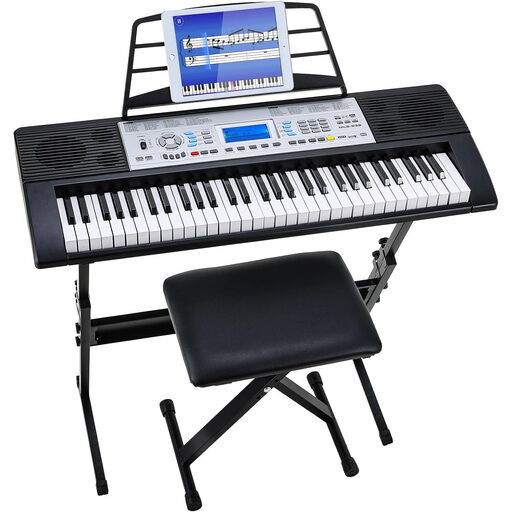 No image available
A good fit if you want to compare a practice setup with a seat and a built-in learning mode.
The product name lists 61 keys, a stand, a stool and a three-level learning mode. Check whether the relevant EU requirements apply to this version and, where required, that it carries the CE marking.
No, you can also practise from your own sheet music or by ear. If you want to use the built-in song lessons or light-up keys for that particular song, check the song list and how the feature works on the exact model first.
Compare the stated dimensions of the instrument with the available space, and allow extra room for a music stand and a seat. Check the headphone socket and power connection on the model. In its EZ-310 manual, Yamaha advises against using the product or headphones at a high or uncomfortable volume for extended periods.
For each version, check whether a power supply, music stand, keyboard stand and headphones are included. Korg lists an adapter and music stand for the Liano; the keyboard stand is sold separately. According to the Dutch government, online purchases from a business in the Netherlands often come with a 14-day cooling-off period, subject to legal exceptions.
Electronic equipment covered by the applicable EU rules on electromagnetic compatibility must meet those requirements and carry the CE marking where required. Your Europe, the European Union’s information portal, explains that CE marking is only mandatory for products covered by applicable harmonised EU rules that require it. So check the specific version and the information provided with it; a CE logo on its own isn’t an independent test of a particular offer.