
Player with limited storage space
You want to practise the intro in a small space and put the instrument away afterwards. Compare the overall dimensions of standalone mini keyboards.


Start by identifying the lowest and highest notes you need to play at the same time in the intro, then measure the space available for setting up and storing your keyboard. A standalone mini keyboard takes up less room, but may not offer enough range to play both notes together. A larger keyboard gives you more range, while a compact MIDI controller is only suitable if you already have a compatible sound source and connection.
You want to practise the intro in a small space and put the instrument away afterwards. Compare the overall dimensions of standalone mini keyboards.
You need to play bass notes and melody at the same time, so check in advance that both parts fit within the range of your chosen keyboard.
You already have a suitable digital sound source and are considering a compact MIDI controller instead of a keyboard with built-in sounds.
Choose this if: the notes in your intro fit within the shorter range and you want to practise without a computer. Yamaha lists 37 mini keys for the PSS-A50; Casio lists 44 mini keys for the SA-81.
Bear in mind: a short keyboard may not have enough room for the bass and melody notes you play at the same time.
Choose this if: your intro needs a wider range to play notes together and you have enough space for a 61-key instrument, such as the Roland GO:KEYS 3.
Bear in mind: the number of keys alone doesn’t tell you whether the overall dimensions will suit your playing and storage space.
Choose this if: you already practise using compatible music software or an external MIDI sound source. The Novation Launchkey Mini 37 MK4 has 37 mini keys.
Bear in mind: to hear what you play, you’ll need a compatible connected sound source and suitable software or hardware.
| What to consider | What should you check? | Who is this important for? |
|---|---|---|
| Playing and storage space | Measure the available width and depth, then compare them with the overall dimensions. Yamaha lists the PSS-A50 at 506 × 201 mm; Casio gives the SA-81 dimensions as 604 × 211 mm. | If I need to put my keyboard away after practising, I want to know whether it will fit both my playing space and storage space. Around 40% of consumers put available space first. |
| Range for your intro | Note the lowest and highest notes you need to play at the same time, then compare them with the keyboard’s range. Yamaha lists 37 keys for the PSS-A50, Casio 44 for the SA-81 and Roland 61 for the GO:KEYS 3. | When I play bass and melody at the same time, I want to reach both parts without having to move the keyboard. Around 30% of consumers give playing range the highest priority. |
| Practising with sound or headphones | Check whether the model has built-in sound, a headphone socket and what type of power supply it needs. Yamaha lists a separately available USB power adaptor for the PSS-A50; Casio says the SA-81 takes batteries or a separately available mains adaptor. | If I want to practise without a computer, I want a keyboard that makes its own sound. For quiet practice, I also look for a headphone socket. Around 20% of consumers prioritise practising with sound or headphones. |
| Connecting to music software | Check which computer, software or external sound source you use and how to connect it. Novation describes the Launchkey Mini 37 MK4 as a controller for compatible software or connected hardware. | If you already practise with music software or an external sound source, you could consider a controller that suits your setup. Around 10% of consumers give music software integration the highest priority. |
The number of keys doesn’t tell you whether the lowest and highest notes in your intro will fit on the keyboard at the same time. A short keyboard may also be less practical for parts that are far apart.
Measure the overall dimensions and check the range of notes in your own intro before choosing.
The Novation Launchkey Mini 37 MK4 controls an external sound source. Without compatible connected software or hardware, it won’t offer the same straightforward way to practise as a keyboard that makes its own sound.
If you want to practise without a computer or external sound source, choose a model with built-in sound.
Yamaha says the USB power adaptor for the PSS-A50 is sold separately. Casio says batteries and a mains adaptor for the SA-81 are sold separately.
Check what’s included in the box and the power supply required for the exact model.
The PSS-A50 is a compact standalone keyboard for anyone short on space who wants velocity-sensitive keys.
The SA-81 has 44 mini keys for anyone looking for more range than a shorter mini keyboard offers.
The GO:KEYS 3 is a standalone keyboard to consider if 61 keys matter more for your intro than having the smallest possible instrument.
The Launchkey Mini 37 MK4 is a compact MIDI controller for an existing software or hardware setup.
These 61-key keyboards are for anyone who wants a wider range when practising a song intro. Also check that the dimensions suit your playing and storage space.
 No image available
The 61-key layout suits anyone looking for more range for their intro than a mini keyboard offers. Measure your available space before choosing.
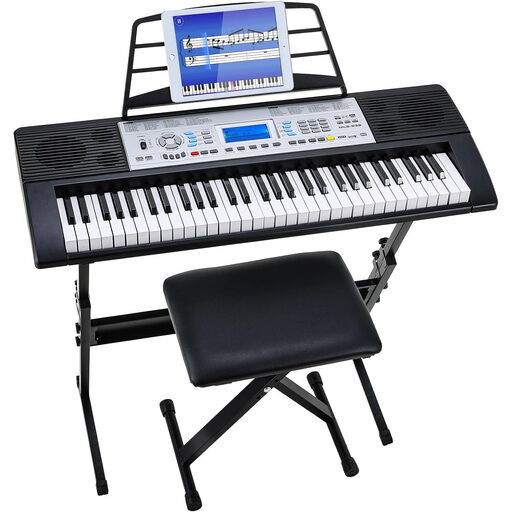
The product name lists a MIDI controller, recording function, speakers, metronome and music stand.
 No image available
With 61 keys, this is an option if your intro needs a wider range. Check that the keyboard and included accessories will fit in your available space.
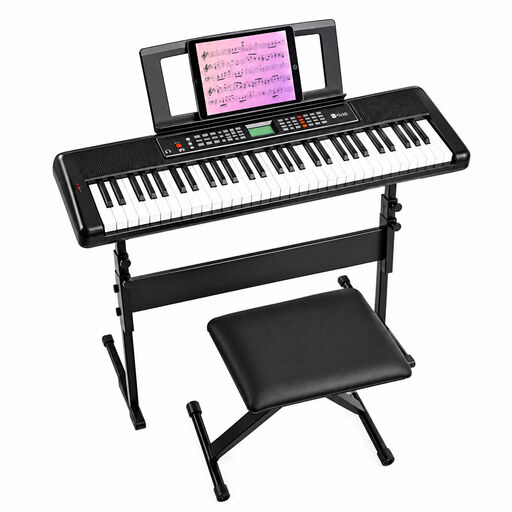
The product name lists a stand, stool, 500 sounds, a three-level learning mode, two speakers and an LCD screen.
 No image available
The 61 keys may suit an intro that needs a wider range. Also check that you have room for the keyboard and the other items in the set.
The product name lists a stand, stool and music stand, 300 sounds, 300 rhythms, a three-level learning mode, an LCD screen and USB-MIDI.
Find the lowest and highest notes you need to play at the same time and try playing them together on the keyboard you’re considering. Octave shift changes the range you can play, but it doesn’t make the keyboard longer.
To hear what you play on the Launchkey Mini 37 MK4, you’ll need compatible instrument software or a connected hardware sound source. Follow Novation’s connection and setup instructions for your chosen setup.
Check the connections and included accessories for the exact model. Yamaha lists a stereo mini-jack and a separately available USB power adaptor for the PSS-A50; Casio lists a stereo mini-jack for the SA-81, with batteries or a mains adaptor available separately. Use the power supply specified by the manufacturer.
According to ACM ConsuWijzer, for a standard online purchase you generally have a statutory cooling-off period that ends 14 days after the product is delivered, subject to applicable exceptions. The seller must also resolve any issue free of charge if a product breaks sooner than expected under normal use. Your statutory guarantee is not automatically limited to the length of any manufacturer’s warranty offered.
According to the European Commission, CE marking is required when the applicable harmonised EU rules specify it for the product. The rules that apply to a particular model and its included power supply must be established for each product. CE marking is not a general quality assessment.