What should you look for when choosing?
Start with the key range your song intro requires, then check which connections, features and dimensions will suit your practice space.
| What to consider |
What should you check? |
Who should pay particular attention? |
| Key range and touch response |
Compare the lowest and highest notes in your intro with the range of the exact model; also check whether the keys are touch-sensitive. |
I want to play the whole intro and practise my touch. Around 36% of consumers say being able to play the intro is their main reason for buying. |
| Practising with headphones |
Check whether there’s a headphone output, what type of socket it has and whether any adapter you need is included. |
If I share the music room, I want to listen to the electronic sound privately. Around 29% of consumers put avoiding disturbing others first. |
| Moving and setting up |
Measure the space available and check the model’s dimensions, weight and power options. |
I need to move or put away the instrument after practising, and want to know what I’ll need to take with me. Around 21% of consumers consider moving and setting up the most important factor. |
| Accompaniment or extra range |
Decide whether your intro needs extra keys or a specific accompaniment; consider the type of key action separately from the number of keys. |
If my piece needs a wider range or I want to practise with accompaniment, I’ll look specifically for that feature. Around 14% of consumers say accompaniment or extra key range is their top priority. |
Brands to consider
These models illustrate different trade-offs in key range, portability and practising with accompaniment. The features listed apply to the models described, not necessarily to the entire brand.
Yamaha
The PSR-E383 is a standalone 61-key keyboard for anyone who wants to practise straight away using built-in sounds.
- Yamaha says the PSR-E383 has touch-sensitive keys, lesson functions and 260 accompaniment styles.
- The instrument has 61 keys, so compare its range with the notes in your intro.
Casio
The CT-S300 is a portable Casiotone option that you can take between practice spaces.
- Casio says the CT-S300 measures 930 × 256 × 73 mm and weighs 3,3 kg; the model has touch response.
- According to Casio, battery life depends on the type of battery and how you play. Check the connections and accessories included with the model on offer.
Korg
The Liano is a piano-focused digital option with a wider key range.
- Korg says the Liano has 88 touch-sensitive LS keys, a headphone socket and eight sounds.
- According to Korg, the instrument is 1.282 mm wide. The description of the LS keyboard doesn’t confirm a weighted hammer action.
Keyboard options at Joybuy
These models are designed for practising on a compact 61-key keyboard, with built-in sounds and the option to listen through headphones.
 No image available
MLS-931 digital piano, 61 keys
For practising with built-in sounds and rhythms; the listing also mentions a headphone socket for private listening.
The product information lists 61 keys, 300 sounds, 300 rhythms, built-in speakers, USB-MIDI, a recording function and a metronome.
The listing also uses the term ‘weighted keyboard’. Check exactly what type of key action this model has; 61 keys offer a narrower range than an 88-key model.
Before buying, check the product and safety information for this exact model.
View at Joybuy
 No image available
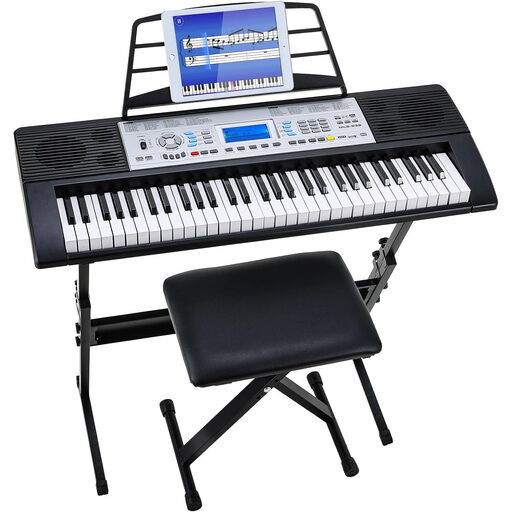
Electronic keyboard set, 61 keys, with stand and stool
A set for setting up a keyboard on a stand with a stool in your practice space; the product information also mentions speakers and a headphone socket.
The product name lists 61 keys, 500 sounds and a three-level learning mode.
Check the connections, bundle contents, and product and safety information for this exact model. The keyboard has 61 keys, so compare its range with your intro.
View at Joybuy
Frequently asked questions
Are 61 keys enough for your song intro?
It depends on the lowest and highest notes in your intro. Compare them with the range of the model you’re considering: Yamaha lists 61 keys for the PSR-E383, while Korg lists 88 keys for the Liano.
Can you practise without disturbing others?
A headphone socket lets you listen to the electronic sound through headphones. Check the connection and whether you need an adapter for the exact model; the keys may still make mechanical noise.
Which accessories should you have ready?
Check that you have a suitable power supply, a stable place to set up the keyboard and, if needed, headphones with the right connection. Korg lists an adapter and music rest for the Liano; don’t assume other models or versions come with the same items.
What should you check for product safety in the Netherlands?
According to the Dutch government, electronic devices placed on the market in the EU must meet the applicable safety requirements and carry a CE mark. Check the product and safety information for the exact model; an online description or CE logo alone doesn’t confirm that all requirements have been met.
What cooling-off period applies to an online purchase?
For an online purchase by a consumer in the Netherlands, the statutory cooling-off period is generally up to 14 days after delivery. ACM ConsuWijzer explains that the 14-day period ends 14 days after delivery; check the terms and any exceptions that apply to your purchase.


