
Student with a small or shared desk
Wants to keep space for a mouse alongside their laptop and is mindful of typing noise when others are nearby.


Choose a compact keyboard if desk space for your mouse and typing in a shared room are important; a wired model is a better fit for a permanent setup where you want to get started without pairing a wireless device. Check the physical key layout and connection on your laptop before you choose. For long design sessions, the position of your screen and keyboard matters too: changing your keyboard alone won’t determine your posture.
Wants to keep space for a mouse alongside their laptop and is mindful of typing noise when others are nearby.
Wants to plug the keyboard straight in and checks that the connection, layout and desk space required are all suitable.
Wants to position their screen and keyboard comfortably, while making room for a mouse and allowing for changes in posture and personal typing preferences.
Start with the limitation you notice most: limited desk space, a preference for avoiding wireless pairing, or a need for customisable keys. Then compare the physical layout and check that your laptop supports the connection you want.
| Buying concern | What to look for | Who will find this important? |
|---|---|---|
| Space and noise | Measure the space on your desk; check the keyboard’s size, whether it has a number pad, and what the manufacturer says about the keys. | If I’m designing at a small or shared desk, I want to keep space for my mouse and avoid unnecessary noise. Around 36% of consumers put space and a quiet environment ahead of other buying concerns. |
| Connection and permanent setup | Check whether your laptop has USB-A or USB-C and whether the keyboard comes with the right connector or an adapter. | For a permanent workspace, I want to plug in straight away without first setting up a wireless connection. Around 29% of consumers give easy connection their top priority. |
| Posture during long typing sessions | Check whether you can position your screen and keyboard separately, whether your mouse fits nearby, and whether you can change posture during long sessions. | If I’m designing and typing for a long time, I want to position my screen and keyboard comfortably and change things up from time to time. Around 21% of consumers prioritise a setup for extended work. |
| Layout and key functions | Compare the physical ISO or ANSI layout, the position of punctuation keys, and whether you can customise the keys you need. | When I want to set up shortcuts or switch between devices, I want to know which functions the exact version supports. Around 14% of consumers give key functions and switching between devices their top priority. |
QWERTY doesn’t tell you everything about the physical layout. ISO versions can differ between countries, so punctuation keys may not be where you expect them.
Compare the image and the stated country layout for the exact version with the keys you often use for design or coding.
A smaller keyboard can free up space for your mouse, but it won’t determine the position of your screen, your posture or how long you work without a break. Arboportaal describes screen-based work as involving repeated hand movements and potentially static physical strain.
Assess the keyboard as part of your complete workspace and check whether you can position your screen and keyboard comfortably and change your posture regularly.
Logitech’s product information for the K120 warns you to keep liquids away from the keyboard, even though it is described as spill-resistant.
Keep drinks away from the keyboard and follow the cleaning instructions for the exact version.
The models mentioned range from compact wireless keyboards to a full-size wired model.
The TK-150 is a wired option; the Lyra is a compact wireless alternative.
The KC 1000 is a slim, wired model for a straightforward permanent setup.
The K3 Max ISO is a compact mechanical option for anyone who wants to customise their keys.
These Joybuy products are designed for compact setups; all the variants shown are listed with a US layout. Check that this layout suits the characters you type often.
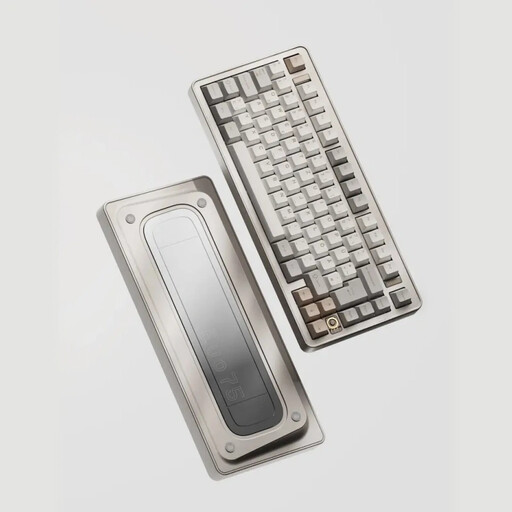 No image available
An option for a compact desk if you want to customise key functions; check first that the US layout suits the way you type.
75% layout, tri-mode, hot-swappable and VIA-compatible.
 No image available
A compact model for anyone looking for a mechanical keyboard for a small desk; bear in mind that it has a US layout.
68 keys, magnetic switches and a metal top plate.
 No image available
A wired option for a permanent workspace with limited desk space; check the US layout before ordering.
75% layout, hot-swappable linear switches and white backlighting.
 No image available
A compact choice if you’re short on desk space and want to customise your keys; check that the US QWERTY layout suits you.
Purple Switch.
 No image available
A compact wired option for a small permanent workspace; note that it has a US QWERTY layout.
60% layout and 61 keys.
Position your screen and keyboard so you can work comfortably, and change your posture regularly. Arboportaal describes this as workplace guidance; rules for employees don’t automatically apply to every student room.
Check which USB connection your laptop has or, for a wireless model, whether your device supports the connection it needs. Also check that the exact version has the key layout you want and whether an adapter is included, if required.
Check the physical ISO or ANSI layout and the position of punctuation keys you use often. A QWERTY label alone doesn’t tell you which country layout or variant you’ll get.
No. According to the Dutch government, the Netherlands has no fixed statutory warranty period: you’re entitled to a product that works as it should, with factors such as the type of product, its price and what you can reasonably expect all taken into account. If there’s a problem, contact the seller.
For online purchases from a business, you generally have a 14-day cooling-off period, according to the Dutch government. Check the terms that apply to your purchase: there are exceptions, and purchases from private sellers aren’t covered by the same rules.