Who is this choice relevant to?

Player with limited storage space

You want to be able to put your instrument away after practising. Compare the model’s width and depth with the space where you plan to store it; Yamaha’s specifications show that dimensions can vary considerably between models.

Beginner who wants to play with both hands

You may want to try more than your first melody. If so, consider the keyboard range and treat touch sensitivity as a separate feature: Yamaha says the PSR-F52 isn’t touch-sensitive, while Casio lists touch sensitivity for the CT-S300.

Player in a shared room

You want to practise at home without playing sound through the speakers. Yamaha lists a headphone socket for the PSS-F30 and PSR-F52; also check that it’s compatible with your headphones.

What should you look for when choosing?

37 mini keys

A good fit when: storage space is your priority and your arrangement fits within the keyboard’s range. Yamaha lists the PSS-F30’s dimensions as 506 × 201 mm.

The trade-off: 37 mini keys give you a smaller playing range than a 61-key model.

61 keys for a wider playing range

A good fit when: you need more keys and can make around 92 to 93 cm of width available. Yamaha lists the PSR-F52 at 920 × 266 mm; Casio lists the CT-S300 at 930 × 256 mm.

The trade-off: both models need more width than the PSS-F30. Yamaha says the PSR-F52 isn’t touch-sensitive, while Casio lists touch sensitivity for the CT-S300.

Keyboard with accompaniment

A good fit when: you want to experiment with sounds and automatic accompaniment as well as playing a melody. Roland describes the GO:KEYS 3 as a 61-key model with accompaniment features.

The trade-off: you don’t need extra features to practise a single melody. Measure the available space before choosing this model for a small room.

What to consider What should you check? Who is this important for?
Playing and storage space Measure the available width and depth. Yamaha lists the PSS-F30 at 506 × 201 mm and the PSR-F52 at 920 × 266 mm; Casio lists the CT-S300 at 930 × 256 mm. If I want to put my keyboard away after practising, I need to know whether it will fit in the available space. Space is the top buying concern for around 36% of consumers.
Keyboard range Compare the lowest and highest notes in your arrangement with the instrument’s range. Yamaha lists 37 mini keys for the PSS-F30; Yamaha and Casio list 61 keys for the PSR-F52 and CT-S300 respectively. If I want to try other melodies or parts too, I need enough keys for the piece I’m playing. Playing range is the top priority for around 29% of consumers.
Practising with headphones Check whether the exact model has a headphone socket and whether the plug will fit. Yamaha lists a stereo mini-jack for the PSS-F30 and PSR-F52. In a shared room, I want to practise without playing sound through the keyboard’s speakers. Quiet practice is the top buying concern for around 21% of consumers.
Features and power supply Check which practice features you’ll actually use, along with the power specifications and what’s included in the box. Yamaha lists a metronome for the PSS-F30; the USB power adaptor is sold separately. As a beginner, I want to know what I need to get started and which practice features the model has. Being able to start straight away is the top priority for around 14% of consumers.

Common buying mistakes

  • Focusing only on how narrow a mini keyboard is

    The Yamaha PSS-F30 has 37 mini keys; the models we looked at with a wider playing range have 61 keys. So a compact size won’t automatically suit every melody.

    Before you buy, compare the lowest and highest notes in your arrangement with the range of the keyboard you’re considering.

  • Assuming a mains adaptor is included

    Yamaha says the USB power adaptor for the PSS-F30 is sold separately. Power options vary by model.

    Check what’s included in the box, the recommended power supply and whether the connection is suitable for use in the UK.

  • Confusing touch sensitivity with the number of keys

    The number of keys and touch sensitivity are different features. Yamaha says the PSR-F52 isn’t touch-sensitive; Casio lists touch sensitivity for the CT-S300.

    Decide separately how many keys you need and whether touch sensitivity matters for the way you want to play.

Brands to compare

Yamaha

The models we looked at come in two sizes: the PSS-F30 with 37 mini keys and the PSR-F52 with 61 keys.

  • Yamaha lists dimensions and power options for these models; the manufacturer says both have a headphone socket.
  • Yamaha says the PSR-F52 isn’t touch-sensitive. The USB power adaptor for the PSS-F30 is sold separately.

Casio

Casio describes the CT-S300 as a 930 × 256 mm model with touch sensitivity.

  • Casio’s specifications make the dimensions and touch sensitivity of this model clear.
  • The CT-S300 is wider than the Yamaha PSS-F30 we looked at. Check which accessories are included with each listing.

Roland

Roland describes the GO:KEYS 3 as a 61-key model with sounds and automatic accompaniment.

  • These features may be useful if you want to experiment with accompaniment as well as playing a melody.
  • You don’t need extra accompaniment to practise a single melody; measure the available space for this model separately.

Joybuy products

These Joybuy products are digital keyboards with 61 keys; some are offered as sets with a stand, bench or stool. Before you buy, check that the bundle and the applicable CE marking on the specific product and any adaptor meet your needs.

MLS-931 digital piano with 61 keys, black

MLS-931 digital piano, 61 keys, black

A good fit if you’re looking for a digital instrument with 61 keys for a wider playing range.

The product name lists weighted keys, speakers, a headphone socket and USB-MIDI.

Joybuy

Electronic keyboard with 61 keys, black

Electronic keyboard, 61 keys, black

A good fit if you’re looking for a 61-key keyboard and want to be able to connect headphones while practising.

The product name lists a recording function, speakers, a metronome and a music stand.

Joybuy
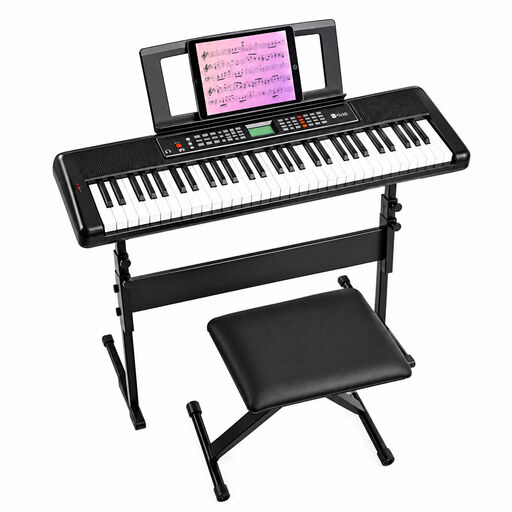
61-key keyboard set with bench and music stand

Keyboard set, 61 keys, with bench and music stand

A good fit if you’re looking for a 61-key keyboard with a bench and music stand.

The product name also lists USB-MIDI.

Joybuy
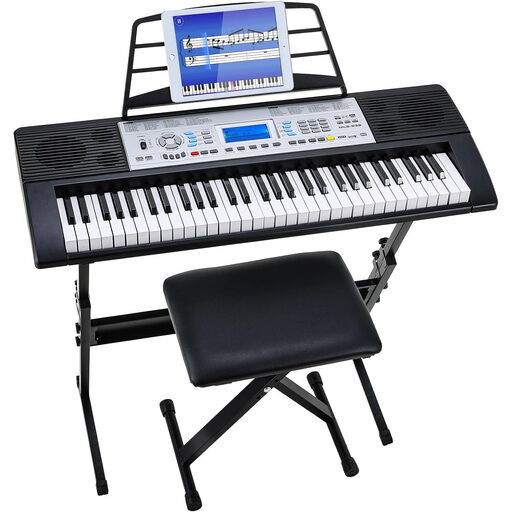
61-key keyboard set with stand and stool

Keyboard set, 61 keys, with stand and stool

A good fit if you’re looking for a stand and stool as well as a 61-key keyboard.

The product name lists an LCD screen and dual speakers.

Joybuy

Frequently asked questions

How can you tell if your festive tune will fit on a small keyboard?

Compare the lowest and highest notes in your arrangement with the keyboard’s range. The Yamaha PSS-F30 has 37 mini keys; the Yamaha PSR-F52 and Casio CT-S300 we looked at have 61 keys. The range you need depends on the notes in your arrangement.

Can you practise without disturbing others through the speakers?

Yamaha lists a stereo mini-jack for headphones on the PSS-F30 and PSR-F52. Check that the plug fits and start at a low volume; headphones won’t eliminate the physical sound of the keys.

Do you need a mains socket or a separate power supply?

This varies by model and version. Yamaha says the PSS-F30 can run on four AA batteries and the PSR-F52 on six; the USB power adaptor for the PSS-F30 is sold separately. Check the recommended power supply and what’s included in the bundle on offer.

What are your rights if a keyboard bought online disappoints or develops a fault?

For eligible distance purchases in the Netherlands, you generally have a 14-day cooling-off period, according to the Dutch Government; this doesn’t apply to purchases from private sellers. A faulty product is a separate matter: ACM ConsuWijzer explains that, under the applicable conditions, the seller must put right a product that breaks too soon under normal use, free of charge.

What should you check for a keyboard’s electrical safety?

Check that the specific electronic product and any adaptor carry the applicable CE marking, and only use a power supply that’s suitable for the model. The Dutch Government explains the CE marking requirement for electronic devices that fall within its scope; this doesn’t confirm the marking on any individual item for sale.
