
Beginner with a small practice space
Wants to learn a melody on an instrument that can be put away after practising. So they compare the key range, dimensions and built-in learning aids. Yamaha and Casio describe these features for various models.


Start by checking the lowest and highest notes in your arrangement, then consider how much space you have. A compact keyboard with 61 touch-sensitive keys may be suitable if the melody falls within that range; only choose extra learning aids if they work with the piece you’re practising. If the part falls outside that range, compare it with an 88-key instrument and consider how much space you’ll need.
Wants to learn a melody on an instrument that can be put away after practising. So they compare the key range, dimensions and built-in learning aids. Yamaha and Casio describe these features for various models.
Wants to listen to the electronic sound through headphones and pays attention to the connection and a sensible listening volume. VeiligheidNL recommends keeping the volume down.
Plays a part for both hands and compares its lowest and highest notes with the range of a 61- or 88-key keyboard before deciding how much space is needed. Yamaha and Korg list these key counts for the models mentioned.
Start with the melody’s range, then decide whether you need visual learning aids, and finally measure the space where you want to use and store the instrument.
| What to consider | What should you check? | Who is this important for? |
|---|---|---|
| Practising with headphones | Check the headphone socket on the exact model and make sure the plug fits. Start with the volume low; headphones won’t block the sound of the keys being pressed. | If I’m practising in a shared space, I want to hear the electronic sound through my headphones without unnecessarily disturbing others. Around 36% of consumers give the option to practise quietly the highest priority. |
| Learning aids for your melody | Check whether the lesson function works with the melody you’ve chosen and whether it requires a supported song or a compatible file. Yamaha describes the EZ-310’s Light Guide; Casio describes illuminated keys and Step Up lessons for the LK-S450. | If you want to learn your own festive melody step by step, learning aids are most useful when they work with the piece you’re practising. Among consumers who prioritise this support, the figure is around 29%. |
| Fitting it in and putting it away | Measure both the space where you’ll set it up and the space where you’ll store it, leaving room to play and use the connections. Casio lists the CT-S300 as measuring 930 × 256 × 73 mm and weighing 3,3 kg; Korg lists the Liano as measuring 1.282 × 290 × 73 mm and weighing 6,0 kg. | If I want to put the instrument away after practising, I consider the space available and how easy it is to handle. Around 21% of consumers put fit and storage first. |
| Enough keys for your arrangement | Find the lowest and highest notes in your score and compare them with the range of the exact instrument. Yamaha lists 61 keys for the PSR-E383; Korg lists 88 keys for the Liano. Touch sensitivity doesn’t automatically mean the keyboard is weighted. | If I’m playing a more extensive part, I want to know whether all the notes fall within the keyboard’s range before choosing an instrument. Around 14% of consumers give that extra key range the highest priority. |
The lesson functions described are designed for supported practice content and don’t guarantee that any song you choose will be available.
Check which songs, files and lesson modes the exact model supports for your melody.
The stated dimensions don’t tell you how much space you’ll need to play, use the connections and put the instrument away.
Measure the space where you’ll set it up and store it, then compare this with the dimensions of the exact version.
Korg describes the Liano’s keyboard as a touch-sensitive LS keyboard; this description doesn’t confirm that it has a hammer-action mechanism.
If piano-style key feel is important for your future lessons, check the keyboard type specifically, not just the number of keys.
Yamaha lists 61 touch-sensitive keys, built-in songs, lesson functions and accompaniment styles for the PSR-E383. According to Yamaha, the EZ-310 has illuminated keys.
Casio describes the CT-S300 as a compact keyboard with touch response. According to Casio, the LK-S450 has illuminated keys and Step Up lessons.
Korg lists 88 keys, a touch-sensitive LS keyboard and a headphone socket for the Liano. The instrument is 1.282 mm wide.
Roland describes the GO:KEYS 3 as a keyboard with 61 keys, built-in sounds and automatic accompaniment.
The Joybuy products below are electronic keyboards with 61 keys, for anyone who wants to practise a melody within that range.
 No image available
An option if the lowest and highest notes in your melody fall within the range of a 61-key keyboard.
The product title lists MIDI, a recording function, speakers, a metronome and a music stand.
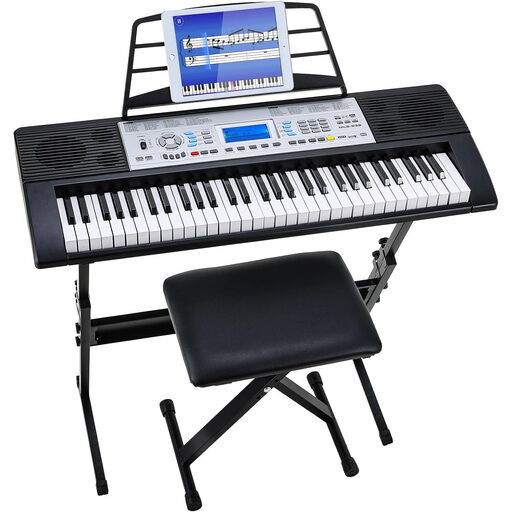 No image available
Could be suitable if you’re looking for 61 keys and want to consider a set with a stand and stool.
The product title lists 500 sounds, a three-level learning mode, dual speakers and an LCD screen.
No. Headphones let you hear the electronic sound, but they won’t silence the physical sound of the keys being pressed. Check the connection on the exact model and start with the listening volume low.
No. Illuminated keys don’t automatically mean that the song you’ve chosen is supported. Yamaha describes the EZ-310’s Light Guide for practising built-in songs; check separately whether your melody can be used with the model you’re considering.
First measure the space for the instrument and its controls, use the power supply specified for the exact model, and follow the accompanying manual. For example, Korg lists an included adapter for the Liano; don’t assume one will also be included with another model.
According to the Dutch government, distance purchases usually come with a 14-day cooling-off period; check the applicable exceptions and the seller’s information. If a product is faulty, the seller must offer a solution. According to the Dutch government, the Netherlands has no fixed statutory guarantee period.
Check the exact offer to see whether suitable headphones, any required plug adapter, a power supply and a stand are included. A model’s specifications don’t automatically confirm what comes with every retailer’s bundle.