What should you consider when choosing?
Compact 61-key keyboard
A good fit if: your practice pieces are within its range and storage space is important. Yamaha specifies touch-sensitive keys for the PSR-E383; Casio lists the CT-S300 as 930 mm wide.
Bear in mind: 61 keys offer a narrower range than the 76- and 88-key models reviewed here. Touch sensitivity is not the same as weighted hammer action.
76-key keyboard
A good fit if: you need a wider range than 61 keys offer but want a portable keyboard. Yamaha specifies 76 touch-sensitive keys for the PSR-EW320.
Bear in mind: Yamaha lists the PSR-EW320 as 1.148 mm wide, with ‘organ-style’ keys; the specifications do not mention weighted hammer action.
Digital piano with 88 weighted keys
A good fit if: your repertoire calls for a wider range or you specifically want to practise on weighted piano keys. Korg specifies that the B2+ has 88 keys with NH hammer action.
Bear in mind: Korg lists the B2+ as 1.312 mm wide. The stand and PU-2 pedal unit are listed separately, so measure the complete set-up.
Measure the usable width and depth of your playing area, including space for sheet music and somewhere to sit. The dimensions quoted are specific to each model: Casio lists 930 mm for the CT-S300, Yamaha 1.148 mm for the PSR-EW320 and Korg 1.312 mm for the B2+.
| What to consider | What should you check? | Who is this important for? |
|---|
| Key range and sheet music |
Compare the lowest and highest notes in your own pieces with the keyboard range; also check whether a music stand is included. |
If I play from sheet music, I want to know whether every note is within range; around 31% of consumers give key range and sheet music top priority. |
| Space and storage |
Measure the space for the instrument, sheet music and somewhere to sit; check the weight if you plan to move the instrument often. |
If I have limited attic space, the whole playing set-up needs to fit; around 25% of consumers prioritise fitting everything in and storage. |
| Quiet practice |
Check the headphone socket on the exact model and whether you need a suitable plug or adapter. |
If I practise in a shared home, I want to be able to avoid using the built-in speakers without assuming that key presses will be inaudible; around 25% of consumers put quiet practice first. |
| Piano feel and pedal |
Check whether the model has weighted keys and which pedal is included with that version. |
If I practise piano technique, I want to know whether the key action and pedal suit what I play; around 19% of consumers choose piano feel or pedal use as their main priority. |
Joybuy products
These Joybuy products have 61 keys and are intended for anyone who wants to practise sheet music within that range. Compare the connections and accessories listed for each version, and measure the space needed for the complete set-up.
 No image available
MLS-931 digital piano, 61 keys, black
Could be a good fit if your sheet music stays within the range of 61 keys and you want to practise on weighted keys.
The product title mentions weighted keys, a headphone socket and a music stand.
Joybuy
 No image available
Electronic keyboard, 61 keys, black
Could be a good fit if your pieces are within the range of 61 keys and you want to keep your sheet music beside the instrument.
The title mentions a music stand, metronome and recording function; the product description mentions a headphone socket.
Joybuy
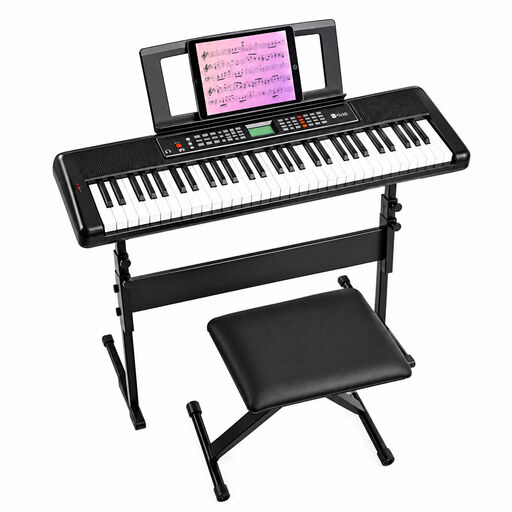 No image available
Digital keyboard bundle, 61 keys, with stand and stool
Could be a good fit if your sheet music is within the range of 61 keys and you want a set-up with somewhere to sit.
The title lists a keyboard stand, stool and music stand. The product description mentions a headphone socket and a 3-level learning mode.
Joybuy
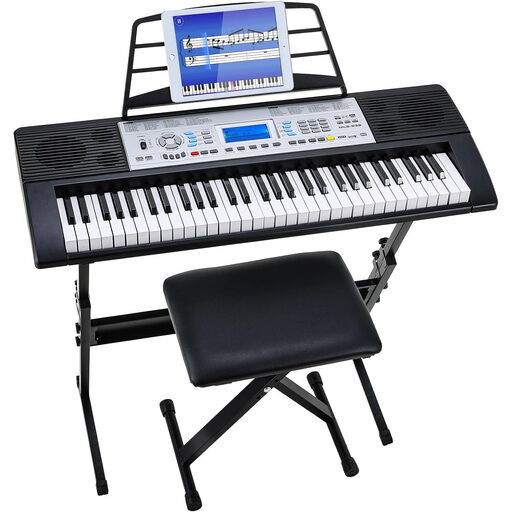 No image available
Keyboard set, 61 keys, with stand and stool
Could be a good fit if your sheet music is within the range of 61 keys and you want a keyboard stand with somewhere to sit.
The product title lists 500 sounds and a 3-level learning mode; the description mentions an adjustable stool, dual speakers and an LCD screen.
Joybuy
Frequently asked questions
How do I start sight-reading on my new instrument?
Before you play, look at the key signature, rhythm and any recognisable patterns in an unfamiliar piece. ABRSM describes this as part of sight-reading; also check in advance that the written notes are within your instrument’s range.
What should I check before setting up an instrument in the attic?
Measure the whole playing area, not just the instrument’s width. Korg specifies that the B2+ is 1.312 mm wide and 336 mm deep without the music stand; the music stand and damper pedal are listed as included, while the stand is listed separately.
Are headphones enough to practise without disturbing anyone?
According to Casio, connecting headphones to the CT-S300 switches off its built-in speakers. That doesn’t mean other people won’t hear the physical sound of the keys being pressed; if necessary, discuss practice times with housemates or neighbours.
What are my rights if I buy online and the instrument doesn’t fit or is faulty?
ACM ConsuWijzer says that online purchases generally come with a statutory cooling-off period of up to 14 days after delivery, subject to exceptions. This is separate from the statutory guarantee: if a product used normally doesn’t do what you could reasonably expect, the seller is responsible for the statutory guarantee.
Are there set times when I’m allowed to play a keyboard at home?
Check the agreements and rules that apply at your address rather than assuming there’s one standard practice time. The Dutch Government advises neighbours to discuss things first if there may be a noise nuisance, and says that in many local authority areas, neighbour noise complaints may be covered by municipal APV regulations.


