
Writers working alongside colleagues
If you type a lot in a shared space, pay attention to the key mechanism and the noise it makes during use. CHERRY and Trust describe certain models as quiet; if possible, try the feel of the keys for yourself.


Start by considering how much typing noise is acceptable in your shared space and which connection is compatible with your computer. A standard keyboard is a sensible choice if you mainly type a lot of text; only choose a split model if you want to position its two halves separately. Descriptions such as ‘quiet’ and ‘ergonomic’ are not comparable noise measurements or proven health outcomes.
If you type a lot in a shared space, pay attention to the key mechanism and the noise it makes during use. CHERRY and Trust describe certain models as quiet; if possible, try the feel of the keys for yourself.
If you want to position your keyboard to suit your preferences, compare a standard layout with a split model. R-Go Tools describes the Split Break as two separate keyboard halves.
Check the connection and keyboard layout of the version you’re considering. Logitech says the MX Keys S can switch between up to three devices; check that the layout suits your workplace.
First, compare the keyboard type and connection with your workplace. Then consider whether the layout and feel of the keys are comfortable for writing and editing web pages.
| What to consider | What to look for | Who is this important to? |
|---|---|---|
| Typing noise | Compare the key mechanism and, if possible, try the keyboard for yourself; manufacturers’ claims are not comparative measurements. | If you type a lot of website copy alongside colleagues, you’ll want to minimise distractions from keystrokes. Around 33% of consumers say typing noise is their top priority. |
| Hand position | A split layout calls for a different way of typing; check that you have enough space, too. | During longer editing sessions, being able to position the keyboard halves yourself may matter more than extra features. Around 27% of consumers put hand position first. |
| Connection and devices | Check that your computer has the required port or wireless connection, and that the keyboard layout is right for you. | If you work across several computers, check that the connection works with each device and consider whether you want to switch between them easily. Around 20% of consumers give device compatibility top priority. |
| Ease of use | Check the cable or receiver, power supply and keyboard layout for the version you’re considering. | If you mainly want a simple, fixed setup, a wired model with a compatible connection may be all you need. Around 20% of consumers prioritise ease of use and cost. |
CHERRY and Trust describe their own keyboards as quiet, but these descriptions do not provide a common measurement basis for comparing models.
Start by choosing a layout and connection that suit your workplace. If possible, try the feel and sound of the keys for yourself.
The Trust Ody II is available as a keyboard on its own and as a keyboard and mouse set. The contents of the box can therefore vary by version.
Read the full product name and check what’s included in the box before comparing versions.
A mouse included in the box may be an extra accessory you don’t need.
The R-Go Split Break version described is wired and has a US QWERTY layout. Its two separate halves also create a different typing setup from a standard keyboard.
Check the connection and keyboard layout, and make sure the split design suits the way you type.
The STREAM KEYBOARD and STREAM KEYBOARD WIRELESS are designed for anyone looking for a standard layout and, according to CHERRY, quiet scissor-switch keys.
The Ody II is a low-profile wireless keyboard for anyone looking for a straightforward typing experience that Trust describes as quiet.
The MX Keys S is aimed at anyone who wants to switch between devices or is looking for backlighting and customisable keys.
The wired Split Break is an alternative if being able to position two separate keyboard halves is important to you.
This selection includes wired and wireless keyboards, with layouts ranging from full-size to more compact. Check the connection and keyboard layout for each model.
 No image available
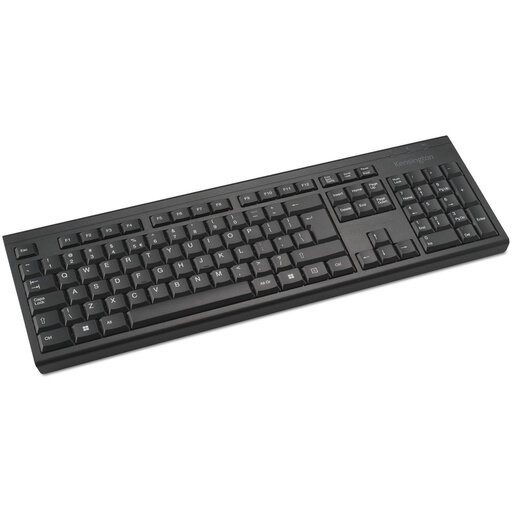
A wired option for typing at a fixed workstation.
QWERTY layout, numeric keypad, full-size layout and plug-and-play connection. This version is black.
 No image available
A wireless full-size keyboard for typing at your workstation.
It connects via a 2.4 GHz USB receiver and has membrane keys. Check that your computer has a suitable USB port.
 No image available
A wireless option if you want to switch between several connected devices.
Full-size layout with numeric keypad and US QWERTY. Trust describes the scissor-shaped keys as quiet. This version has a built-in battery that charges via USB-C.
 No image available
A more compact wired layout for anyone looking to save desk space.
75% layout with 83 keys, USB-C connection, linear hot-swappable switches and white backlighting. Check that the US QWERTY layout suits you.
 No image available
A compact wired option for anyone looking for a smaller keyboard layout.
60% layout with 61 keys, RGB lighting and a USB connection. Its membrane design is described as having a mechanical feel. Check the US QWERTY layout.
For employees who work at a screen for more than 2 hours a day, Arboportaal states that the screen and keyboard must not be attached to each other. When using a laptop, you must therefore be able to use a separate screen or keyboard; whether this applies to you depends on your working situation.
Check the connection for the specific version and make sure your computer has a suitable port. Trust says the Ody II has a stowable USB receiver; CHERRY lists a 2.4 GHz connection for the STREAM KEYBOARD WIRELESS.
According to the Dutch government, if a product is faulty, you can ask the seller to put things right. The seller is responsible for providing a product that works properly; in the situation described, repair or replacement must not incur an additional charge.
Dutch government information refers to the European Radio Equipment Directive (RED) for devices with Bluetooth or a radio frequency module. The applicable requirements depend on the connection and the product version; a statement on a product page does not, by itself, prove that a specific item meets every requirement.
The Dutch government lists options for old devices including a shop or online service where you buy a similar device, and your local council’s recycling centre. Take used batteries to a separate collection point; don’t put them in general waste.