
Writer in a shared space
You work on longer drafts with colleagues nearby, so the sound of the keys and a comfortable typing experience both matter to you.


Choose a keyboard with a key feel and sound that suit working alongside colleagues. Then check that its size, layout and connection options work for your desk. A compact model leaves more room for your mouse, while a full-size keyboard keeps the numeric keypad. Some manufacturers describe their models as quiet, but these labels are not comparable sound measurements.
You work on longer drafts with colleagues nearby, so the sound of the keys and a comfortable typing experience both matter to you.
You switch between your keyboard and mouse while editing and want enough room to position both.
You use more than one device or desk, so you need to find the right balance between the keyboard’s layout, connection options and portability.
Start with a key feel and sound that you find comfortable when writing alongside colleagues. Then choose a size and connection type to suit your number-crunching, mouse space and devices.
| What to consider | What to look for | Who might value this most? |
|---|---|---|
| Key noise while writing | If possible, try the key feel and sound; don’t compare models based on the word ‘quiet’ alone. | If you often write alongside colleagues, you’ll want to know how the keys sound in your space. Around 36% of consumers say quiet typing is their top priority. |
| Posture and mouse space | Check the width and whether the numeric keypad is integrated; also consider where you can position your mouse. | If you switch frequently between your keyboard and mouse while editing, the space available on your desk matters. Around 29% of consumers prioritise posture and room for their mouse. |
| Connecting at different workstations | Check Bluetooth support, whether a USB receiver is included, the ports available and the power supply. | If you work at more than one computer or desk, you’ll want to know whether you can connect and take the keyboard with you. Around 21% of consumers prioritise switching between devices or workstations. |
| Layout and wired connection | Check the exact key layout and connection type, such as USB-A. | For a single desktop PC, a familiar Dutch keyboard layout may matter more than wireless switching. Around 14% of consumers say this basic set-up is their top priority. |
Manufacturers use descriptions such as ‘quiet’ or ‘noise-reducing’, but these don’t tell you how models compare with one another or how they’ll sound in your space.
Where possible, try the exact model in a similar environment, and don’t choose based on the word ‘quiet’ alone.
A product title that says QWERTY doesn’t guarantee that the key layout matches the Dutch version you’re looking for.
Check the full name of the layout and, if available, look at an image of the keys for the version you’ve chosen.
A compact model frees up space for your mouse, but may not have an integrated numeric keypad. A full-size keyboard can include one, but takes up more room.
Before choosing a size, think about how often you enter budgets or other strings of figures when putting together your pitch.
The MX Keys S is designed for text work and switching between devices; Logitech also offers the more compact MX Keys Mini.
The KW 9100 SLIM is a low-profile keyboard with scissor switches, Bluetooth and a 2.4 GHz receiver.
The Compact Break is a compact keyboard for anyone who wants to keep their keyboard and mouse close together.
The wired KB216 is available as a full-size keyboard with a Dutch QWERTY layout.
Keychron describes the B6 Pro as a slim, full-size keyboard with several connection options.
This selection includes keyboards for shared office workstations, from full-size wired models to compact and mechanical versions. Above all, check the layout, connection type and size to find one that suits your desk.
 No image available
An option for a fixed workstation if you want a numeric keypad for entering figures.
Full-size; wired; QWERTY layout; plug and play.
 No image available
A compact option if you want to free up desk space; check whether the US QWERTY layout is right for you.
75% size; mechanical; US QWERTY layout; wired, Bluetooth or 2.4 GHz.
The product title mentions Gradient Grey, side-printed keycaps and Reaper Switch.
 No image available
A wired option for a fixed workstation; bear the cable in mind if you often move between desks.
94 keys; mechanical; metal casing; detachable wrist rest and phone stand.
 No image available
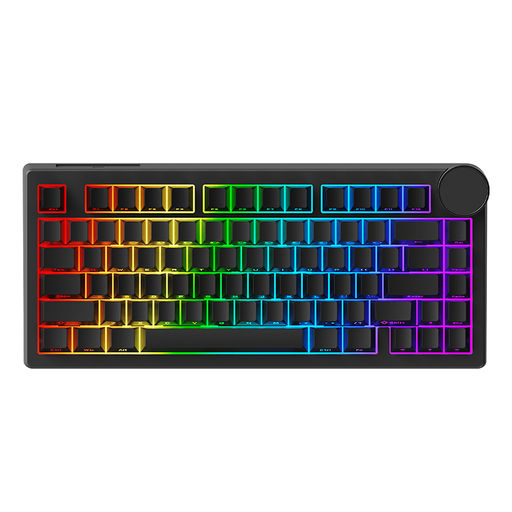
A compact wired option if desk space matters to you; check that the layout and switch type suit your preferences.
75% layout; wired; mechanical; magnetic switches.
The product title mentions black keycaps with side-printed legends and a metal dial.
 No image available
A compact option if you switch between devices; check in advance that the US QWERTY layout is right for you.
TKL size; scissor keys; Bluetooth or USB receiver; supports up to three devices according to the product description.
The product description calls the keys quiet and flat; this isn’t an independent sound measurement.
Not in every case. For employees who work at a screen for more than two hours a day, Arboportaal says that the screen and keyboard must not be attached to each other. With a laptop, you must therefore be able to use either a separate screen or a separate keyboard. This is a conditional workplace requirement, not a general buying requirement for every reader; discuss your set-up with your employer.
Adjust the workstation to your own body measurements and take breaks from screen work. Arboportaal also recommends varying your working posture and taking short breaks; a break indicator on a keyboard is no substitute for a suitable set-up and taking breaks.
Before buying, check whether your device supports Bluetooth or has a suitable port for the receiver supplied. According to CHERRY, the CHERRY KW 9100 SLIM supports Bluetooth or a 2.4 GHz receiver and charges via USB-C; follow the instructions for pairing and cleaning.
For consumer purchases made online, you generally have a statutory cooling-off period of up to 14 days after delivery; ACM ConsuWijzer also explains that there are exceptions. Check the terms of the specific seller and don’t use the keyboard more than necessary to assess it.
According to ACM ConsuWijzer, you have statutory rights in addition to any manufacturer’s warranty. If a product used normally doesn’t meet the expectations you were entitled to have, the seller must offer an appropriate solution free of charge; this right isn’t necessarily limited to a fixed manufacturer’s warranty period.