
Designers working at a shared desk
You want to be able to type while other people are working nearby. Logitech and Trust describe the keys on certain models as quiet, but this is not an independent comparison of their noise levels.


First, choose a layout and connection that suit your computer and daily work. At a shared desk, typing noise and room for your mouse also matter. A compact keyboard can leave more space beside it, while a full-size model includes a numeric keypad. Manufacturers describe some keys as quiet, but Logitech, Trust and R-Go Tools do not provide comparable sound measurements that let you rank their models by noise level.
You want to be able to type while other people are working nearby. Logitech and Trust describe the keys on certain models as quiet, but this is not an independent comparison of their noise levels.
You switch between your keyboard and mouse and want to leave enough room for both. The keyboard’s width and whether it has a numeric keypad are important factors.
You work on more than one computer or mobile device and want the connection and shortcut keys to suit the devices you use. Logitech and Trust describe models with options for switching between devices.
Start with a layout and connection that suit your devices. Then consider how much mouse space you need, whether you want a numeric keypad and how important quieter typing is for your work.
| What to consider | What should you check? | Who should consider this? |
|---|---|---|
| Typing noise | Key shape, key action and whether you can assess the sound at your workplace. | If I’m designing alongside other people, I want to type without distracting them unnecessarily. For around 33% of consumers, quieter typing is the top buying priority. |
| Desk space | Overall width, whether it has a numeric keypad and where you’ll place your mouse. | If I often switch between my keyboard and mouse, I want enough room without missing any keys I need. Around 27% of consumers put desk space at the top of their list. |
| Switching between devices | Bluetooth, whether it comes with a USB receiver and how the shortcut keys work with your operating system. | If I work on several devices, I want to know whether one keyboard can connect to them and which keys I can use. Around 20% of consumers say switching between devices is their top priority. |
| Working posture | Keyboard and mouse position, the layout you want and whether there’s software for break reminders. | During longer design sessions, I want to set up my workspace to suit me and vary my work; a keyboard alone can’t do that. Around 20% of consumers choose working posture as their main consideration. |
Logitech and Trust describe certain models as quiet, but these product claims are not comparable sound measurements.
Consider the key shape and action, and assess the typing noise yourself if it matters in your workspace. Check the returns policy before you buy.
A compact model can leave more room beside the keyboard, but it may not have a numeric keypad. The Trust Ody II does have one, but takes up more desk space.
Think through your design and other work tasks, then compare the layout with the keys you need.
If you find you often enter numbers after all, you may need a separate numeric keypad.
Trust describes the Lyra as having a USB receiver and Bluetooth, while the Ody II comes with a USB receiver. So, you can’t assume they offer the same connection options.
For the version you’re considering, check the connection type, available ports and compatibility with your operating system.
Logitech describes the Pebble Keys 2 K380s as a compact Bluetooth keyboard that lets you switch between devices.
The Lyra and Nado II have compact layouts, while the Ody II is an alternative with a numeric keypad.
The Compact Break is designed for a compact workspace, where the position of your keyboard and mouse matters.
This selection from Joybuy includes compact and foldable keyboards, as well as a full-size model. Compare the layout and connection with your workspace and devices.
 Image unavailable
A good fit if you want a wired keyboard and room to move your mouse.
The TKL layout has no numeric keypad. The product description mentions USB and plug-and-play use with a PC or PS5.
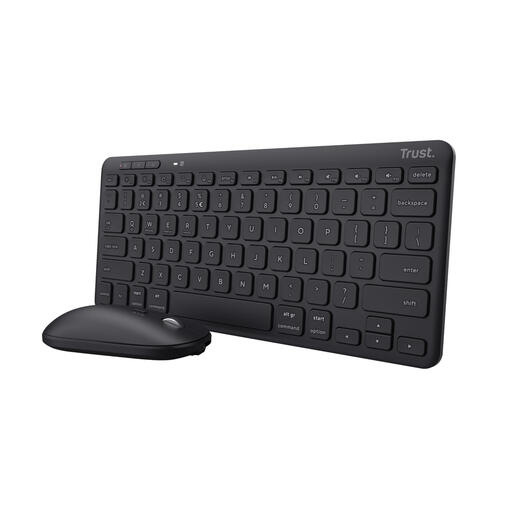 Image unavailable
A good fit if you want a compact keyboard to use with several devices.
The product description mentions a USB receiver, Bluetooth, switching between up to three devices and a rechargeable battery. Trust describes the keys as quiet, but this is not a comparable sound measurement.
 Image unavailable
A good fit if you’re looking for a foldable keyboard with a built-in touchpad for a compact set-up.
The product information lists Bluetooth, 63 keys and a touchpad. Check that the stated compatibility suits your device.
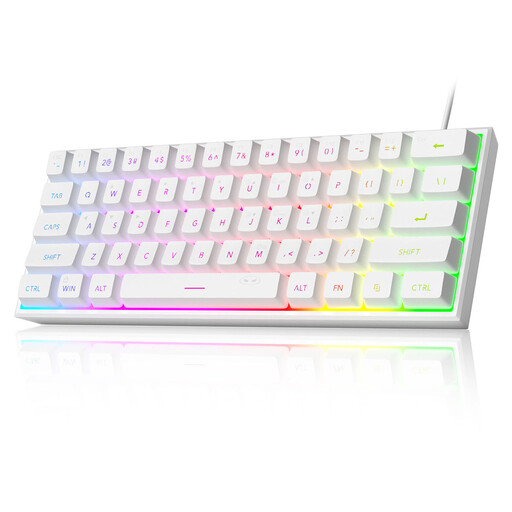 Image unavailable
A good fit if you want a compact layout and have limited desk space.
The product title lists a wired 60% layout with 61 keys and RGB lighting. The product description mentions USB and support for Windows and Mac; it doesn’t specify the typing noise level.
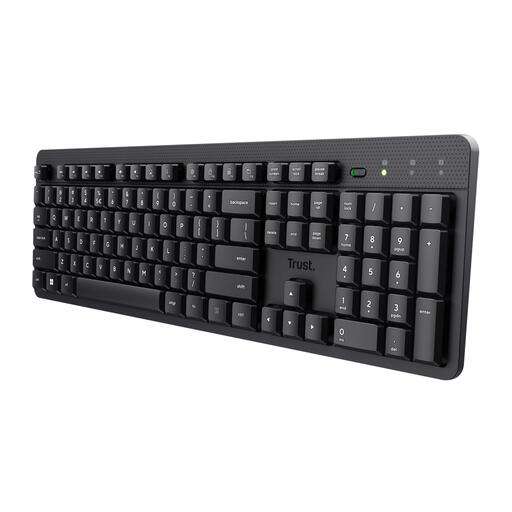 Image unavailable
A good fit if you need a numeric keypad and are happy to use more desk space for it.
The product information mentions low-profile keys and a USB receiver. Trust describes the keys as quiet, but the product description doesn’t provide a comparable sound measurement.
Not always. Arboportaal states that for employees who work with display screens for more than two hours a day, the screen and keyboard must not be attached to each other. When using a laptop, it must therefore be possible to use a separate screen or keyboard. This is not a general purchase requirement for every private user.
Set up your workspace to suit you and break up your screen work. Arboportaal recommends changing posture and taking short breaks. A break indicator can remind you to do this, but it won’t set up your workspace for you.
Check the details for each model and version. Trust describes the Lyra as having a rechargeable battery and connecting via a USB receiver or Bluetooth. The R-Go Compact Break is available in wired and wireless versions and uses software for its break indicator.
For online consumer purchases, ACM ConsuWijzer says you generally have a 14-day cooling-off period after delivery. Check the applicable exceptions and returns policy. If a product is faulty, the seller is responsible for the statutory guarantee. This is separate from returning an item because you’ve changed your mind.