What should you look for?
First decide whether you mainly switch between devices, need more space or use one dedicated computer. Then choose the connection, layout and any extra keys that suit the way you work.
Full-size keyboard for multiple devices
A good fit if: you work on teaching materials across different devices and want to keep a numeric keypad. Trust lists three Bluetooth channels and a USB receiver for the Vaiya; HP lists Bluetooth and a dongle for the 475.
Keep in mind: a full-size model takes up space, and wireless use may mean recharging or replacing batteries. Check the layout and which connections are allowed at your workplace.
Compact Bluetooth keyboard
A good fit if: you want to leave room for papers or take your keyboard with you. Logitech says the Pebble Keys 2 K380s can switch between three devices.
Keep in mind: check that the compact layout and lack of a numeric keypad work for the data you enter every day.
Wired USB keyboard
A good fit if: you use one dedicated computer and don’t need a wireless connection. Logitech describes the K120 as ready to use as soon as it’s plugged in via USB.
Keep in mind: the cable stays on your desk, and you can’t switch between paired devices at the touch of a button. Check that a suitable USB port is available.
Wireless with a single USB receiver
A good fit if: you want to type on one computer without a cable and can plug a receiver into it. Trust lists a USB receiver for the Ody II; CHERRY describes the STREAM KEYBOARD WIRELESS as a 2.4GHz model.
Keep in mind: check that a USB port is available, and don’t assume you can switch between devices using Bluetooth. Descriptions of quiet typing are not comparable sound measurements.
| What to consider |
What should you check? |
Who might this matter more to? |
| Switching between devices |
Check the number of supported connections, whether a receiver is included and the connection options available on each device. |
If I work on teaching materials on both a laptop and a tablet, I want to switch between them without needing a second keyboard. Around 33% of consumers rank device switching as their top priority. |
| Quiet typing |
Look at the description of the keys and, where possible, try out how they feel to type on; a manufacturer’s claim is not a comparative sound measurement. |
When other people are working nearby, I want to take the sound of my keys into account. Quiet typing is the top priority for around 25% of consumers. |
| Space and posture |
Compare the dimensions and keyboard layout with the space available and your need for a numeric keypad. If you work for long periods, consider your overall workstation setup too. |
If I need to keep teaching books and papers next to my keyboard, I want enough space and a suitable setup. Space and posture are the top priority for around 25% of consumers. |
| Easy connection |
Check that the computer has a suitable USB port, that a receiver is allowed and that you have the keyboard layout you need. |
For one dedicated computer, I want to plug in and get started without switching between devices. Easy connection takes priority for around 17% of consumers. |
Keyboards at Joybuy
This selection includes keyboards for switching between devices, typing on one dedicated computer and working with limited desk space.
 No image available
HP 725 Multi-Device Rechargeable Wireless Keyboard
This model suits a shared desk where you switch between multiple devices and want to use a numeric keypad.
The description lists a full-size layout, connections to three devices via two Bluetooth connections and a dongle, USB-C charging and programmable keys.
Joybuy
 No image available
Trust Lyra keyboard and mouse, QWERTY US English
This model suits you if you want to switch between multiple devices and can use the included mouse as part of the same workstation setup.
The description lists connections to up to three devices via Bluetooth or a USB receiver. Trust describes the keys as quiet scissor keys. The title specifies a QWERTY US English layout.
Joybuy
 No image available
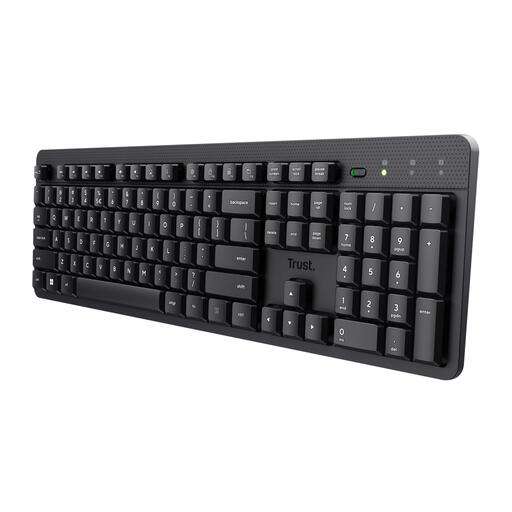
Trust Ody II wireless keyboard, QWERTY US
This model suits a dedicated computer if you’re looking for a full-size keyboard with a numeric keypad and a USB receiver.
Trust describes the keys as soft and virtually silent. The product name specifies a spill-resistant design and QWERTY US layout; the description says it connects via the included USB receiver.
Joybuy
 No image available
Trust Vaiya wireless keyboard, QWERTY US
This model suits you if you want to switch between different teaching devices and enter numbers on a full-size keyboard.
The description lists three Bluetooth channels and a USB receiver, a numeric keypad and a rechargeable battery. The title specifies a QWERTY US layout and scissor keys.
Joybuy
 No image available
Voxis B033 foldable Bluetooth keyboard
This model suits you if you’re short on space or want to take a keyboard with you for use with a tablet, smartphone or computer.
The description lists a foldable design with 63 keys, Bluetooth and support for iOS, Android and Windows. The product name also mentions a touchpad.
Joybuy
Frequently asked questions
Should an employee at a shared laptop desk be able to use a separate keyboard?
According to Arboportaal, the screen and keyboard must not be attached to each other when an employee works at a screen for more than 2 hours a day; when using a laptop, a separate screen or keyboard must then be available. This is a conditional workplace requirement, not a recommendation to buy a specific keyboard model.
How do I connect a wireless keyboard if the work computer doesn’t have a free USB port?
A model that supports Bluetooth can pair without a USB receiver, provided the computer supports Bluetooth and that connection is allowed. A model that only works with a receiver does need a suitable USB port, so check the specifications for the exact model.
Can I clean a shared keyboard with any cleaning product?
No. Follow the cleaning instructions for the exact model. HP describes the 475 as sanitiseable, but that doesn’t mean other keyboards can withstand the same products. Logitech’s cleaning information applies to the products it specifies.
What rights do I have when buying a keyboard online in the Netherlands?
When you buy online from a business, consumers generally have a 14-day cooling-off period in many cases, according to the Dutch Government; exceptions may apply. This is separate from your rights if a product is faulty. The Dutch Government also states that the Netherlands does not have a fixed statutory two-year guarantee period for all products. If a school or organisation is placing the order, check whether the consumer purchase information applies.


