
Editor of lengthy guides
If you often switch between instructions, headings and images, check how easy it is to reach the navigation keys. Microsoft Support describes cross-references as a Word feature, not a keyboard feature.


Choose a keyboard that gives you easy access to the navigation and function keys in your writing software; the keyboard itself won’t create cross-references. In Word, Microsoft Support advises creating the target first, such as a heading or image, and then inserting the cross-reference. Also choose a keyboard that suits your typing posture, available desk space and the exact key layout.
If you often switch between instructions, headings and images, check how easy it is to reach the navigation keys. Microsoft Support describes cross-references as a Word feature, not a keyboard feature.
When you’re writing for long periods, choose a keyboard layout and working posture that suit you and your workspace. The shape of a keyboard alone cannot guarantee a particular health outcome.
If you also spread pattern pieces or notes beside your computer, a keyboard without a numeric keypad can free up space. Consider how often you enter measurements and quantities, too.
Start with the keys you use most often when editing your guide. Then weigh up the layout, your typing posture and the space you need for your mouse and paper pattern pieces.
| What to consider | What should you check? | Who should pay particular attention? |
|---|---|---|
| Document navigation | Check where the arrow, navigation, function and modifier keys are on the exact model. Try them out in your writing software. | If I often navigate between steps and images, I want the keys I use to be within easy reach. In this guide, consumers who prioritise document navigation account for around 36%. |
| Typing for long periods | Assess your hand position, keyboard layout and the distance to your mouse in your own workspace. | If I write for long stretches, I want a layout that suits my hands and workspace. Consumers who prioritise typing comfort account for around 29%. |
| Space and layout | Check the full keyboard image and the exact language layout. Also consider how often you enter measurements as numbers. | If I have pattern pieces and notes beside my computer, I want to save space without making number entry unnecessarily awkward. Consumers who prioritise desk space account for around 21%. |
| Noise and connectivity | Check the key mechanism, available connections and compatibility with your computer. | If I work in a shared space or switch between devices, I want to know in advance how noisy the keyboard is and how it connects. Consumers who prioritise quietness or connection flexibility account for around 14%. |
Cross-references are created in your document software, and you need to create a target first. A customisable key won’t make this feature available by itself.
Check the steps in your writing software before choosing a keyboard for its customisable keys.
The Keychron K3 Max ISO collection includes several national layouts. So the same model name doesn’t necessarily mean the keys have the same labels or positions.
Check the exact variant and an image of its keys, especially if you often use shortcuts and punctuation.
A TKL keyboard saves space by leaving out the numeric keypad. That can be less convenient if you often enter measurements and quantities.
Weigh the space saved against how often you type numbers while editing patterns.
The MX Keys S is a full-size wireless keyboard for anyone who values customisable keys and the ability to switch between devices.
The STREAM KEYBOARD and STREAM KEYBOARD TKL are wired options with scissor-switch keys, available with or without a numeric keypad.
The Pro Fit Ergo KB675 EQ TKL is a compact, curved model with customisable keys.
The K3 Max ISO collection is a compact mechanical keyboard with a 75% layout.
These keyboards suit a range of writing needs, from navigating long documents and entering numbers to saving space with a more compact layout.
 No image available
A full-size option if you want separate navigation keys and a numeric keypad when editing lengthy documents.
QWERTY layout, wired plug-and-play connection and a numeric keypad.
The product description mentions a separate navigation cluster with arrow and function keys.
 No image available
A wired mechanical option if you have a permanent workspace and want to use a detachable wrist rest while typing.
The product description mentions a metal case, PBT keycaps, a hot-swappable PCB and a detachable wrist rest.
 No image available
A full-size option if you enter numbers and want to switch between several devices.
The product description mentions scissor-switch keys, a numeric keypad, a USB receiver, three Bluetooth channels and USB-C charging.
This model has a US/QWERTY layout; check that the key labels and positions suit your preferences.
 No image available
The compact layout could be a good fit if you want to keep space beside your keyboard and are looking for a mechanical model.
The product description mentions an 82-key layout with arrow and function keys, and Bluetooth, 2.4 GHz and USB-C connectivity.
This model has a US/QWERTY layout; check the exact key labels and positions.
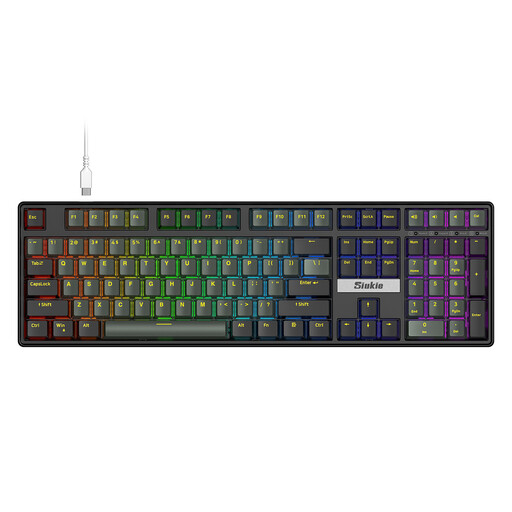 No image available
A wired full-size option if you regularly enter numbers while adjusting pattern pieces.
The product description mentions a 108-key layout, a numeric keypad and detachable switches.
No, a keyboard won’t create those cross-references by itself. In the Word process described by Microsoft Support, you first create the target, such as a heading or image, and then insert the reference in Word. A customisable key can only help with actions supported by your software and settings.
Compare the connections and operating system requirements for the exact keyboard model with your computer. For the KB675 EQ TKL, Kensington lists two Bluetooth connections and one connection via a 2.4 GHz USB-A receiver, and excludes Windows 11 on Arm for this model.
No, consider your whole workspace too, and alternate screen work with other tasks or breaks. Arboportaal states that for employees who work at a screen for more than 2 hours a day, the screen and keyboard must not be attached to each other; this requirement does not automatically apply to every individual buyer.
According to ACM ConsuWijzer, for a standard online purchase you generally have a statutory cooling-off period of up to 14 days after delivery; check which exceptions apply. If a product is faulty, the seller is responsible for the statutory guarantee. Any manufacturer’s guarantee is separate.