First, choose a layout that gives you easy access to the commands in your writing software and operating system. Programmable keys are most useful if you want to set up actions you use repeatedly. Then weigh up a compact keyboard, a familiar layout and separately positionable halves against ease of navigation, desk space and how much adjustment they require. A different keyboard shape is no substitute for varying your activities or setting up your workspace appropriately.
Who are these keyboards for?
Writers who revise a lot
You often switch between writing, moving and formatting text. First, check which keyboard shortcuts your writing software already offers. Microsoft Support, Google Help, Keychron and Logitech describe relevant commands and customisation options.
Writers who work for long periods
You want to consider your hand position and workspace setup without expecting one keyboard to prevent discomfort. Arboportaal recommends varying your activities and taking micro-breaks; the R-Go Tools manual explains how to position the two keyboard halves separately.
Writers with an established workflow
You want keys within easy reach and a layout that suits your computer and writing software, rather than having to learn a new key arrangement. Microsoft Support, Google Help and CHERRY provide information to help you check that the layout, system and keys work together as expected.
What should you look for when choosing?
First, check the keyboard shortcuts for your writing software and operating system. Then choose a shape and layout that suit the way you navigate, your workspace and your preferred connection.
Each row describes one key reason for choosing a keyboard, although several of these factors may matter to you at the same time.
| What to consider |
What to look for |
Who is this important for? |
| Shortcuts and revisions |
Make a note of the commands you use most often and check which keys or software you need to carry them out exactly as you want. |
If I often move and format text, I want to know whether my software already supports those actions with keyboard shortcuts. Around 36% of consumers make shortcuts for recurring revisions their top priority. |
| Hand position and variation |
See how any keyboard halves can be positioned and whether the setup suits your workspace. |
During long writing sessions, I want to choose the distance and angle between my hands, while also leaving room for breaks. Around 29% of consumers prioritise hand positioning. |
| Layout and navigation |
Compare the physical layout and the position of the arrow keys, punctuation marks and frequently used navigation keys with your software and system. |
If I’m used to a particular layout, I want the navigation and shortcut keys to match the way I work. Around 21% of consumers make familiar key navigation their top priority. |
| Connection and key feel |
Check the connection on the exact model you’re considering and, if possible, assess the sound of the keys in a similar working environment. |
In a shared workspace, I want to know in advance which connection will work and whether the keys sound pleasant there. Around 14% of consumers prioritise the connection or key sound. |
Common buying pitfalls
-
Assuming programmable keys automatically mean better shortcuts
Writing software often already has keyboard shortcuts. What you can automate depends on the application and software you use.
First, try the existing commands you use most. Then decide whether you want to remap keys or automate actions.
-
Confusing ‘slim’ with ‘narrow’, or mixing up different versions
CHERRY lists the standard KC 6000 SLIM as 440 mm wide and offers a separate Mac version. For the Keychron K3 Max, hot-swap is available only on the specified version.
Check the full model name, version, dimensions, physical layout and connection before ordering.
-
Assuming a split keyboard or break indicator will prevent discomfort
Separately positionable halves and an indicator don’t remove the need for a suitable workspace and actual breaks.
Check how the keyboard fits into your own setup and take breaks from screen work. Arboportaal recommends micro-breaks, among other things. An indicator can remind you, but it can’t take the break for you.
Brands to consider
Keychron
An option to consider if you’re looking for a compact keyboard with customisable keys.
- Keychron lists the K3 Max as having a 75% layout, wired and wireless connections, and key remapping through Keychron Launcher.
- Hot-swappable switches are available only on the specified RGB version. Check the variant and whether its layout offers enough navigation keys for the way you work.
Logitech
An option to consider if you want a familiar keyboard shape with customisable actions for tasks you repeat.
- Logitech describes Smart Actions for the MX Keys S through Logi Options+.
- Check that the software works with your computer and applications. Logitech’s claim that increased key stability reduces noise is a manufacturer claim, not an independent sound comparison.
R-Go Tools
An option to consider if you want to position the two keyboard halves separately.
- The R-Go Tools manual describes separately positionable halves and a break indicator for the Split Break v2.
- An indicator is no substitute for a break, and the shape may take some getting used to. The manufacturer’s description doesn’t guarantee an individual result; check the connection and version too.
CHERRY
An option to consider if you’re looking for a full-size wired keyboard.
- CHERRY lists the standard KC 6000 SLIM as having a scissor mechanism, Windows compatibility, USB-A and a width of 440 mm.
- A slim design doesn’t automatically mean a keyboard takes up little space. The standard KC 6000 SLIM and KC 6000 SLIM FOR MAC are separate versions.
Joybuy products
These keyboard options for scriptwriting and text editing range from full-size to compact layouts, with different connections and key arrangements.
 No image available
Wired QWERTY keyboard with numeric keypad
A good fit if you’re looking for a full-size keyboard with a fixed wired connection for navigating text.
The product title describes a black, full-size QWERTY keyboard with a numeric keypad and plug-and-play connection.
View at Joybuy
 No image available
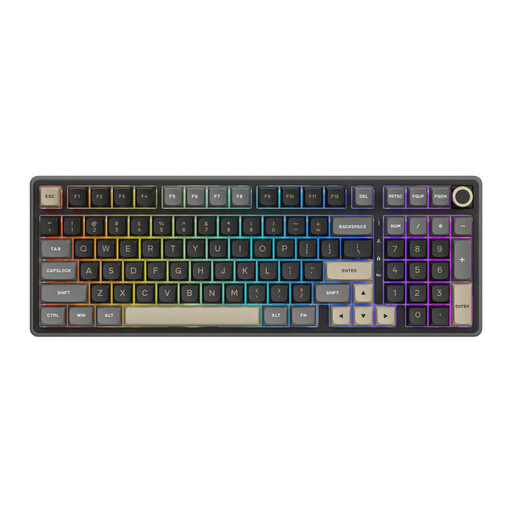
RK ROYAL KLUDGE R98 Pro wired mechanical keyboard
A good fit if you’re looking for a wired mechanical keyboard with a numeric keypad and volume knob.
The product title lists hot-swappable switches and the Beige Switch variant.
View at Joybuy
 No image available
Ticktype DP104 Tri-Mode mechanical keyboard, 108 keys, US layout
A good fit if you’re looking for a full-size mechanical keyboard and want to use a US layout.
The product title lists 108 keys and Silent Tactile Switches. Check that the US layout suits the key positions you’re used to; ‘Silent’ is a product description, not an independent sound measurement.
View at Joybuy
 No image available
Ajazz AK820 Pro 75% mechanical keyboard, Grey, Flying Fish Switch, QWERTY US
A good fit if you’re looking for a more compact layout with arrow and function keys.
The product title lists QWERTY US and wired, Bluetooth and 2.4 GHz connections. Check that the US layout suits the key positions you’re used to.
View at Joybuy
 No image available
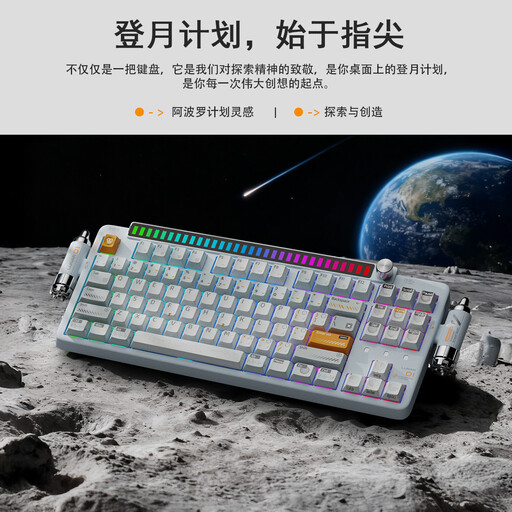
KEYSME Lunar 01 80% Tri-Mode mechanical keyboard, White, QWERTY US
A good fit if you’re looking for a compact layout with a programmable knob and several connection options.
The product title lists hot-swap switches, a programmable knob and a 4000mAh battery. Check that the QWERTY US layout suits the key positions you’re used to.
View at Joybuy
Frequently asked questions
Do I need programmable keys to use keyboard shortcuts?
No, not for using existing keyboard shortcuts. Word and Google Docs offer key combinations for their applications. Start with the commands available in your software and operating system. Remapping or automation is most useful if you want to customise or combine actions. Microsoft Support and Google Help document these shortcuts.
Why does a shortcut in a guide sometimes work differently?
The keys shown may depend on your physical layout and operating system. Microsoft Support notes that its Word shortcut guide assumes a US keyboard layout; Google Help distinguishes between Windows or ChromeOS and Mac. Check your layout, system settings and application before assuming the keyboard is faulty.
How can I set up for long writing sessions?
Take breaks from screen work and set up your workspace to suit the way you use it. Arboportaal recommends micro-breaks and varying your activities, among other things. A break indicator on a keyboard can remind you, but it can’t take the break for you.
What are my rights if a keyboard bought online isn’t suitable or breaks too soon?
For an online consumer purchase, you generally have a 14-day cooling-off period from delivery, although exceptions may apply. If a product is faulty, the seller is responsible for the statutory guarantee. In the Netherlands, this doesn’t have a fixed duration for all products; the assessment depends on what you could reasonably expect. ACM ConsuWijzer explains these rules.
Do I have to use a separate keyboard with a laptop?
This isn’t the case for every user. Arboportaal outlines requirements for employees who work at a screen for more than 2 hours a day: the screen and keyboard must not be attached to each other, and laptop users must be able to use a separate screen or keyboard. Whether these workplace requirements apply to you depends on your working situation.


