What should you look for when choosing?
First, make a note of the screen reader and development commands you use regularly. Then compare the layout, the numbers and symbols you need, and the space the keyboard takes up.
| What to consider |
What should you look for? |
Who is this important to? |
| Navigation and screen reader |
Check that your regular commands work with the available keys and key combinations. |
If I code and navigate without a mouse, I want to use the keys I’m familiar with straight away. Around 36% of consumers give direct access to navigation and screen reader commands top priority. |
| Entering code and results |
Check the exact QWERTY layout and whether you want a number pad. |
If I enter lots of programming symbols and results, I want to find characters and numbers where I’m used to them. Around 29% of consumers prioritise code, symbols and number entry. |
| Workspace and typing comfort |
Compare the dimensions and key construction, and check that the keys you need are included. |
At a small desk or when working in different places, I want to save space without losing access to the commands I use regularly. Around 21% of consumers give workspace and typing comfort top priority. |
| Legible key labels |
Decide whether you mainly need visual contrast or tactile orientation, and check for any software-specific shortcuts. |
If I read key labels as well as using speech, larger lettering and contrast may make them easier to recognise. Around 14% of consumers prioritise legible key labels. |
Keyboards at Joybuy
This selection includes keyboards for wired or wireless typing, navigation and number entry while you build a sports results website. For each version, check that the layout and features work with your screen reader commands.
 No image available
Redragon 94-key full-metal wired mechanical keyboard
A wired option if you want to type directly on a connected keyboard while building your site.
The product information lists PBT keycaps, RGB lighting, a detachable wrist rest and a hot-swappable PCB.
View at Joybuy
 No image available
HP 725 Multi-Device Rechargeable Wireless Keyboard
An option to consider if you’re looking for a wireless keyboard with programmable keys and switch between devices.
The product information lists a full-size layout, Bluetooth for two devices and a 2.4 GHz receiver for one device. It charges via USB-C.
View at Joybuy
 No image available
Trust Vaiya full-size wireless keyboard, US QWERTY
The number pad may come in handy if you regularly enter sports results.
The product information lists scissor keys, a rechargeable battery and connections to up to four devices via a USB receiver and three Bluetooth channels. The layout described is US QWERTY.
View at Joybuy
 No image available
Apple Magic Keyboard Universal, Dutch QWERTY, black
An option if you want a Dutch QWERTY layout and separate keys for number entry and navigation.
The product information lists a number pad, arrow keys and document navigation keys. The title mentions USB and Bluetooth; the description lists a rechargeable battery.
View at Joybuy
 No image available
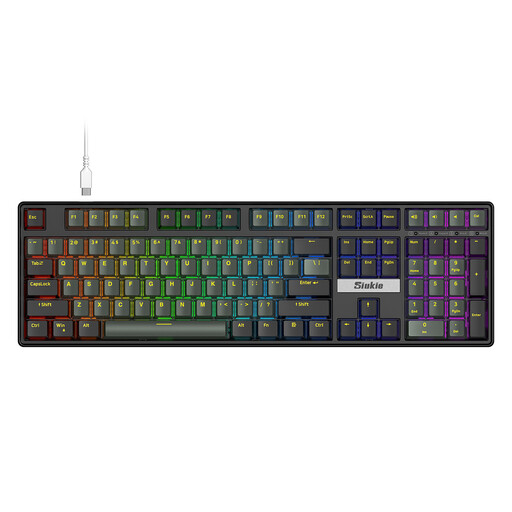
Siukie CR108 108-key wired mechanical keyboard
A wired option if you want a keyboard with a number pad for data entry.
The product information describes a full-size layout, mechanical keys, replaceable switches and a wired USB connection.
View at Joybuy
Frequently asked questions
Do I always need a separate number pad for a screen reader?
No, it’s not a general requirement. Check which keys your screen reader layout and personal commands use: a full-size keyboard has a separate number pad, while a compact layout may require different combinations or a separate pad.
How can I test whether a keyboard suits the way I work?
Go through your usual workflow in your development environment and on the results website without using a mouse. Test navigation, input and the screen reader commands you use, and check that any configured shortcuts don’t override screen reader commands. A keyboard is no substitute for building an accessible website.
Do I need to buy batteries for a wireless keyboard?
It depends on the model. Trust describes the Lyra Compact as rechargeable; check how the exact version charges and what’s included in the box.
Does my sports results website have to be legally accessible in the Netherlands?
This can’t be determined from the description ‘sports results website’ alone. Dutch accessibility requirements apply to government websites. Since 28 June 2025, accessibility requirements have also applied to certain products and services, including online shops, subject to conditions and exceptions. Whether your site falls into a particular category depends on who provides it and what visitors can do on it.
Can I return a keyboard bought online if I don’t like the layout?
When you buy from a business remotely, you’ll generally have a 14-day cooling-off period, subject to legal exceptions. The Dutch government explains this cooling-off period for distance purchases; check the terms of the specific purchase. This arrangement doesn’t apply to purchases from a private individual.


