Start with a layout you know, where you can find the navigation, function and modifier keys you need for your screen reader. Then choose according to your main priority: a conventional wired keyboard for a familiar starting point, a split model if you want to try a different typing position, or a large-print model if you can still use the key labels. If you’re considering programmable keys, first check that the configuration software is accessible within your workflow.
Who is this guide for?
Screen reader user building the website
If you mainly create and manage rehearsal pages using a keyboard, a familiar layout and easy-to-reach navigation keys are important. Koninklijke Visio explains how to use a Windows PC with NVDA via the keyboard and speech output.
Creator who types for long periods
If you write or edit a lot of rehearsal text, you can compare keyboards by key position and how familiar they feel. Logitech describes the ERGO K860 as a split keyboard designed for a different typing position; try it for yourself to see whether the layout suits your workflow.
Creator who also reads key labels
If you use your sight as well as speech, larger or higher-contrast key markings may be useful. Bear in mind that these labels will only help if you can see and use them yourself.
What should you look for when choosing?
First, check that the layout and keyboard shortcuts work with your screen reader and editor. Then weigh up typing comfort, visible markings and any reprogramming options in light of your own workflow.
| What to consider |
What should you check? |
Who might prioritise this? |
| Layout and keyboard shortcuts |
Check the physical layout, function, arrow and modifier keys, and try the screen reader commands you use. |
I want to find familiar keys quickly in my screen reader and editor. Around 36% of consumers put layout and keyboard shortcuts first. |
| Typing for long periods |
Try the hand and wrist position, and practise your usual keyboard shortcuts on any unfamiliar layout. |
If I edit long texts, I want to check that the key positions remain comfortable for me. Around 29% of consumers put typing comfort first. |
| Visible key markings |
Decide whether you can use larger or higher-contrast labels, and check that all the keys you need are present. |
I use my sight as well as speech to find keys. Around 21% of consumers prioritise easy-to-read key markings. |
| Programmable keys |
Check which browsers are supported and try using the configurator with your screen reader. |
If I want to set up my own key commands, I need to be able to configure them as part of my workflow. Around 14% of consumers put programmable keys first. |
What to watch out for
-
Choosing an unfamiliar layout without checking your keyboard shortcuts
An ANSI layout or a keyboard with a simplified layout may have different key positions or be missing keys you’re used to using.
Check the exact variant and go through the keys you need for your screen reader and editor.
You may need extra practice before you can use your regular commands fluently on a different layout.
-
Confusing large-print labels with screen reader compatibility
Visible markings and software-specific function keys are not the same as screen reader support.
Choose larger labels only if you can use them, and check any special keys against the software you actually use.
-
Buying programmable keys without trying the configurator
A programmable keyboard is not necessarily easy to configure with a screen reader.
Test the setup process before relying on customised keys for important commands.
Setting up and testing your own key commands may take extra time.
Brands to consider
Logitech
The K120 is a conventional wired full-size option; the ERGO K860 has a split design for anyone who wants to try a different key position.
- Logitech describes the K120 as a wired USB keyboard with a numeric keypad.
- The ERGO K860’s split design may take some getting used to. Logitech’s claims about typing position are manufacturer claims, not a proven outcome for every user.
CHERRY
The KC 1000 is a conventional wired full-size office keyboard with cursor and number keys.
- CHERRY lists USB-A and Windows compatibility for this model.
- According to CHERRY, this model does not have backlit keys. Check the regional variant; features of the KC 1000 do not necessarily apply to other models.
ZoomText
The ZoomText Large-Print Keyboard is designed for users who want larger or higher-contrast labels and use ZoomText or Fusion.
- The option described combines visible key markings with special keys for the named software.
- The markings are only useful if you can see them; check that the software-specific keys are compatible with your version.
Clevy
The Contrast Keyboard is an option for anyone looking for larger keys and characters with more contrast.
- Clevy describes the keyboard as having larger keys and characters.
- Clevy says some keys have been omitted to make the layout less cluttered. Check that it includes the shortcuts you need.
Keychron
The V6 8K is an example of a wired, programmable mechanical keyboard.
- For the V6 8K, Keychron lists QMK, hot-swappable switches and a full-size ANSI layout.
- The manufacturer says the web configurator supports a limited choice of browsers; its accessibility with a screen reader has not been confirmed.
Keyboards at Joybuy
These Joybuy products include a conventional wired keyboard and compact mechanical models. With compact layouts, check that the keys you use most often remain easy to reach.
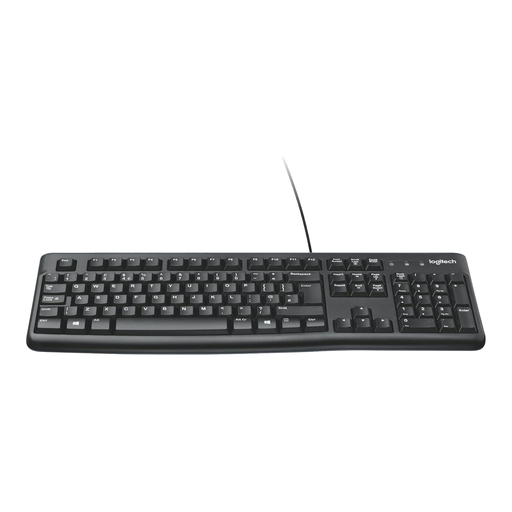 Image unavailable
Logitech K120 wired keyboard, black
Ideal if you’re looking for a familiar full-size layout with a numeric keypad.
Wired USB keyboard with a numeric keypad.
View at Joybuy
 Image unavailable
Ajazz AK820 Pro 75%, US-QWERTY
Ideal if you’re looking for a compact layout and want to check first that its different key positions work with your usual shortcuts.
The product information lists a 75% layout, US-QWERTY, arrow and function keys, plus wired, Bluetooth and 2.4G connectivity.
View at Joybuy
 Image unavailable
AULA F75 75%, US-QWERTY
Ideal if you want a compact layout; check in advance that the 75% key positions work with your usual commands.
The product information lists a 75% layout, function keys, USB-C and wireless connectivity options.
View at Joybuy
 Image unavailable
AJAZZ AK820 MAX 75%, US-QWERTY
Ideal if you want to keep arrow and function keys on a compact layout and can check the different key positions in advance.
The product name lists 75%, US-QWERTY and wired and wireless connectivity options.
View at Joybuy
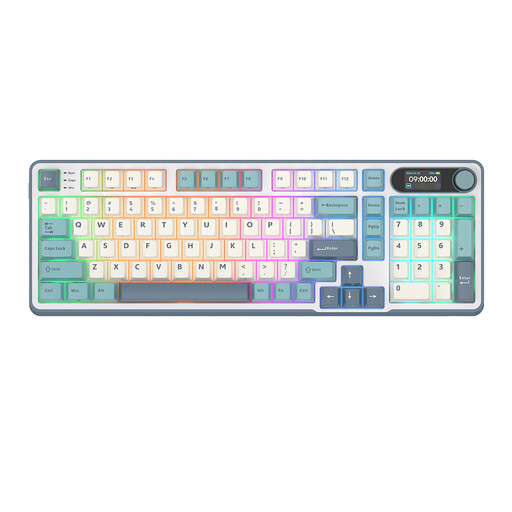 Image unavailable
RK ROYAL KLUDGE S98, 98 keys
Ideal if you’re considering a 98-key layout; bear in mind that it does not have a numeric keypad.
The product name lists a 96% layout and 98 keys. The product information lists USB-C, Bluetooth and 2.4G.
View at Joybuy
Frequently asked questions
Will a large-print keyboard automatically work better with a screen reader?
No. Larger labels only help if you can use them visually. The special keys on the ZoomText model are linked to ZoomText and Fusion; check the layout with your own screen reader too.
How should I check a new keyboard when setting it up?
Connect it according to the model’s requirements, then try the keys you use every day with your own screen reader, including navigation and modifier keys. Logitech describes the K120 as a wired USB keyboard; CHERRY lists USB-A and Windows for the KC 1000.
Do I need to buy a braille display for spellchecking?
Not necessarily. Koninklijke Visio explains that a braille display renders written text in a tactile form and can help you check spellings that are difficult to hear through speech output. Some displays can also be used for typing and navigation; that’s a separate decision from choosing a keyboard.
What can I do if I’m not happy with the keyboard layout after buying online?
According to ACM ConsuWijzer, online consumer purchases generally come with a cooling-off period of up to 14 days after delivery, although there are exceptions. This is separate from your legal right to a product that meets the required standards: according to the Dutch government, the expected lifespan depends on what you could reasonably expect from the product.
What should I consider if the website publishes choir members’ names or photos?
Before publishing, decide which personal data you need and assess the applicable legal basis. The Dutch Data Protection Authority points out that organisations must take privacy rules into account when publishing other people’s data online; your choice of keyboard does not change those obligations.


