Start by checking the physical key layout against your computer’s input layout. Test keys such as the backslash, square brackets and braces before choosing a keyboard. A compact model can free up space on a small shared desk. A wired connection is another practical option, while an adjustable split model suits anyone who wants to set the position of each keyboard half. None of these features, on its own, guarantees fewer typing errors or discomfort.
Who is this for?
Regex beginner with a desktop computer
Wants to find symbols in predictable places and edit patterns without having to second-guess the key layout. MDN Web Docs explains the special characters used in regular expressions, while Microsoft Support explains how to manage keyboard and input layouts in Windows.
Quiet typist at a shared desk
Wants to minimise disruption to others and leave enough room for a mouse and notes. Logitech and CHERRY describe features of their keyboards, but their information is not a comparable measurement of typing noise.
Typist who wants to adjust their working posture
Wants to adjust the position of their hands, wrists and keyboard during longer periods of screen work, and consider whether a split keyboard will fit in the available space. Kinesis describes the adjustable halves of the Freestyle2.
What should you look for?
First, check the physical keys and active input layout. Then consider the keyboard’s size and connection for your workspace, and decide whether you want to be able to adjust its position.
| What to consider |
What should you check? |
Who is this most important for? |
| Symbols and key layout |
Check the exact regional variant and test the backslash, brackets and braces with your computer’s input layout. |
If I want to type regex symbols without searching for them, I make sure the physical keys match the selected layout. Around 36% of consumers prioritise predictable symbol input. |
| Typing noise |
Where possible, assess the exact switch or keyboard variant. Manufacturer descriptions are not comparable sound measurements. |
At a shared desk, I want to type without unnecessarily disturbing others, but a label such as ‘quiet’ doesn’t tell me how loud the keyboard will sound in my surroundings. Around 29% of consumers prioritise low typing noise. |
| Space and connection |
Compare the dimensions and key layout with the space you need for your mouse and notes. Also check which port or connection your computer supports. |
If I move between desks, I want a keyboard that fits and is easy to connect to the computer I’m using. Space and connection are the main considerations for around 21% of consumers. |
| Adjustable working posture |
Check how much space the keyboard halves need and whether you can position your chosen setup comfortably. |
If I want to position my hands and wrists differently, being able to move the keyboard halves matters, though it takes space and may require some adjustment. Around 14% of consumers prioritise an adjustable posture. |
Common pitfalls
-
Looking only for ‘QWERTY’
A product may be available in different regional variants. The active Windows input layout may also differ from what the physical keys suggest, so symbols can appear in different places.
Check the full variant description and test the symbols you need for regex on the computer you’ll be practising on.
-
Assuming ‘quiet’ means it has been measured consistently
Manufacturers sometimes describe noise reduction or different switch variants, but these descriptions aren’t a direct comparison between models.
Check which variant is on offer and, where possible, assess the typing noise before using the keyboard in a shared space.
-
Choosing a compact keyboard without checking which keys you need
A compact design can free up space, but its key layout differs from that of a full-size keyboard. Connections vary too: a wired model may require a specific port.
Compare the key positions, available ports and dimensions of the exact model with your computer and workspace.
Brands to consider
Logitech
The MX Keys Mini is designed for a small desk and has low-profile keys. The MX Mechanical is for anyone specifically looking for a mechanical switch variant.
- Logitech describes the improved key stability of the MX Keys Mini as helping to reduce noise.
- The MX Mechanical is available with different switch variants, which Logitech says differ in feel and sound. These descriptions aren’t an independent comparison of typing noise; check the regional layout too.
CHERRY
The KC 6000 SLIM is a full-size wired keyboard for a desktop computer.
- CHERRY specifies a scissor mechanism, a USB-A connection and a length of 440 mm.
- It has a numeric keypad, so it takes up more space than a compact keyboard. The product specification doesn’t give a comparable sound measurement; check that you’re choosing the EU QWERTY version.
Keychron
The B1 Pro is a compact keyboard for anyone who wants to switch between devices or connection types.
- Keychron specifies a 75% layout, with Bluetooth, 2.4GHz and wired connections.
- Check the exact key variant when you buy; the product information provided doesn’t confirm that it comes with a Dutch layout.
Kinesis
The Freestyle2 is designed for anyone who wants to position the two keyboard halves themselves.
- Kinesis describes the halves as independently adjustable. For the PC version, a Dutch retailer lists a wired connection and an ANSI US International QWERTY layout.
- The setup needs space and may take some getting used to. An adjustable design alone doesn’t prove that any discomfort will go away.
Joybuy products
These Joybuy products are compact keyboards with an explicitly stated US layout. Check that the physical key layout suits your computer’s input settings and your preferred key positions.
 No image available
Redragon M68 Magnetic Switch Mechanical Keyboard, 68 Keys, US Layout
A compact wired option if you’re looking for a keyboard explicitly listed with a US layout.
68 keys; US layout; magnetic switches; wired connection.
View at Joybuy
 No image available
AJAZZ AK820 MAX, 75%, 82 keys
A compact wired option if you’re looking for a keyboard with a 75% layout.
75% layout; 82 keys; wired connection; magnetic switches.
View at Joybuy
 No image available
AJAZZ AK820 75%, US-QWERTY, Linear Switches
A wired option if you’re looking for a compact keyboard explicitly listed with a US QWERTY layout.
75% layout; 83 keys; wired; hot-swappable linear switches.
View at Joybuy
 No image available
KEYSME Lunar 01, 80%, Tri-Mode, US Layout
An option if you’re looking for an explicitly stated US layout and a choice of connection types.
80% layout; US layout; Bluetooth, 2.4 GHz and wired connection; 4000mAh battery.
View at Joybuy
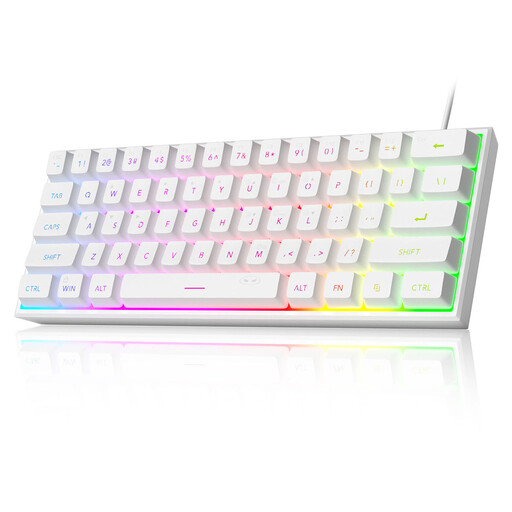 No image available
MageGee TS91, 60%, 61 keys, US-QWERTY
A compact wired option if you’re looking for a keyboard explicitly listed with a US QWERTY layout.
60% layout; 61 keys; wired; membrane keys with a mechanical feel, according to the product description.
View at Joybuy
Frequently asked questions
Why don’t regex symbols appear where they’re shown on my keyboard?
Check whether the active input layout matches the physical key layout. Microsoft Support explains how to add and change input layouts in Windows. Then test the characters you need, such as the backslash and brackets. A different setting doesn’t automatically mean you need a new keyboard.
How do I keep a shared keyboard clean?
Switch off the keyboard or unplug a wired model before cleaning it, and follow the instructions for your model. Logitech recommends switching off or unplugging its keyboards as the first step in its cleaning instructions; this advice doesn’t automatically apply to every other brand.
What if a keyboard I bought online isn’t right for me or becomes faulty?
For eligible online purchases by consumers in the Netherlands, the Dutch government says you’ll often have a 14-day cooling-off period. Faulty products are also covered by the statutory guarantee: the Netherlands has no fixed statutory guarantee period, and the seller must offer a solution when a claim is valid. Check the terms and conditions and who the seller is.
Is a separate keyboard legally required when working on a laptop?
Not for every buyer or working situation. According to the Dutch Arboportaal, for an employee who works at a screen for more than 2 hours a day, the screen and keyboard must not be joined together. When using a laptop, that employee must therefore be able to use a separate screen or keyboard. This isn’t a general product specification for all keyboards.


