
Proofreader working alongside colleagues
You’re reading a report and typing comments while someone is working nearby. Trust and CHERRY describe certain models as quiet, but their typing noise has not been compared like for like here.


Start by deciding what matters most at your shared desk: keeping typing noise to a minimum, having more space, keeping a numeric keypad or switching between devices. A compact keyboard can free up desk space, while a full-size model keeps the numeric keypad; also check that your computer supports the connection and keyboard layout you need. Descriptions such as ‘quiet’ are manufacturer claims, not the result of a like-for-like noise comparison.
You’re reading a report and typing comments while someone is working nearby. Trust and CHERRY describe certain models as quiet, but their typing noise has not been compared like for like here.
You have little room for a keyboard and mouse, and rarely use the numeric keypad. A model without an integrated numeric keypad may fit your available space better; CHERRY describes its TKL model as more compact than the version with a numeric keypad.
You take your keyboard with you or switch between permitted devices. In that case, its size, available connections and ability to switch between devices are all relevant; Trust describes these options for the Lyra Compact.
First decide whether noise, desk space, the numeric keypad or connecting to multiple devices is your priority. Then check that the connection and keyboard layout are suitable for your shared workspace.
| What to consider | What should you check? | Who might it matter more to? |
|---|---|---|
| Key noise | Check the description of the exact model. Don’t treat a quietness claim as a decibel guarantee unless it is backed by comparable measurements. | If colleagues are working nearby, I mainly want my typing to disturb them as little as possible. Around 33% of consumers prioritise quiet typing. |
| Desk space | Check whether the model has a numeric keypad and whether its dimensions leave room for your mouse and documents. | If I have little room beside my mouse and rarely use the numeric keypad, a compact model may be a better fit. Around 27% of consumers prioritise saving space. |
| Connecting and switching | Check which USB ports are available, whether Bluetooth is supported and what the work computer’s pairing policy allows. | If I switch between permitted work devices, I want a connection that works at my desk. Around 20% of consumers prioritise connecting to or switching between devices. |
| Working posture and keyboard layout | Consider whether the key layout suits the way you type. Also look at your screen, chair and desk; a keyboard cannot adjust your entire workspace on its own. | For longer proofreading sessions, I want a layout that feels comfortable to use and suits my workspace. Around 20% of consumers prioritise this consideration. |
Trust and CHERRY use descriptions that suggest their keyboards are quiet, but these do not provide directly comparable noise measurements.
First choose the size and connection that suit your workspace. Treat quietness as the manufacturer’s description, not as a comparison between models.
The CHERRY STREAM KEYBOARD TKL does not have an integrated numeric keypad, whereas the Trust Ody II does, according to its product information.
Think about how many numbers you enter when proofreading reports before choosing a compact size. Also check which navigation keys the model has.
The Trust Ody II uses a USB receiver; Trust also lists Bluetooth for the Lyra Compact. These connection options are not the same.
Check which ports or Bluetooth connection are available on the exact model, and whether pairing is permitted on your work computer.
CHERRY offers the STREAM KEYBOARD and the more compact STREAM KEYBOARD TKL, both with SX scissor switches. CHERRY describes the typing action as quiet.
The Ody II is a full-size keyboard with a USB receiver; the Lyra Compact is designed to be more compact and connect to multiple devices.
Logitech describes the MX Keys S as a full-size keyboard with backlighting and the ability to switch between up to three devices. Logitech lists the MX Keys Mini as a more compact alternative.
The Compact Break range focuses on compact keyboards with a break indicator. According to R-Go, both wired and wireless versions are available.
This selection includes compact wired models and wireless keyboards with or without a numeric keypad, suitable for proofreading reports at a shared desk.
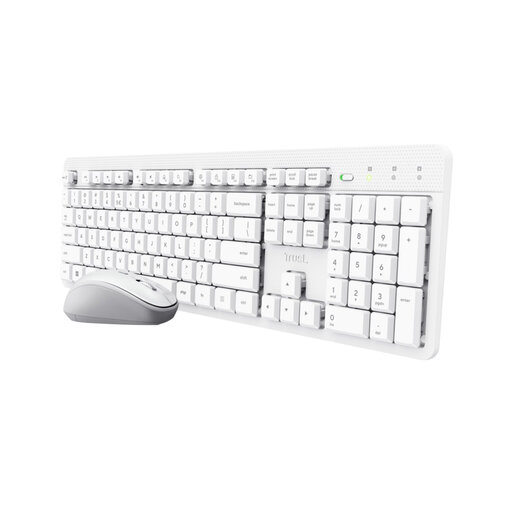 Image unavailable
Suited to anyone who wants to type wirelessly and prefers a full-size layout with a numeric keypad; Trust describes the keys as quiet.
Wireless connection via USB receiver.
 Image unavailable
Suited to anyone looking for a compact keyboard and wanting to switch between permitted devices; Trust describes the scissor keys as quiet.
Connects via USB receiver or Bluetooth; according to Trust, it can connect to up to three devices.
The product name specifies QWERTY US English. Check that this layout suits your work.
 Image unavailable
Suited to anyone who wants to keep the full-size layout with a numeric keypad and switch between multiple devices.
USB receiver and Bluetooth; the product description lists support for up to four devices and a rechargeable battery.
The full-size design takes up more desk space than a compact keyboard.
 Image unavailable
Suited to anyone looking for a more compact wired mechanical layout who doesn’t need an integrated numeric keypad.
75% layout with 83 keys, US QWERTY, linear switches and hot-swap, according to the product name.
The description specifies a wired connection; check that your work computer supports it.
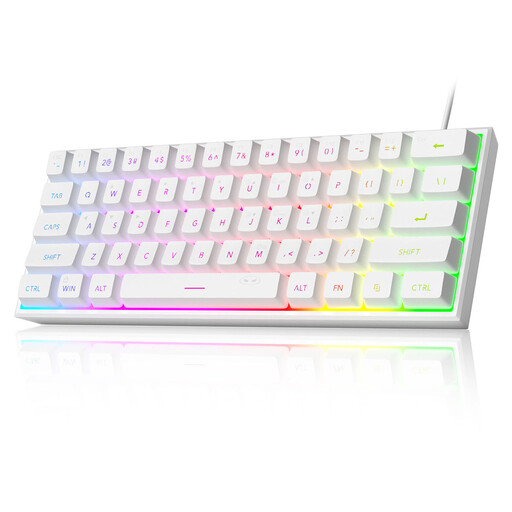 Image unavailable
Suited to anyone short on desk space who wants a compact wired model; according to the product description, it has no numeric keypad.
The product name specifies 60%, 61 keys, US QWERTY and RGB lighting.
The description lists membrane keys with a mechanical feel. Check that the compact layout suits your work.
Not in every situation. According to Arboportaal, rules apply to employees who do screen-based work for more than two hours a day, including a requirement that the screen and keyboard must not be attached to one another. Discuss the set-up of a shared workspace with your employer; this requirement is not a general purchasing rule for everyone.
First check which connections and pairings are permitted at your workspace. The CHERRY STREAM KEYBOARD TKL is wired; the Trust Ody II uses a USB receiver, and Trust also lists Bluetooth for the Lyra Compact. Whether the work computer allows these connections depends on the ports available and your workplace policy.
No. A keyboard cannot set up your entire workspace on its own. Arboportaal outlines requirements for screen-based work; the break indicator on the R-Go Compact Break is a manufacturer-described aid, not a replacement for setting up your workspace properly.
For distance purchases from a business, the Dutch government lists a 14-day cooling-off period. Before ordering, check who the seller is and what information about returns is included with the offer.
For radio equipment covered by the Radio Equipment Directive, EU rules set requirements relating to safety, electromagnetic compatibility and spectrum use, among other things. This does not in itself mean that a specific offer complies with those requirements; check the information for the exact wireless model. Don’t automatically assume these radio-specific rules apply to a keyboard that is wired only.