
Programmers who enter lots of test values
If you regularly enter amounts and other figures, you may appreciate a separate number pad and easy access to programming symbols.


A full-size keyboard is a good fit for programming and testing a savings interest calculator if you regularly enter numerical test values. A compact model makes more sense if desk space matters more and you rarely use a number pad. A split keyboard may suit you if you want to adjust your hand position, but it takes some getting used to and you’ll need to consider your whole workspace.
If you regularly enter amounts and other figures, you may appreciate a separate number pad and easy access to programming symbols.
The position of your keyboard, hands and mouse all matter. Assess your whole workspace, not just the keyboard’s shape.
Typing noise may matter in a shared space. If you move between workspaces, connecting to different computers may also be a consideration.
Start with the keys you need for numbers, code and navigation. RTINGS highlights easy access to features such as a number pad, arrow keys and function keys when choosing a keyboard for programming. Your workspace, typing noise and switching between devices can help narrow down your choice further.
| What to consider | What to look for when buying | Who should give this extra thought? |
|---|---|---|
| Numbers, code and navigation | Check the physical ANSI or ISO layout, your computer’s configured software layout, and whether the keyboard has arrow keys, function keys and a number pad. | When entering amounts and checking tests, I want easy access to numbers, symbols and navigation keys. Around 36% of consumers make layout and test input their top buying priority. |
| Posture during long sessions | Consider the position of your keyboard and mouse, the height and the space available; see if you can try out a split layout. | If I type for long periods, I want to position my keyboard and mouse so my whole workspace suits me. Around 29% of consumers prioritise posture. |
| Typing noise in a shared space | Check the mechanism on the exact model and, if possible, try it out in the space where you work. | In a shared workspace, I want to consider typing noise without assuming that every mechanical keyboard sounds the same. Around 21% of consumers prioritise typing noise. |
| Connections and switching between devices | Check the supported operating systems, connections and features of the exact model. | If I switch between computers, I want to know which connection options and device-switching features my keyboard supports. Around 14% of consumers make switching between devices their top priority. |
Physical ANSI and ISO layouts differ, and your computer’s configured layout also affects how you enter characters. The QWERTY label alone doesn’t tell you where to find every coding symbol.
Compare the photo and specifications of the exact model with your computer’s layout. Also check the symbols you often use for code and Dutch text.
A TKL model has no number pad, and more compact layouts may make other keys less accessible too.
Run through a typical work session involving amounts, test cases, arrow keys and editor commands before choosing a layout.
A split keyboard won’t automatically adjust your workspace or change how you break up your screen-based work.
Assess your whole setup and try out the position of a split model if you’re considering that layout. The Dutch Working Conditions Portal (Arboportaal) also advises changing posture during screen-based work and taking regular micro-breaks.
Keychron makes mechanical models for anyone looking for a particular layout or programmable keys.
The MX Keys S is a low-profile wireless keyboard for anyone who wants to switch between work devices.
The wired STREAM KEYBOARD range includes a full-size model and a TKL version without a number pad.
The Freestyle2 is an example of a keyboard with two halves that can be positioned separately.
The Split Break v2 is a model with separately positionable halves and a break indicator.
This selection includes compact layouts, full-size models with a number pad and options for use with multiple devices.
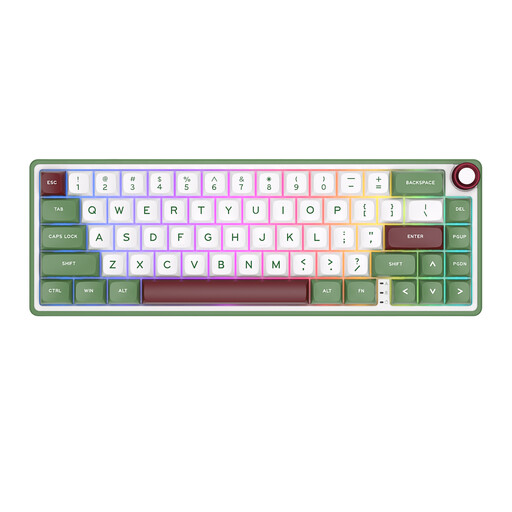 Image unavailable
The compact layout may suit you if you want to save space and customise keys for editor commands.
The product name specifies a wired mechanical layout with 66 keys, RGB lighting and hot-swappable Chartreuse Switch.
The product description mentions QMK/VIA and programmable keys; check that the layout and connection suit your computer.
 Image unavailable
The compact US layout may suit you if you need to save desk space and its physical layout matches your computer.
The product name specifies magnetic switches and a metal top plate. Check where the coding symbols you use most often are on the exact model.
 Image unavailable
This model may suit you if you’re looking for a wireless keyboard for multiple devices with programmable keys.
The product description specifies a full-size layout and USB-C charging. Check which connections and features are available on the model on offer.
 Image unavailable
A full-size keyboard with a number pad may suit you if you enter figures often and want to switch between devices.
The product description specifies scissor-style keys and connections to up to four devices. Check that the US layout matches your computer’s settings.
 Image unavailable
The 75% layout may suit you if desk space is a priority and you’re looking for a wired keyboard.
The product name specifies hot-swappable linear switches and PBT keycaps. Check that the US layout works for the coding symbols you use.
Compare the physical ANSI or ISO layout with the one you set on your computer. Check the characters you need for both code and Dutch text on your own setup; the QWERTY label doesn’t tell you where to find every character.
It depends on the model and feature. Logitech says the MX Keys S can switch between up to three devices. To customise certain functions, such as lighting settings, Logitech specifies Logi Options+. Check compatibility for the exact model.
The Dutch Working Conditions Portal (Arboportaal) advises changing posture during screen-based work, adjusting your workspace and taking regular micro-breaks. A different keyboard can be part of your setup, but it can’t guarantee that you’ll avoid discomfort.
For online purchases made by consumers from businesses, a 14-day cooling-off period applies in many cases, although exceptions may apply. Products must also be fit for purpose. According to the Dutch government, statutory guarantee in the Netherlands has no fixed time limit, and the retailer is your point of contact if something goes wrong.
The Dutch Authority for Digital Infrastructure states that electrical and electronic equipment must carry the correct CE marking. Also check the instructions and specifications for the exact model. If you’re unsure about the marking, contact the retailer.