
Two players at one keyboard
You want to practise at the same time, so you’ll need to check that the two-player layout works for both parts.


To play together on one instrument, you need a confirmed duet mode; to practise on your own with a recorded partner part, you’ll need a suitable recording and playback function. Then compare the notes in both parts with the available key range, and measure the space needed for the instrument, music stand and players. A compact keyboard takes up less width, while a digital piano may offer 88 keys and a different key action.
You want to practise at the same time, so you’ll need to check that the two-player layout works for both parts.
You play one part and want to hear the other; your own recordings are different from parts in built-in songs. Yamaha describes recording functions for the PSR-E383 and PSR-EW320; Casio describes part selection for built-in songs on the CT-S400.
You’re looking for a suitable range and touch response, but you also need to be able to use the instrument quietly and set it up practically.
First decide whether you’ll play together or want to listen back to a part you’ve recorded yourself. Then check the required key range and the space needed for the complete setup.
| Point to consider | What to look for when buying | Who is this important for? |
|---|---|---|
| Playing two parts at once | Compare the lowest and highest notes in both parts with the exact split-keyboard layout. | If you’re playing together on one instrument, the layout needs to work for both parts. Around 36% of consumers say playing together at the same time is their main consideration. |
| Listening back to your own part | Check whether you can record and play back your own part while playing live; built-in practice songs are not the same thing. | If you practise alone, you’ll want to be able to hear the partner part you’ve played yourself. Around 29% of consumers put this need first. |
| Quiet, compact setup | Measure the space needed for the instrument, music stand and players, and check the number and type of headphone sockets. | If your practice space is small or you want to play with headphones, the width and connections are key. Around 21% of consumers prioritise these practical requirements. |
| Key range and touch response | Check the lowest and highest notes in the score, and try the key action on the exact model if possible. | If you need a wide range and piano-style touch, an 88-key model also needs to fit in your space. Around 14% of consumers make range and touch response their main criteria. |
Duet mode splits a single keyboard. If a part includes notes outside the range of its section, you won’t be able to play that part as written.
Before buying, compare both parts with the exact split layout of the model you’re considering.
For the CT-S400, Casio describes selecting left- or right-hand parts in built-in songs. This doesn’t confirm that you can record and play back a duet part you’ve played yourself. Yamaha lists recording functions separately for the PSR models covered here.
Choose based on the source you want for the partner part, and check that recording and playback work while you’re playing live.
You’ll also need room for a second player, music stand and any stand you’re using. Connections also vary by model.
Measure the entire setup and check the connections and included accessories for the specific offer.
Depending on your setup, you may need a suitable stand, headphone adaptor or an extra pair of headphones.
Yamaha lists 61 keys and duet mode for the PSR-E383, and 76 keys, duet mode and two recording tracks for the PSR-EW320.
According to Roland, the FP-30X has 88 PHA-4 keys and two headphone outputs.
For the CT-S400, Casio describes selecting left- or right-hand parts and adjusting the tempo of built-in songs.
Korg specifies that the B2 has a weighted 88-key keyboard and is 1.312 mm wide.
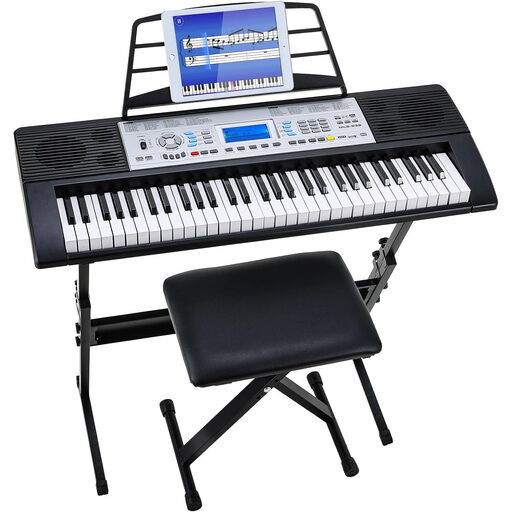
This Joybuy product selection focuses on a 61-key keyboard set for practising with a more compact setup.
 No image available
This set may suit you if you’re looking for a 61-key keyboard; check that its range covers both parts of your duet.
The product information lists 500 built-in sounds and a three-level learning function.
Before buying, check that the specific keyboard and its power supply meet the applicable EU safety requirements and carry the required CE marking.
Not necessarily. Casio describes duet mode as dividing the keyboard into two sections with the same pitch range and tone. Check how it works on the exact model version and compare the layout with the notes in both parts.
Remember to allow space for the music stand and players too. Check that your headphones fit the socket: Yamaha lists one PHONES/OUTPUT socket for the PSR models covered here, while Roland lists two headphone outputs for the FP-30X.
According to the Dutch government, you’re entitled to a product that works as it should, and there is no fixed statutory warranty period in the Netherlands. If a product is faulty, contact the seller; any additional manufacturer’s warranty doesn’t replace these rights.
According to the Dutch government, you generally have 14 days to change your mind when buying at a distance. Check the terms and any exceptions that apply to your purchase.
According to the Dutch government, electronic devices sold on the EU market must meet the applicable safety requirements and carry the required CE marking. Check this for the specific keyboard and its power supply; a brand name alone doesn’t prove compliance.