
Writer with a cluttered desk
You write alongside a mouse, notes or printed scenes, and want to know how much usable space the keyboard will leave.


Start by looking at the space available on your desk and the keys you use when writing and revising scenes. A compact keyboard can leave more room for your mouse and notes, but check that the navigation keys are still easy for you to reach. Then consider the connection, layout, posture and noise in your writing space; there’s no one choice that suits every writer.
You write alongside a mouse, notes or printed scenes, and want to know how much usable space the keyboard will leave.
You move text around and navigate between scenes during revisions. The arrow keys and function keys you use may matter more than having the smallest possible keyboard.
You take your posture, breaks and noise levels for others into account, and consider the keyboard as part of your overall workspace.
First measure the free space on your desk, then check which keys you want to have within easy reach while writing and revising.
| Consideration | What to look for | Who might prioritise this? |
|---|---|---|
| Desk space | Measure the available width and depth, including space for your mouse. Compare the dimensions of the exact version and check whether it has a number pad. | If I want to keep my script, notes and mouse beside the keyboard, I start with the space available. Around 29% of consumers give desk space top priority. |
| Writing and revising scenes | Check the arrow keys, function row and any keys or key combinations used by your writing software. Make sure the key labels also match your chosen input layout. | When rewriting, I want to move quickly between scenes without having to search for the functions I need. Around 23% of consumers prioritise direct access to revision keys. |
| Posture | Consider the position of your keyboard, mouse and screen together. Factor in changing your position and taking breaks when planning your workspace. | If I’m planning long writing sessions, I look at my whole set-up, not just the keyboard’s dimensions. Around 18% of consumers prioritise posture during long sessions. |
| Noise in a shared space | Check the mechanism used in the exact version and, if possible, try the keyboard in a similar setting. Don’t rely on terms such as ‘quiet’ or ‘mechanical’ alone. | When other people are working in the same room, I want to know what the keys sound like before choosing a mechanism. Around 18% of consumers give reducing typing noise top priority. |
| Connection and compatibility | Check which USB-A or USB-C ports are available, whether Bluetooth is supported and whether there are any system requirements. Decide whether you want to switch between devices. | If I want to use the keyboard with my own computer or several devices, I check the connection and required support first. Around 12% of consumers put connection and compatibility at the top of their list. |
Compact keyboards vary in layout and connection. A smaller keyboard isn’t automatically more comfortable if you often use navigation keys while rewriting.
Check the exact key layout, how easy the keys you need are to reach, and how much room will be left for your mouse.
The standard Magic Keyboard (USB-C) and versions with Touch ID or a number pad are different models, with their own features and system requirements.
Compare the full product name and the details of the version you’re considering.
Descriptions of mechanisms or quiet typing don’t provide comparable measurements of the noise made by different versions.
Check the mechanism used in the exact version and, if possible, try typing on it in a similar setting.
The Lyra is a compact wireless option to compare if you want to switch between devices at a small desk.
The UltraBoard 950 V2 is a compact wired option to consider if a fixed connection and room for your mouse are important to you.
The KW 7100 MINI BT is a compact option for anyone who wants to switch between devices wirelessly.
The standard Magic Keyboard (USB-C) in the Dutch version is worth comparing if you use a compatible Mac.
The K3 Version 2 is a compact mechanical option to compare if you’re considering a 75% layout with both Bluetooth and wired connectivity.
This selection includes compact keyboards for a small workspace, including models to consider if you’re looking at a mechanical layout. Check the key layout for each version, and make sure the keys you need for revisions suit the way you work.
 No image available
The 75% layout is worth comparing if you want to free up desk space. Check that the US layout suits your input settings.
QWERTY US layout; wireless mechanical keyboard; PBT keycaps.
 No image available
The 75% layout is worth comparing if you’re looking for a compact design. Check that the US layout and connection options suit your computer.
QWERTY US layout; three connection options; hot-swappable switches.
 No image available
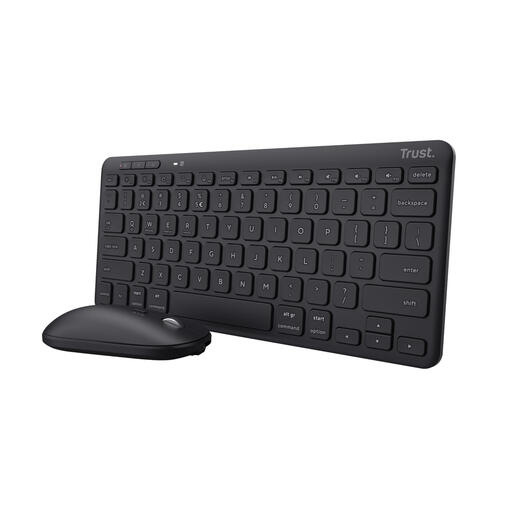
A keyboard and mouse set could be a good fit if you’re looking for both for a compact workspace. Check the US layout and that the set connects to your devices.
Compact wireless set; rechargeable; QWERTY US layout.
 No image available
The compact layout is worth considering if you want to save space and are looking for a mechanical keyboard. Check the US layout and which connection mode suits your device.
QWERTY US layout; wired, Bluetooth and 2.4G connections; hot-swappable switches.
 No image available
The compact Huntsman Mini is worth comparing if desk space matters to you. Before choosing, check how easily you can reach the keys you use to revise your script.
Not necessarily. First measure the space available, then check whether the arrow keys, function row and other keys you use for revisions are easy to reach directly or through key combinations you’re happy with. The Keychron K3 Version 2 is one example of a 75% layout with a function row, according to Keychron.
First check the physical key layout and the input layout set up on your computer. Microsoft Support explains how to view and change installed input layouts in Windows; changing a software setting won’t change the labels on the keys.
No. The Dutch Arboportaal recommends varying your tasks, regularly looking away from the screen and taking microbreaks when working with a screen. It also advises you to consider your overall workspace. A compact keyboard can be part of your set-up, but it doesn’t replace these considerations.
Not necessarily. According to the Dutch government, you have statutory rights against the seller if a product is faulty, and the Netherlands has no fixed statutory warranty period. Before deciding, check what additional cover a paid warranty provides.
No, this isn’t a general requirement for every private buyer. The Arboportaal outlines rules for employees who spend more than two hours a day working with a screen: the screen and keyboard must be separate. This workplace rule doesn’t automatically apply to everyone writing at home.