Which option is right for you?

Practising melodies on a standalone instrument

If you want to practise a film theme without a computer, you can weigh up built-in sounds, key response and how easy the instrument is to put away. Yamaha and Casio describe specific standalone keyboard models with touch-sensitive keys and built-in sounds.

Learning a piano part

If you mainly want to practise a piano part with both hands, compare the range of the score, the key action and the width of the setup. Roland and Korg describe digital pianos with 88 keys, but with different key actions.

Creating a film sound with software

If you want to enter notes and use virtual instruments, a MIDI controller is most useful when paired with a suitable computer, software and audio setup. Arturia describes the MiniLab 3 as a controller for use with software instruments.

What should you look for?

Standalone keyboard

Best if: you want to practise a melody or simplified arrangement straight away, without a computer.

Bear in mind: compare the lowest and highest notes in your arrangement with the keyboard’s range. Built-in sounds won’t necessarily include the specific sound of a film score.

Digital piano

Best if: you mainly want to practise a piano part with both hands on a larger keyboard, and you have enough space.

Bear in mind: compare the key action of each model individually and measure the space available for the instrument, player and setup.

MIDI controller with software

Best if: you want to play or edit the theme using software instruments and already have a suitable computer setup.

Bear in mind: a controller won’t necessarily produce sound on its own like a standalone keyboard; check that its key format suits your arrangement.

What to considerWhat should you check?Who should pay particular attention?
Melody and sounds Check the range of your arrangement, the key response and whether you want to practise without a computer. Yamaha lists 61 touch-sensitive keys and built-in sounds for the PSR-E383. I want to play a melody straight away and choose the sound myself; around 36% of consumers say practising melodies straight away is their main concern.
Space and private practice Measure the space for the instrument and player, and check for a headphone socket. Casio gives the CT-S300’s dimensions as 930 × 256 × 73 mm; Korg lists the Liano as 1,282 × 290 × 73 mm, excluding the music rest. If my room is small or I want to put the instrument away after practising, dimensions and the option to listen through headphones matter a lot; around 29% of consumers say space and private practice are their top priorities.
Piano range and key response Compare the lowest and highest notes in the score and the key action. Roland lists the FP-10 with an 88-key PHA-4 Standard keyboard; Korg describes the Liano as having an 88-key LS keyboard with touch response. I mainly want to learn a piano part with both hands, so I pay attention to both range and feel; around 21% of consumers put piano range and key response first.
Software and MIDI Decide whether you want to enter MIDI notes or record the instrument’s sound; check which connections and software features are listed for each model. If I want to edit notes in software or use virtual instruments, the computer setup is part of my decision; around 14% of consumers give software production top priority.

Easy-to-miss buying considerations

  • Choosing based only on the number of keys

    Instruments with 61 keys and models with 88 keys don’t necessarily have the same key action or setup. A piece may also extend beyond the range of the keyboard you choose.

    Compare the lowest and highest notes in your piece, the key action and the dimensions of the space where you’ll set it up separately.

  • Mistaking a MIDI controller for a standalone keyboard

    For the MiniLab 3, Arturia describes software and audio setup for using software sounds. This means the controller isn’t necessarily suitable for playing without a computer.

    Choose this option if you want to work with software; if you want to practise straight away without a computer, compare instruments with built-in sounds.

  • Measuring only the instrument itself

    The listed dimensions of the Korg Liano don’t include the music rest. Korg also says that the stand is sold separately.

    Allow space for the music rest, chair, player and any stand too.

Brands to compare

Yamaha

The PSR-E range is a good place to start when comparing standalone keyboards with built-in sounds and lesson features.

  • Yamaha lists 61 touch-sensitive keys, accompaniment styles and USB audio/MIDI for the PSR-E383.
  • Check that the notes in your arrangement fit on the keyboard; these features don’t necessarily apply to other Yamaha models.

Casio

The Casiotone CT-S300 is worth considering if you want a standalone keyboard that you can move around regularly.

  • Casio lists the CT-S300 as 930 mm wide, weighing 3.3 kg, with touch response.
  • The description of its sound quality is Casio’s own claim, not an independent listening assessment.

Roland

The FP-10 is a digital piano for anyone who prioritises piano playing and a larger keyboard over the most compact possible setup.

  • Roland lists the FP-10 with 88 keys featuring PHA-4 Standard action, built-in speakers, headphone use and a metronome.
  • Make sure you have enough space for the instrument and player; claims about how it feels to play come from Roland.

Korg

The Liano is an 88-key alternative to compare if you want a full range in a slim instrument.

  • Korg lists a touch-sensitive LS keyboard, a headphone socket and a width of 1,282 mm.
  • The LS keyboard is different from the PHA-4 Standard keyboard on the Roland FP-10; Korg says the stand is sold separately.

Arturia

The MiniLab 3 represents the controller option for anyone who wants to edit a film theme using software instruments.

  • Arturia lists 25 mini keys, included software and MIDI control.
  • To use software sounds, you’ll need to set up your computer, software and audio output; this is a controller option, not a recommendation for a standalone keyboard.

Joybuy keyboards for practising melodies

This selection focuses on standalone 61-key keyboards with built-in sounds for practising melodies.

MLS-931 digital piano with 61 keys, black

MLS-931 digital piano, 61 keys

Suitable if you want to practise melodies using built-in sounds and connect headphones.

The product description lists 61 touch-sensitive, weighted keys, 300 sounds, speakers and a headphone socket.

View at Joybuy

Electronic keyboard piano with 61 keys, speakers and music rest

Electronic keyboard piano, 61 keys

A standalone option to compare if you want to practise melodies with built-in sounds.

The product title lists a recording function, metronome, MIDI controller function, speakers and music rest; the description mentions a headphone socket and a three-step learning system.

View at Joybuy

Digital keyboard piano with 61 keys, stand, stool and music rest

Digital keyboard piano, 61 keys, set with stand and stool

This set is a good option to compare if you want a keyboard with a range of sounds and a learning mode.

The product title lists 300 tones, 300 rhythms, a three-level learning mode, a stand, stool and music rest.

View at Joybuy
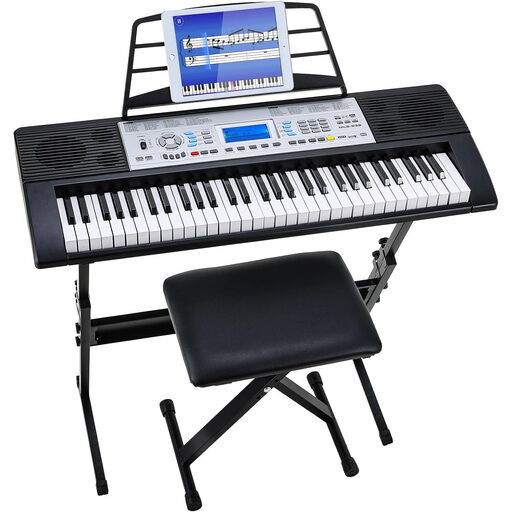
Digital keyboard with 61 keys, stand and stool

Digital keyboard, 61 keys, set with stand and stool

A standalone option to compare if you want to practise in a structured way using built-in sounds.

The product title lists 500 sounds, a three-level learning mode, a stand and a stool. According to the product description, use only the supplied 100–240 V adapter and make sure the stand is securely fastened.

View at Joybuy

Frequently asked questions

Are 61 keys enough for my film theme?

It depends on the arrangement you want to play. Compare its lowest and highest notes with the range of the exact instrument: Yamaha says the PSR-E383 has 61 keys, while Roland lists 88 keys for the FP-10 and Korg lists 88 for the Liano. A complete piano part may call for a different option from a single melody.

How do I set up for practising with headphones?

Before buying, check the connections on the exact model and allow space for a music rest and seat too. Korg lists a headphone socket for the Liano and gives its dimensions excluding the music rest; Roland describes headphone use with the FP-10. Follow the instructions for connecting, power and volume in the manual for your chosen model.

Can a MIDI controller play a film theme on its own?

Don’t assume that it can. Arturia describes the MiniLab 3 as a controller and provides instructions for connecting to a computer and setting up audio output to use software sounds. If you want to get started without a computer, compare standalone instruments with built-in sounds.

Who can help if an instrument I bought online is faulty, and can I change my mind?

According to the Dutch government, if a product is faulty, the seller must provide a solution; in the Netherlands, there is no fixed statutory guarantee period that applies to all products. When you buy online from a business, you’ll usually have 14 days to change your mind, although exceptions apply. Before ordering, check who the seller is and which returns information applies to your purchase.

Is a CE logo on a keyboard a certification mark?

No. The European Commission explains that, where applicable EU rules require it, CE marking indicates the manufacturer’s declaration of conformity; there is no central EU body that issues a general CE certificate. The rules that apply depend on the specific product.
