
Sorting photos around colleagues
You sort or describe photos while other people work nearby. The sound of your keyboard and mouse at your desk may therefore influence your choice.


Start with your day-to-day work: a standard keyboard described as quiet may suit you if colleagues sit nearby, programmable keys can be useful for repeated tasks, and a compact model can free up space for your mouse. Also check the connection, key layout and any software requirements. None of these features automatically makes a keyboard suitable for every photo application.
You sort or describe photos while other people work nearby. The sound of your keyboard and mouse at your desk may therefore influence your choice.
You repeat tasks in photo or publishing software and want to check whether keyboard shortcuts or customisable keys work with your software and office computer.
You often switch between your keyboard and mouse, or have your eye on a compact keyboard. How many keys you need close to hand is also worth considering.
Suitable if: colleagues sit nearby and you mainly use existing keyboard shortcuts.
Bear in mind: terms such as ‘quiet’ are not based on comparable sound measurements; check the connection and layout too.
Suitable if: you regularly carry out the same tasks in supported software.
Bear in mind: features may depend on the software and the permissions on your office computer. A full-size model takes up more desk space than a compact keyboard.
Suitable if: you want to keep space free for your mouse and don't need a dedicated number pad.
Bear in mind: fewer keys are close to hand, and the typing sound of mechanical models may not be suitable for a shared space.
| What to consider | What should you check? | Which consumers is this important for? |
|---|---|---|
| Typing sound | Compare the sound of the keys and mouse clicks at your intended workstation; check the connection and physical layout too. | If colleagues sit nearby, I want to avoid typing and clicking becoming an unnecessary distraction. Around 36% of consumers put quiet working at the top of their purchase priorities. |
| Keyboard shortcuts | Check the shortcuts available in your photo app and whether you’re allowed to use any customisation software on your office computer. | For repeated tasks, I want to know whether my software and work computer support the features. Around 29% of consumers prioritise repeat tasks. |
| Mouse space and size | Check whether you need a number pad and whether the keyboard and mouse will both fit at your workstation. | If I often switch between the mouse and keyboard, space for both matters. Around 21% of consumers prioritise mouse space and comfort. |
| Connection and layout | Check the available USB ports or Bluetooth support, along with the exact physical key layout of the version you’re considering. | Before choosing, I want to be sure the connection and layout suit my computer and everyday typing. Around 14% of consumers put connection and layout first. |
Trust and CHERRY describe their keys as quiet, but these descriptions don’t provide comparable sound measurements.
Consider your shared workspace and, where possible, assess both keyboard noise and mouse clicks in your intended set-up.
Customisable keys and actions are only useful if they work with your application and you can set them up on your office computer.
First, check the shortcuts in your photo app and, if necessary, ask whether additional keyboard software is allowed.
Keyboards can vary in their connection, size and physical layout. A model name alone won’t always tell you which version you’re looking at.
Before buying, check the full model and version name, connection and key layout.
The Ody II is a wireless standard keyboard that Trust positions for office work.
The MX Keys S is a full-size option for those who want to customise keys for repeated computer tasks.
The wired STREAM KEYBOARD is designed for conventional office typing.
The Compact Break is a compact option for those who want to position their mouse closer to the keyboard.
The K3 Max is a compact mechanical model for those who want to customise key functions.
This selection includes compact keyboards and keyboard-and-mouse sets for workstations where size, connection or sound may be a consideration.
 Image unavailable
The compact 75% layout may suit you if you want to keep space free for your mouse.
The product details list tri-mode connectivity, USB-C, hot-swappable switches and saved macro settings. The description of sound-dampening layers is a product claim, not a comparative measurement.
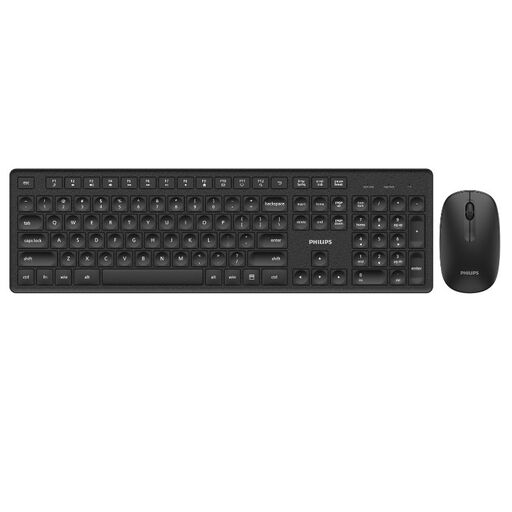 Image unavailable
This set may be worth considering if you want to choose a keyboard and mouse together and need a number pad.
The version is described as having a full-size UK QWERTY keyboard, a 2.4 GHz USB receiver and a mouse described as quiet. Check that the layout suits the way you type.
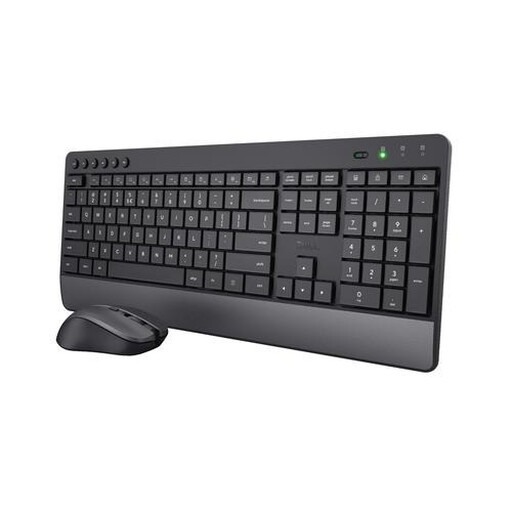 Image unavailable
This set may suit you if you’re looking for a full-size keyboard with a number pad for a shared workspace.
Trust describes the keys and mouse buttons as quiet. The version is listed as wireless and US QWERTY, with a wrist rest; check that the layout suits you.
 Image unavailable
The full-size layout with a number pad may suit you if you enter figures and want a standard-size keyboard.
Trust describes the keys as scissor-style and quiet. The product details list a USB receiver, three Bluetooth channels and a rechargeable battery; check which connection suits your computer and workspace.
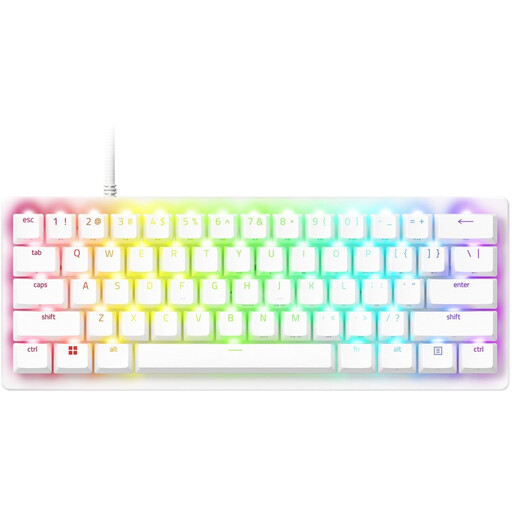 Image unavailable
The compact 60% size can free up space for your mouse if you don’t often need the omitted keys close to hand.
The product details list a USB-C connection, programmable keys and macro recording. Razer Synapse is listed for advanced settings; check whether you can use that software at work.
Not necessarily. First, check which keyboard shortcuts your photo application already offers. If you then want to customise tasks, see whether the necessary keyboard software is supported and can be used on your office computer.
It depends on the model. The Trust Ody II uses a USB receiver; Keychron also lists Bluetooth and a wired connection for the K3 Max. Check the available ports, pairing options and IT policy before choosing a version.
No. A compact model changes how you can position your keyboard and mouse, but your whole workstation still matters. A comfort claim for a keyboard is no guarantee against discomfort.
According to Arboportaal, for employees who work at a screen for more than 2 hours a day, the screen and keyboard must not be attached to one another. When using a laptop, the employee must therefore be able to use a separate screen or keyboard. This is a conditional workstation requirement, not a general obligation to choose a particular keyboard.
For a qualifying distance purchase by a consumer, a 14-day cooling-off period applies in many cases, according to the Dutch government. Consumers in the Netherlands are entitled to a product that is fit for purpose, but there is no fixed statutory warranty period for all products. If buying in a business’s name, check the agreed terms; consumer rules do not automatically apply to a business purchase.