Who is this choice relevant to?

Sight-reader with piano repertoire

You want to play parts for both hands from sheet music. Compare the range of your pieces with the keyboard, and decide whether you also want to practise with weighted keys. Yamaha and Casio describe models with 61 or 76 keys; Yamaha and Korg also document digital pianos with 88 keys.

Player in a small practice space

You’ll set up the instrument in a rehearsal studio or move it regularly. When choosing, allow space for the instrument, your chair and your sheet music. Yamaha lists the P-145 as 1,326 mm wide; check the dimensions of the version you’re considering too.

Player in a shared studio

You want to practise while other people are using the room. Check that the instrument has a suitable headphone socket and that you can position your sheet music comfortably. Korg lists a PHONES socket and a music rest for the B2.

What should you look for?

61-key keyboard

A good fit if: your practice pieces fall within its range and you’re looking for a portable keyboard. Yamaha describes the PSR-E383 as a touch-sensitive model with practice features.

Bear in mind: 61 keys don’t offer the same range as an 88-key keyboard, and touch sensitivity isn’t the same as a weighted hammer-action mechanism.

76-key keyboard

A good fit if: your parts need a wider range than a 61-key model offers, but you still want a keyboard. Casio lists 76 keys for the CT-S1-76BK.

Bear in mind: 76 keys still don’t cover the full 88-key range. Casio lists an optional adapter for wireless connectivity; if you need this feature, check whether it’s included in the offer.

Digital piano with 88 weighted keys

A good fit if: your sheet music calls for a wider range or you specifically want to practise with a weighted piano action. Yamaha describes the P-145 as having a GHC keyboard; Korg lists weighted keys for the B2.

Bear in mind: measure the space available and check the version and accessories. Yamaha lists the P-145 as 1,326 mm wide; the Korg B2 specifications on the US manufacturer page include an optional PU-2 for half-pedal use.

What to consider What should you check? Who is this important for?
Key range and touch Compare the lowest and highest notes in your pieces with a 61-, 76- or 88-key keyboard. Separately, decide whether you need weighted keys. If I’m reading parts for both hands, I want to know whether the lowest and highest notes fit on the keyboard, and whether the touch suits my goals. Around 33% of consumers prioritise range and touch.
Space and sheet music setup Measure the available width and depth, including space for a chair and sheet music. Check whether the version you’ve chosen has a music rest. I want to set up my instrument and sheet music neatly, even when studio space is limited. Around 27% of consumers prioritise a suitable studio setup.
Practising with headphones Check the headphone output and the appropriate plug on the exact version. Also check what happens to the speakers when headphones are connected. When other people are using the studio, I want to be able to practise without sound coming through the speakers. Around 20% of consumers say quiet practice is their main consideration.
Practice features Compare the features of the exact model, such as a metronome or lesson functions. Choose only features that suit your practice routine. If I want to practise passages and tempo independently, I look for features that support this, without assuming they’ll read sheet music for me. Around 20% of consumers prefer built-in practice aids.

Common buying mistakes

  • Assuming lots of sounds make an instrument suitable for every practice piece

    A large selection of sounds doesn’t tell you whether all the notes in your sheet music fit on the keyboard. Yamaha describes the PSR-E383 as having 61 keys, so range is still a separate point to consider.

    Before buying, compare the lowest and highest notes in a few representative pieces with the instrument’s key range.

  • Confusing touch sensitivity with weighted hammer action

    Yamaha describes the PSR-E383 as touch-sensitive and the P-145 as having a weighted GHC keyboard. These terms refer to different key mechanisms.

    If you also want to practise piano technique as well as sight-reading, check the specifications for the exact model.

  • Assuming a basic instrument comes as a complete package

    Accessories and package contents can vary between versions. Check what’s included in the offer before assuming you’ll have everything you need for a complete practice setup.

    Compare the listed items with what you need for the instrument, sheet music and pedal use.

    According to Korg, the separately available PU-2 is required for half-pedal use with the Korg B2. Also check the contents of the Dutch offer; the specifications mentioned are from Korg’s US product page.

Brands to consider

Yamaha

The models reviewed offer different options: the PSR-E383 is a 61-key keyboard with practice features, while the P-145 is a digital piano with 88 weighted keys.

  • According to Yamaha, the PSR-E383 has touch-sensitive keys and lesson functions. Yamaha says the P-145 has an 88-key GHC keyboard.
  • The PSR-E383 has a smaller key range than the P-145. Yamaha lists the P-145 as 1,326 mm wide, so measure the space available for your setup.

Casio

The CT-S1-76BK reviewed here is a 76-key option for anyone looking for a wider range than a 61-key keyboard offers.

  • Casio lists 76 keys for the CT-S1-76BK.
  • 76 keys still don’t cover the full piano range. Casio lists an optional adapter for wireless MIDI and audio connectivity; check whether it’s included with the version you’ve chosen.

Korg

According to Korg, the B2 is a digital piano with 88 weighted keys, a metronome and a music rest.

  • Korg lists a PHONES socket, a music rest and a damper pedal as included with the B2.
  • Korg lists the separately available PU-2 for half-pedal use. The specifications consulted are from Korg’s US product page; check the package contents for the Dutch offer.

Joybuy products for sight-reading

These are 61-key instruments for practice pieces that fit within this range. Compare the listed features and accessories with the setup you need.

MLS-931 digital keyboard, 61 keys, black

MLS-931 digital keyboard, 61 keys, black

This 61-key model is suitable for practice pieces whose notes fall within its range; check this against your sheet music.

The product name lists weighted keys, 300 sounds, 300 rhythms, an LCD screen and USB-MIDI.

View at Joybuy

Electronic keyboard, 61 keys, black, with music stand

Electronic keyboard, 61 keys, black, with music stand

This model has 61 keys; compare its range with the lowest and highest notes in your practice pieces.

The product name lists a MIDI controller, recording function and speakers. A metronome and music stand are also mentioned in the name.

View at Joybuy
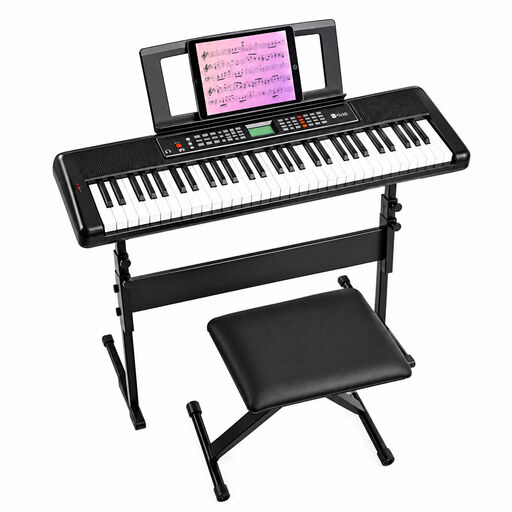
61-key keyboard set with stand, bench and music stand

Keyboard set, 61 keys, with stand and bench

The 61 keys are suitable for pieces whose notes fall within this range. Check that the included setup suits the space in your studio.

The product name lists a stand, bench, music stand, 300 sounds and 300 rhythms, a three-level learning mode, an LCD screen and USB-MIDI.

View at Joybuy
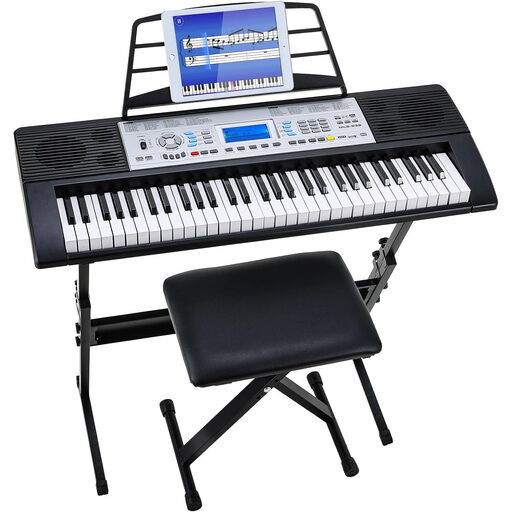
61-key keyboard set with stand and stool

Keyboard set, 61 keys, with stand and stool

This model has 61 keys; check whether its range is sufficient for the parts you want to read.

The product name lists a stand, stool, 500 sounds, a three-level learning mode, two speakers and an LCD screen. The product description recommends adult supervision during assembly and use.

View at Joybuy

Frequently asked questions

Are touch-sensitive keys the same as weighted piano keys?

No. Yamaha describes the PSR-E383 as touch-sensitive and the P-145 as having a weighted GHC keyboard. Choose based on what you want to practise in addition to reading music, and check the specifications for the exact model.

What should you check when setting up in a rehearsal studio?

Measure the space for the instrument, sheet music and seating. Also check the music rest and accessories included with your chosen version. Yamaha lists the P-145 as 1,326 mm wide, and Korg says the B2 includes a music rest.

What extra items might you need?

Check the contents of the specific offer and compare them with your setup. For half-pedal use with the Korg B2, Korg lists the separately available PU-2; also check which stand and other accessories are included with the version.

What if a keyboard bought in the Netherlands develops a fault too soon during normal use?

According to ACM ConsuWijzer, if a product doesn’t perform as you could reasonably expect during normal use, the seller must provide a free remedy under the applicable conditions. This could be a repair, replacement or refund; there isn’t one fixed statutory guarantee period for every product.

Which product safety rules are relevant when buying in the Netherlands?

Electrical and electronic appliances placed on the market in the Netherlands must comply with the applicable European rules. According to Ondernemersplein, the manufacturer applies a CE marking when one is required for the appliance, following the required conformity assessment. Check that the version on offer is subject to the relevant requirements and complies with them.
