
Piano technique student
If you’re practising left-hand patterns that also need to work on an acoustic piano, the keyboard range and weighted action may matter more than a compact design.


If you’re studying piano technique or taking lessons that require a piano keyboard, a digital piano with 88 weighted keys is generally the better choice. For left-hand patterns and chords that fit within a smaller range, a portable keyboard with 61 or 76 keys may be enough. Yamaha’s model specifications distinguish between these types of keyboard, but they are not a comparative playing test. Also check the headphone socket, the available space and what’s included with the exact version.
If you’re practising left-hand patterns that also need to work on an acoustic piano, the keyboard range and weighted action may matter more than a compact design.
For bass notes, chords and rhythmic patterns, it’s useful to check whether 61 keys cover your exercises or whether you need more room to play.
If you need to set up or move your instrument without unnecessarily disturbing others, pay close attention to the connections, dimensions and stability of the setup.
A good fit if: your left-hand patterns and accompanying chords fit within the range, and you move the instrument regularly.
Consider: a touch-sensitive keyboard is not the same as a weighted piano keyboard; check the range required by your learning materials.
A good fit if: you need more room for low notes alongside your right hand, but aren’t necessarily looking for a weighted piano keyboard.
Consider: Yamaha says the PSR-EW320 has an organ-style keyboard; also measure up to check whether its stated width of 1,148 mm will fit in your practice space.
A good fit if: piano technique, dynamics or a wider note range are central to your practice, and you have room for a full-size keyboard.
Consider: models vary in dimensions, pedal options and included parts; headphones won’t make the physical sound of the keys silent.
In a shared music room, the main things to weigh up are your learning goals, the notes both hands need to play at once, the noise level and the space available for your setup.
| What to consider | What to look for | Who is this important for? |
|---|---|---|
| Key action suited to your lessons | Ask whether your course requires a piano keyboard. Compare the action of the exact version. | If I’m practising piano technique, I want an action that matches what I need to do on an acoustic piano. Around 33% of consumers prioritise a piano-style action. |
| Range for both hands | Note down the lowest and highest notes you need to play at the same time, then compare them with the keyboard’s range. | When my left hand plays bass notes while my right hand continues higher up, I want to know whether both parts will fit. Around 27% of consumers prioritise having enough range for both hands. |
| Practising with headphones | Check the socket on the exact model and which plug will fit. Start with the volume low. | If I’m practising in a shared room, I want to listen through headphones without the amplified sound carrying through the room. Around 20% of consumers prioritise private listening. |
| Setup and transport | Measure the available width and depth. Check the stand, power supply, pedal and what’s included with each version. | When I use the instrument in different places, I want it to fit and stand securely. Around 20% of consumers prioritise placement and transport. |
A keyboard can be touch-sensitive without having a weighted piano keyboard. Yamaha describes the PSR-EW320 as having organ-style keys and touch response, while the P-145 has a GHC keyboard.
Let your learning goals determine the type of action you need, rather than relying on the words ‘touch-sensitive’ alone.
If your course requires a piano keyboard, you may need a second instrument if you choose a keyboard first.
Casio lists the CDP-S110 as 232 mm deep and 1,322 mm wide, so even a shallow cabinet can still take up a fair amount of width.
Measure both the width and depth of the available table or stand.
You may need a different stand or practice space if the instrument won’t fit where you planned to put it.
Casio lists an SP-3 pedal with the CDP-S110, while Roland names the optional DP-10 for extended pedal functionality with the FP-10.
Check what’s included with the exact version and whether the accessories are compatible with the model.
You may need to buy suitable accessories separately to complete your setup.
Yamaha offers portable keyboards with 61 or 76 keys, as well as the P-145 digital piano with 88 GHC keys.
The CDP-S110 is a digital piano option with 88 hammer-action keys.
The FP-10 is an 88-key digital piano for piano-focused practice.
The ES120 is a portable digital piano with a Responsive Hammer Compact keyboard.
These Joybuy product picks are suited to practising left-hand patterns on a keyboard or digital piano.
 No image available
Could suit you if you’re looking for a 61-key instrument for exercises within that range.
The product description lists a weighted, touch-sensitive keyboard, a metronome and a headphone socket.
 No image available
Could suit you if you’re practising left-hand patterns within a 61-key range.
The product description lists a metronome, a headphone socket and a music stand.
 No image available
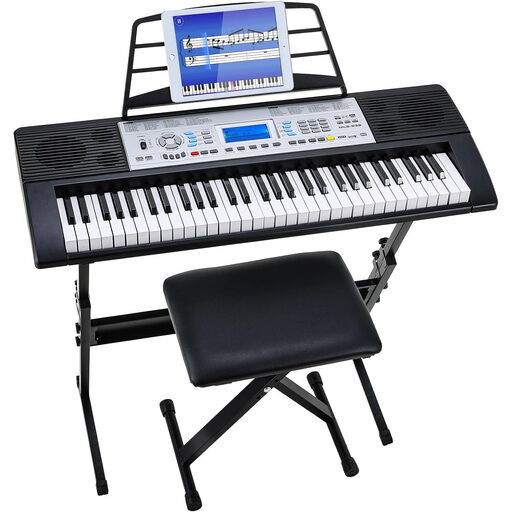
Could suit you if you’re looking for a keyboard with the parts for a permanent practice setup.
The product description lists 300 tones and rhythms, plus a stand, bench and music stand in the set.
 No image available
Could suit you if you’re looking for 61 keys and want to factor the included setup into your choice.
The product description lists 500 sounds, two speakers, a stand and an adjustable bench.
Compare the lowest and highest notes you need to play at the same time with the range of the exact instrument. The number of keys alone won’t tell you whether your exercise will fit.
Use a stable stand that’s suitable for the model and follow the setup instructions. Roland warns in the FP-10 manual that incorrect placement can make the instrument unstable; this guidance applies specifically to that model.
Compare what’s included with the exact version against what you need, such as a power supply, stand, headphones and pedal. For consumer purchases in the Netherlands, you have statutory rights if a product breaks down too soon; the Dutch government lists free repair or replacement as possible remedies. A manufacturer’s warranty does not replace these statutory rights.
According to the Dutch government, many distance purchases come with a 14-day cooling-off period. There are exceptions, and the type of seller may matter, so check the terms of the specific purchase.
No, not automatically: according to the European Union, CE marking is required for products covered by specific harmonised EU rules, including certain electrical and electronic equipment. A CE mark is not an independent quality award; the conformity of a specific version must be assessed separately.