If you mainly play a melody and chords that fit within 61 keys, a compact keyboard could be a practical choice for a small practice space. For a written piano part with a wider range or a piano-style touch, an 88-key digital piano may be a better fit. Before you buy, measure the space available and check the headphone socket, power supply and accessories included with the exact model.
Who is this choice relevant to?
Melody and chord player
You want to learn a musical theatre song on a standalone instrument and put it away when you’ve finished. Compare the range of your part with a compact keyboard; Yamaha describes the PSR-E383 as a 61-key keyboard, while Casio lists a range of built-in tones for the CT-S1.
Piano part player
You’re learning a written part for both hands and prioritise range and key feel, provided you have room for a wider instrument. Yamaha lists 88 keys for the P-145, and Korg also specifies an 88-key keyboard for the B2+.
Quiet practice player
You share your practice space and want to play with suitable headphones. Check the connection and how it works on the exact model; Korg describes a PHONES socket on the B2+, while Roland lists two headphone outputs on the FP-30X.
What should you look for when buying?
Compact keyboard with built-in tones
Choose this option if: you mainly practise a melody and chords, the notes fit within 61 keys and you want to put the instrument away regularly.
Bear in mind: a shorter keyboard may not cover the range of your piano part; built-in accompaniment styles won’t necessarily match the accompaniment for your musical theatre song.
88-key digital piano
Choose this option if: you want to practise the full piano part or a piano-style touch, and have enough room to set up and store the instrument.
Bear in mind: the models mentioned are more than 1.3 metres wide; check which tones and accessories come with each model too.
| What to consider |
What should you check? |
Who is this more important to? |
| Range and touch |
Compare the highest and lowest notes you play at the same time with the keyboard’s range, and consider its touch response. |
If I’m playing the full piano part, I don’t want to run out of keys at the top or bottom. Around 31% of consumers prioritise range and touch response. |
| Space to set up and store |
Measure the available width and depth, allowing room for a music rest and cables. |
In a small room, I want to know in advance whether I can put the instrument away after practising. Around 25% of consumers give available space top priority. |
| Practising with headphones |
Check the type of socket, whether it works with your headphones and if you need a suitable adapter. |
If I share the space, I want to practise without sound from the speakers. Around 25% of consumers choose quiet practice as their main consideration. |
| Tones and accompaniment |
Decide whether you need a different tone or a built-in pattern, then check the features of the exact model. |
If I want to practise with a different tone or a rhythm pattern, I want to know what the instrument actually offers. Around 19% of consumers prioritise tone selection or accompaniment. |
Common buying mistakes
-
Choosing based only on the number of tones
A wide choice of tones or accompaniment styles won’t solve the problem if the keyboard is too short for your piano part.
First, check the range of your arrangement. Then consider whether extra tones or accompaniment styles would be useful for the way you practise.
-
Mistaking an 88-key digital piano for a compact keyboard
The 88-key models mentioned are more than 1.3 metres wide. The stand for the Korg B2+ is sold separately.
Measure both your playing area and your storage space. Also check which parts are included with the specific model.
The stand for the Korg B2+ is listed as sold separately, so bear this in mind when setting up your practice space.
-
Assuming every pair of headphones will fit straight away
A listed headphone socket doesn’t automatically mean your headphone plug will fit.
Check the connection type and headphone compatibility in the manual for the exact model.
Brands to compare
Yamaha
The PSR-E383 is a 61-key keyboard with accompaniment features; the P-145 is an 88-key digital piano. They are different options, not interchangeable versions.
- Yamaha says the PSR-E383 has touch-sensitive keys and 260 Styles. Yamaha lists 88 keys and a width of 1.326 mm for the P-145.
- Don’t assume the PSR-E383’s accompaniment features are available on the P-145; measure up for the wider digital piano.
Casio
The Casiotone CT-S1 is an option for playing solo with a range of built-in tones.
- Casio lists piano, electric piano and organ tones.
- These tones alone don’t mean that a specific musical theatre accompaniment or recording function is included. Check the exact model.
Korg
The B2+ is a piano-focused option with 88 keys and a headphone socket.
- Korg specifies an NH keyboard, a PHONES socket and a damper pedal included in the box.
- The stated dimensions without the music rest are 1.312 × 336 × 117 mm; the stand is sold separately.
Roland
The FP-30X is an 88-key digital piano with headphone sockets.
- Roland lists a PHA-4 Standard keyboard and two headphone outputs.
- Roland’s statements about the sound are manufacturer claims, not an independent comparison with other models.
Joybuy products for practising on 61 keys
The Joybuy products below are 61-key models for practising melodies and chords. Check that your musical theatre part fits the range of the keyboard you choose.
 No image available
MLS-931 digital piano, 61 keys, black
An option for melodies and chords that fit within 61 keys.
The product name lists 300 sounds, 300 rhythms, an LCD screen, USB-MIDI, speakers and a headphone socket. The description mentions weighted, touch-sensitive keys.
Compare the highest and lowest notes in your arrangement, when played together, with the range of 61 keys.
Joybuy
 No image available
Electronic keyboard, 61 keys, black
An option for a part that fits within the range of 61 keys.
The product name lists a MIDI controller, recording function, speakers, metronome and music stand. The description mentions a headphone socket.
Check that the socket is compatible with your headphones and that your part fits within the keyboard’s range.
Joybuy
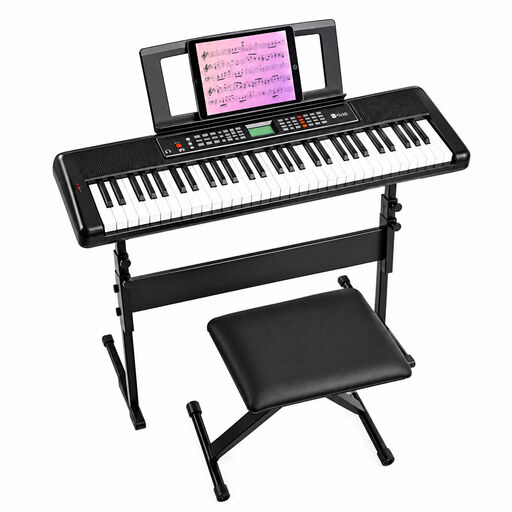 No image available
Digital keyboard piano set, 61 keys, black
This set is designed for a permanent practice spot; check that there’s room for the stand and stool.
The product name lists 300 tones, 300 rhythms, a 3-level learning mode, an LCD screen and USB-MIDI. The set includes a stand, stool and music stand; the description mentions a headphone socket.
Your part must fit within the range of 61 keys.
Joybuy
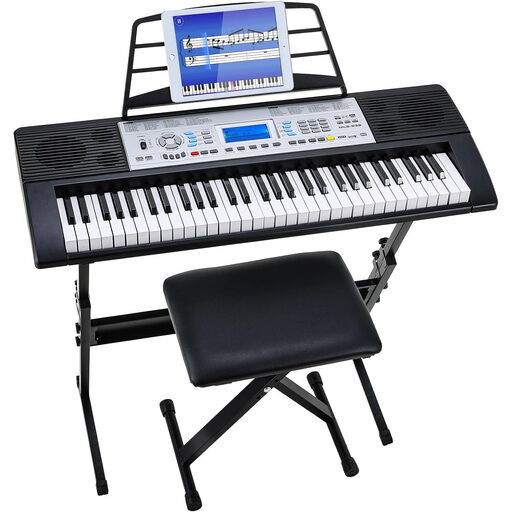 No image available
Digital keyboard set, 61 keys, black
A set for practising in a permanent spot, provided the stand and stool fit in the space available.
The product name lists 500 sounds, a 3-level learning mode, two speakers and an LCD screen. The set includes a stand and stool.
Compare your part with the range of 61 keys before you choose.
Joybuy
Frequently asked questions
Are 61 keys enough for my musical theatre song?
That depends on your arrangement. Compare the lowest and highest notes you need to play at the same time with the range of the keyboard you choose; the number of keys alone doesn’t guarantee that every piano part will fit.
What should I check when setting up and using the instrument?
Measure the space, including room for a music rest and cables. Before use, check that the specific model comes with the right power supply and the accessories you want. Korg lists an adapter and damper pedal among the items included with the B2+, but the stand is sold separately.
Which safety marking should I check when buying?
The Netherlands Food and Consumer Product Safety Authority states that CE marking is compulsory for electrical products covered by the relevant rules. According to Your Europe, CE marking is only required when harmonised EU rules say so. So check the specific model, including the power supply provided; CE marking is not proof that each individual instrument has been independently tested.
What if the keyboard breaks too soon during normal use?
In the Netherlands, you have a legal guarantee in addition to any manufacturer’s or seller’s warranty. According to ACM ConsuWijzer, if a product is faulty, the seller must provide a free solution, depending on the circumstances. This does not mean that every keyboard has a fixed guarantee period.


