For singing musical theatre songs with chords, a touch-sensitive keyboard with transposition and a suitable headphone socket may be enough, as long as your parts fit within its key range. Check the connections on the exact model, though. If you need the full range, compare an 88-key model with a light touch, such as the Korg Liano, with a weighted model such as the Yamaha P-145. Headphones won’t muffle your singing or the physical sound of the keys.
Who is this for?
Singer accompanying themselves in a shared home
You practise musical theatre songs with melodies and chords, and want to listen to the instrument through headphones. Transposition and accompaniment features can be useful when practising different songs and keys; Yamaha describes these features on the PSR-E383.
Player practising written piano parts
You want to play both hands’ parts on the keyboard and may be looking for a particular key action. Korg describes the Liano as having 88 touch-sensitive LS keys, while Yamaha specifies that the P-145 has an 88-key GHC weighted keyboard.
Practising with limited space
You share your living space and need to be able to set up your instrument or put it away after practising. Compare the dimensions of the model on offer, and allow space for the music rest, seat and cables too.
What should you look for?
Start by deciding whether you mainly want to accompany your singing or practise piano parts with a wider range. Then check that the key action and the space you have available suit your rehearsals at home.
Compact 61-key keyboard
A good fit if: you mainly play melodies and chords, and your parts fit within the range. Yamaha describes the PSR-E383 as having touch-sensitive keys, accompaniment styles and transposition.
Bear in mind: 61 keys offer a more limited range than 88, and touch-sensitive doesn’t mean the keys are weighted.
88 keys with a light touch
A good fit if: you want the full keyboard range but don’t need weighted hammer action. Korg describes the Liano as having 88 touch-sensitive LS keys.
Bear in mind: Korg states that the stand is sold separately. Measure the space you have for both the instrument and music rest.
Digital piano with 88 weighted keys
A good fit if: practising piano parts and having weighted keys are your priorities. Yamaha specifies that the P-145 has an 88-key GHC weighted keyboard.
Bear in mind: Yamaha lists the P-145 as 1,326 mm wide and weighing 11.1 kg. Check the connections and accessories included with the model, too.
| What to consider |
What should you check? |
Who is this mainly for? |
| Sound at home |
Check the headphone socket, plug size and volume control on the exact model. |
If my housemates are at home, I want to listen to the instrument through headphones; my singing and the physical sound of the keys will still be audible. Around 33% of consumers give quiet practice at home top priority. |
| Singing accompaniment |
Check whether you can easily use transposition and any accompaniment features. |
If I’m practising a musical theatre song in a different key, I want to be able to adjust the accompaniment to suit. Around 27% of consumers prioritise flexible vocal accompaniment. |
| Range and key action |
Compare the lowest and highest notes in your parts with the keyboard, and distinguish between a light touch and weighted keys. |
If my parts involve both hands and require a particular playing feel, I want to know in advance whether the keyboard is suitable. Around 20% of consumers give part range and piano playing top priority. |
| Space and storage |
Measure the available space and check which music rest, stand and power supply are included. |
If I need to put my instrument away after practising, I want to know whether it will fit in the space I have. Around 20% of consumers prioritise how easy it is to set up and store. |
Common buying mistakes
-
Confusing touch-sensitive keys with weighted keys
The touch-sensitive LS keys on the Korg Liano are not the same as the weighted GHC keyboard Yamaha describes for the P-145. Both models have 88 keys, but their key actions are different.
Decide whether you mainly need the full range or specifically want weighted piano keys. If possible, try the key action before you buy.
-
Comparing only the number of keys
A 61-key model may suit melodies and chords, but a written part may include notes outside its range.
Check the lowest and highest notes in a few representative musical theatre parts before choosing a model.
-
Assuming the instrument comes with everything you need to set it up
What’s included and which connections are available can vary between models. For example, Korg states that the stand for the Liano is sold separately.
Check what comes with the model on offer and compare it with what you already have at home.
You may need a separate stand and, if necessary, suitable cables or adapters to complete your setup. Check before you decide.
Brands to compare
Yamaha
The PSR-E383 is a 61-key model designed for accompaniment, while the P-145 is an 88-key model with a weighted keyboard. These features apply to the models mentioned.
- Yamaha says the PSR-E383 has touch-sensitive keys and accompaniment styles. For the P-145, Yamaha specifies an 88-key GHC weighted keyboard.
- Check the headphone socket and accessories included with the exact model.
Casio
The CT-S300 is a compact Casiotone keyboard with touch response, designed for people who also need to consider its size and portability.
- Casio Netherlands lists the CT-S300 as measuring 930 × 256 × 73 mm, weighing 3.3 kg and featuring touch response.
- Check the headphone socket and transposition features on the specific Dutch model.
Korg
The Liano is an option if you’re looking for 88 keys in a lightweight, portable digital instrument.
- Korg specifies 88 touch-sensitive LS keys, transposition and a headphone socket.
- Touch-sensitive LS keys are not weighted hammer action. Korg states that the stand is sold separately.
Roland
The GO:KEYS 3 is a 61-key option if you want to explore sounds and automatic accompaniment.
- Roland’s product description mentions sounds and automatic accompaniment; the manual describes transposition.
- Check the connections and regional model before ordering. These features come from the manufacturer and are not an independent comparison of sound or suitability.
Joybuy products
The products below are 61-key keyboards for melodies and chords. Check that your musical theatre parts fit within their range.
 No image available
61-key electronic keyboard with MIDI and recording function, black
This 61-key model may suit melodies and chords, as long as your parts fit within its range.
Features listed: MIDI, recording function, speakers, metronome and music rest.
Joybuy
 No image available
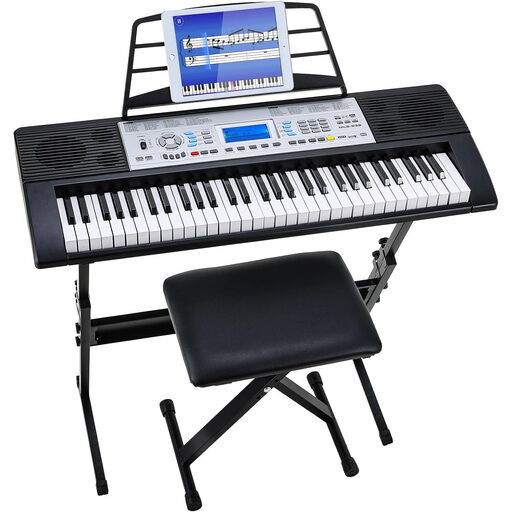
61-key digital keyboard with 500 sounds, stand and stool, black
This 61-key model may suit melodies and chords, as long as your parts fit within its range.
The product title lists 500 sounds, a three-level learning mode, dual speakers and an LCD screen. The model is described as a set with a stand and stool; check what’s included with the version on offer.
Joybuy
Frequently asked questions
Can I practise with headphones without my housemates hearing anything?
A headphone socket lets you listen to the electronic instrument signal privately. Headphones won’t automatically muffle the physical sound of the keys or your own singing, so it’s also worth agreeing practice times with your housemates.
What should I check when setting up a keyboard in a small room?
Measure the available space, including room for the music rest and a seat, and check the connections and accessories included with the exact model. Korg states that the stand for the Liano is sold separately.
What if a keyboard I bought online doesn’t fit or breaks too soon?
For an ordinary online product purchase, you generally have a statutory cooling-off period. According to ACM ConsuWijzer, it ends 14 days after delivery, subject to applicable exceptions. This is separate from your statutory rights if a product doesn’t meet what you were entitled to expect; contact the seller if it’s faulty.
Is there one nationwide time limit for practising keyboard at home?
The Dutch government says that nuisance caused to neighbours may be covered by local municipal by-laws in many municipalities. Check your local rules and any house agreements, rather than assuming you can practise at any time.
Is a CE mark an independent quality mark for every keyboard?
No. According to the European Commission, the CE mark indicates that the manufacturer considers the product to comply with the relevant EU product rules; there is no central EU body that issues a general certificate for this. The requirements that apply depend on the specific product.


