Start with a keyboard layout that lets you enter the accents and punctuation you need reliably. Then choose between a wired model, which needs no wireless connection but leaves a cable on the desk, and a wireless one, which makes it easier to clear the desk but requires a receiver and power. Treat ‘quiet’ as the manufacturer’s description, not as a measured difference between models.
Who is this keyboard for?
A writer working alongside colleagues
If you write museum text while others are working nearby, a quiet typing experience and a practical layout for entering text may be important. Trust and CHERRY describe specific models as quiet; these are manufacturer claims, not comparative sound measurements.
Someone sharing a desk
If you want to clear the desk once you’ve finished writing, compare a wired connection with a wireless model that uses a receiver. Trust and HP describe different connection options; check that the required USB port and any receiver are allowed on your work computer.
An editor who types frequently
During longer typing sessions, the position of your screen, chair and mouse also matters, as does being able to change your posture or task. Arboportaal recommends adjusting your workstation every time you move to a new place.
What should you look for?
First, choose the physical keyboard layout and connection that suit your writing and shared workspace. Then compare specific features, such as a quietness claim or an unusual shape.
Wired office keyboard
A good fit if: you usually use the same computer and want to plug in directly without a wireless receiver.
Bear in mind: the cable stays on the shared desk; a manufacturer’s description of a keyboard as quiet is not a comparative sound measurement.
Wireless with a USB receiver
A good fit if: you want to take the keyboard with you after writing or clear the desk.
Bear in mind: you’ll need to take the receiver with you or put it away, and the workplace must allow personal peripherals.
Compact or split
A good fit if: desk space or a different hand position matters more to you than a familiar, full-size layout.
Bear in mind: a compact model may be missing some keys or a numeric keypad; a split layout may take some getting used to.
| Consideration |
What should you check? |
Who should consider this? |
| Quiet typing |
Look for a quietness claim for the exact model; if sound is a deciding factor, assess it in the room where you’ll use it. |
If colleagues work nearby, you’ll want to avoid making unnecessary noise while writing. Around 31% of consumers put quiet typing first. |
| Characters and layout |
Check both the physical keyboard variant and the input layout selected on your computer; test the accents and punctuation you use. |
If you write precise museum text, you’ll want to enter characters without unnecessary corrections. Around 25% of consumers prioritise this text layout. |
| Connecting and clearing away |
Check the available USB port, workplace policy and whether any receiver can be put away after use. |
If several people use the desk, you’ll want to connect quickly and clear the workspace afterwards. Around 25% of consumers put this first. |
| Typing comfort |
Assess the keyboard alongside your chair, screen and mouse position; if possible, try an unusual layout first. |
If you type for longer periods, you’ll want a layout that suits your workspace and gives you room to change position. Around 19% of consumers make comfort during longer typing sessions their top priority. |
Common buying mistakes
-
Choosing based on ‘QWERTY’ alone
The physical keyboard layout and the computer’s input layout are two different things. The wrong setting can make accents or punctuation appear differently from what you expect.
Check the full variant and test the characters you need on the computer you’ll be writing on. Microsoft Support explains how to check and change the input layout in Windows.
Allow time to correct incorrectly entered characters or change the work computer’s settings.
-
Treating ‘quiet’ as a proven sound ranking
The quietness descriptions from Trust and CHERRY referenced here are manufacturer claims, not comparative sound-level measurements.
Choose your preferred connection and layout first. If key noise is a deciding factor, assess it in the room where you’ll be writing.
-
Choosing wireless without checking the work computer
The Trust Ody II uses a USB receiver that needs to be connected and put away. You’ll therefore need a suitable port and permission to use personal peripherals.
Check the connection and workplace policy in advance, and agree where the receiver will be kept after use.
-
Assuming an ergonomic model can replace a properly set-up workspace
A different keyboard shape is just one part of your workstation. Arboportaal recommends adjusting your workstation and changing your posture.
Assess the layout alongside your chair, screen and mouse positions, and break up your screen-based work.
Brands to consider
Trust
The Primo and Ody II models mentioned offer wired and wireless options for a shared desk.
- Trust lists a USB-C cable with a USB-A converter for the Primo, and a stowable USB receiver for the Ody II.
- The quietness descriptions apply to the specific models and are not an independent comparison.
CHERRY
The KC 1000 is a slim, wired office model; the KC 6000 SLIM and KC 1068 have their own distinct features.
- CHERRY describes the KC 1000’s keys as soft and quiet. According to CHERRY, the KC 6000 SLIM has a scissor mechanism and a full-size layout.
- The IP68 specification applies to the KC 1068 and does not automatically apply to other CHERRY models.
HP
The HP 150 Wired Keyboard variant 664R5AA#ABB is a wired chiclet-style office keyboard.
- HP lists USB plug-and-play and 12 Fn combinations.
- Check the physical layout of the variant on offer; descriptions of comfort do not prove that the model prevents discomfort.
Logitech
The K120, Signature Slim K950 and ERGO K860 offer different connection and layout options.
- The K120 is wired, the K950 can switch between three paired devices according to Logitech, and the K860 has a split layout.
- These features apply to the models mentioned; ergonomic benefit claims for the K860 are manufacturer claims and do not apply to the entire range.
Keyboards at Joybuy
This selection includes wired and wireless models, including compact layouts for anyone looking to save desk space. For each model, check that the connection and keyboard layout suit the shared work computer and your writing.
 No image available
Trust GXT 833 Thado TKL keyboard
A wired option if you want to avoid a separate wireless receiver and leave room for your mouse.
The description lists a membrane keyboard, US QWERTY layout and a 1.8 m USB cable. The TKL layout has no separate numeric keypad.
View at Joybuy
 No image available
REDRAGON wired mechanical keyboard, 94 keys
A wired option for a fixed workstation if you’re looking for a mechanical keyboard with 94 keys.
The product information lists a metal case, PBT keycaps and a detachable wrist rest. Check that the physical layout matches the characters you use.
View at Joybuy
 No image available
Redragon M68 compact mechanical keyboard
A compact, wired option if you want to save desk space and a US layout suits your text input.
The description lists 68 keys, magnetic switches and a detachable Type-C cable. The compact layout has fewer keys than a full-size model.
View at Joybuy
 No image available
HP 725 wireless keyboard
A wireless option if you want to switch between several work devices; check in advance which connection types are allowed in your workplace.
The product information lists Bluetooth, a 2.4GHz receiver, switching between three devices and USB-C charging.
View at Joybuy
 No image available
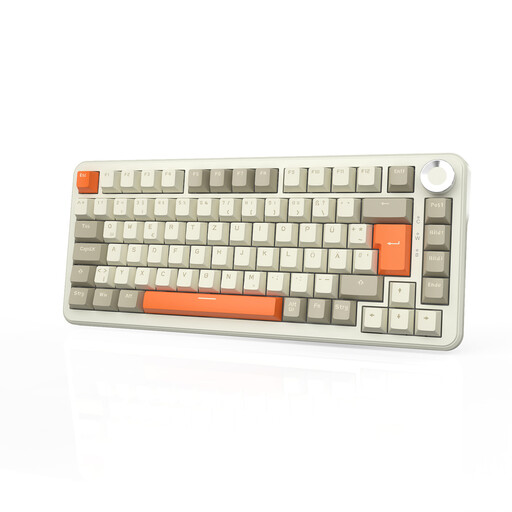
AJAZZ AK820 MAX, German QWERTZ layout
A compact option if the German QWERTZ layout suits your writing and you want a choice of connection options.
The title lists a 75% layout and USB-C, Bluetooth and 2.4GHz connections. Check the physical layout carefully before ordering.
View at Joybuy
Frequently asked questions
Does a museum have to provide a separate keyboard for screen-based work?
For employees who do screen-based work for more than 2 hours a day, the screen and keyboard must not be attached to each other, according to Arboportaal. When using a laptop, a separate screen or keyboard must therefore be available. This requirement does not make any one keyboard model mandatory.
How can I check why an accent or punctuation mark is appearing incorrectly?
Check both the symbols printed on the keys and the input layout selected on your work computer. Microsoft Support explains how to check and change the Windows layout; test the characters you need before completing a museum text.
Is a wireless keyboard immediately ready to use with a shared work computer?
Not always: the Trust Ody II uses a USB receiver. Check that a suitable port is available and ask the administrator whether personal peripherals are allowed. Put the receiver away after use so you can take it with you.
What can I do if the keyboard I bought is faulty?
For a purchase made by a consumer in the Netherlands, the seller must offer a solution if the product does not meet what you could reasonably expect from it. The Dutch government does not specify a fixed statutory warranty period. Online consumer purchases that qualify generally come with a 14-day cooling-off period; check the terms of your specific purchase.


