
Mapmaker in a shared office
You want to create maps without disturbing your colleagues with the sound of your typing. Also consider the keys and shortcuts you use in your mapping software.


If you enter lots of numbers, a full-size keyboard with a number pad is practical; if you mainly want more room for your mouse, a compact model may suit you better. In a shared office, choose a model described as quiet, but don’t treat a manufacturer’s claim as proof that it’s quieter than other keyboards. Also check the layout, connection and any software for customising keys.
You want to create maps without disturbing your colleagues with the sound of your typing. Also consider the keys and shortcuts you use in your mapping software.
You regularly enter coordinates or other numbers, and weigh the convenience of a number pad against having more room for your mouse.
You take your keyboard with you or work on several computers. In that case, the connection, key layout and size are important considerations.
| What to consider | What to look for | Who is this important for? |
|---|---|---|
| Typing noise | Check whether the manufacturer describes the keys as quiet and look at the exact model. Don’t compare these claims as if they had all been measured in the same way. | If I work in a shared office, I want to type without unnecessarily disturbing my colleagues. Around 33% of consumers prioritise quieter typing. |
| Shortcuts and numbers | Check the layout and whether it suits the tasks you carry out in your mapping software; also consider how often you use the number pad. QGIS documents customisable keyboard shortcuts. | If you regularly enter coordinates or use recurring commands, you’ll want keys that suit the way you work. Around 27% of consumers prioritise map controls and number entry. |
| Mouse space and typing posture | Compare the keyboard’s width and physical layout with the space available on your desk. A split layout may take some getting used to and, by itself, doesn’t prove a personal ergonomic benefit. | If I want to keep room for my mouse beside the keyboard or try a split layout, the setup matters. Around 27% of consumers focus mainly on mouse space or typing posture. |
| Connection and portability | Check whether your work computer supports Bluetooth, a USB receiver or a cable, and whether the key layout suits your needs. | If you regularly move between workstations or devices, you’ll want a connection that works with them and a keyboard that’s easy to take with you. Around 13% of consumers prioritise switching between workstations or devices. |
Manufacturers describe some of the models reviewed as quiet, but these product descriptions don’t provide a common basis for ranking them acoustically.
Use quietness as a selection criterion, not as proof that one model is the quietest. Check the size and connection at the same time.
According to CHERRY, the CHERRY STREAM KEYBOARD TKL has no number pad, while the full-size STREAM KEYBOARD does.
Before you buy, decide whether you’re more likely to need the number pad for mapping tasks or want extra room for your mouse beside the keyboard.
A keyboard and mouse set is a different product configuration from a standalone keyboard.
Before ordering, compare the full product name and check which items are included in the version you’ve chosen.
The STREAM models reviewed offer a wired option for a fixed workstation, with or without a number pad.
The MX Keys S reviewed is designed for customisable controls, while the Pebble Keys 2 K380s has a compact Bluetooth design and lets you switch between devices.
The Ody II reviewed is a wireless option with a full-size layout; according to Trust, the Keyra has a split layout.
This selection includes keyboards for entering numbers, working in a compact setup and switching between workstations or devices.
 No image available
A full-size layout with a number pad for anyone who regularly enters numbers.
The product name specifies a wired plug-and-play connection and use at home or in the office.
 No image available
The compact 75% layout may suit you if you want to keep some space beside the keyboard.
The product name specifies a mechanical keyboard with wired, Bluetooth and 2.4G connections, plus Gradient Grey keycaps with side printing. The description mentions essential navigation keys.
 No image available
A keyboard and mouse set for anyone looking for a compact layout and connections to different devices.
The product information lists a TKL layout, Bluetooth and a USB receiver. The keys are described as quiet scissor keys. This is a set, not a keyboard on its own.
 No image available
A full-size model with a number pad for anyone who regularly enters numbers.
The product information describes quiet keys and connections via a USB receiver or Bluetooth. The listed layout is QWERTY US.
 No image available
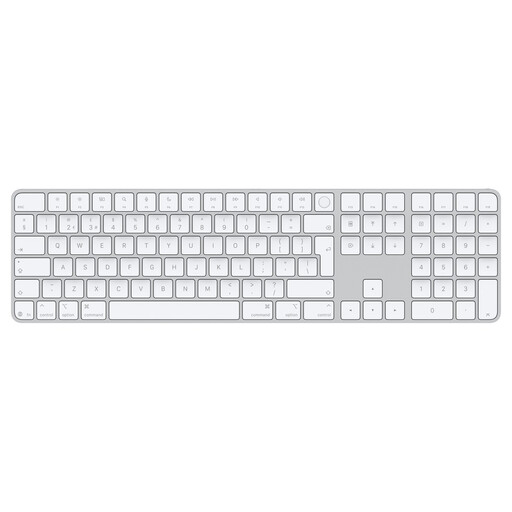
A model with a number pad for entering numbers and a listed Dutch layout.
The product information lists Bluetooth and states that this model is designed for Mac models with Apple silicon.
Not necessarily: in the example reviewed, you can customise keyboard shortcuts in QGIS itself. Check which commands you use in your mapping software and whether you can change the necessary settings on your work computer.
Set up your workstation to suit your body measurements and take breaks from screen work. Arboportaal advises limiting intensive use of a screen, keyboard and/or mouse to a maximum of 6 hours a day; this is advice, not a statutory product limit established here. If you start to experience discomfort, seek advice from your health and safety officer or occupational physician if necessary.
According to Arboportaal, for an employee who works with a screen for more than 2 hours a day, the screen and keyboard must not be attached to one another. Whether this applies depends on the working situation; the rule doesn’t specify a particular keyboard model.
When you buy as a consumer in the Netherlands, you’re entitled to a product that works properly, and the seller is your point of contact for a solution. According to the Dutch government, there’s no fixed statutory guarantee period; a manufacturer’s guarantee is in addition to your statutory rights.