
Portal developer who uses lots of keyboard shortcuts
You develop and test mouse-free navigation, and want to carry out repetitive tasks efficiently without making visitors rely on your customised keys.


For repetitive development tasks, a keyboard with customisable keys can be useful. When entering historical texts, however, a familiar layout and easy-to-reach keys are often more important. For long sessions, choose a shape that suits your workspace, but always test the portal separately with a standard keyboard: personal macros do not make a website accessible by themselves.
You develop and test mouse-free navigation, and want to carry out repetitive tasks efficiently without making visitors rely on your customised keys.
You enter descriptions and dates, and often switch between text fields and source material. Key placement matters more than extra macros.
You want to take hand position and workspace layout into account when working on text or code for long periods.
First decide whether you mainly want to customise repetitive development tasks, enter text and source material using a familiar layout, or take your hand position into account during long sessions.
| What to consider | What should you check? | Who is this important for? |
|---|---|---|
| Customisable keys | Which keys can be customised, what software is required, and whether you’re allowed to use it on your computer. | I want to customise recurring development tasks, but visitors must be able to use the portal without my settings. Around 36% of consumers prioritise customisable keys. |
| Text and navigation keys | The physical layout, the position of the navigation keys, and whether you need a number pad. | When entering descriptions and dates, I don’t want to have to search for familiar keys. Around 29% of consumers prioritise text and navigation keys. |
| Hand position | The shape of the keyboard, the space on your desk, and how it fits into your workspace setup. | During long writing or development sessions, I want to take my hand position into account without expecting a keyboard on its own to prevent discomfort. Around 21% of consumers prioritise hand position. |
| Connectivity and settings | The available computer ports and whether you can use configuration software on your computer. | I want to know in advance whether the keyboard will connect to my desktop computer and whether I can change its settings there. Around 14% of consumers consider connectivity and configuration first. |
According to the W3C Web Accessibility Initiative, features covered by the relevant keyboard criterion must be operable through a keyboard interface. A personally configured shortcut is no substitute for testing the website’s own controls and focus.
A personal shortcut does not replace the keyboard controls visitors need. If menus or forms are difficult to operate, the website itself may need remedial work.
Test the key features without your macro configuration too, and check that you can move keyboard focus out of every component.
A compact model may place keys differently from what you’re used to. According to Keychron, the Keychron V1 8K has a 75% ANSI layout; the PERIBOARD-512 is available in several physical language layouts.
Check the key legends and the position of the keys you use most for text entry and navigation.
Arboportaal describes both repetitive hand movements and static strain in screen-based work. A keyboard’s shape is only one part of choosing your workspace setup.
Consider how the layout fits your workspace and how long it may take to get used to. Remember to vary your activities during long sessions, too.
The MX Keys S and ERGO K860 are two different models to compare: according to Logitech, the former offers key customisation through Logi Options+, while the latter has a fixed split design.
The V1 8K is a wired model with a compact 75% ANSI layout.
The PERIBOARD-512 is a wired USB-A model with a split layout and integrated wrist rest.
According to Kinesis, the Freestyle2 has two keyboard modules that can be positioned separately.
This Joybuy selection includes compact mechanical keyboards with different layouts and connection options. Above all, check that the physical key layout suits your typing needs; a keyboard is no substitute for a separate accessibility test of the portal.
 No image available
The 68-key layout and US layout are worth considering if that compact physical layout suits your typing needs.
The product name mentions magnetic switches, a metal top plate and an 8000Hz polling rate.
 No image available
Consider this version if you’re looking for a compact 75% layout with several connection modes and a US layout suits your typing needs.
The product name mentions three connection modes, a volume knob, an 8000mAh battery and a hot-swappable design.
 No image available
This wired version is an option if you’re looking for a compact 82-key layout for a fixed workspace.
The product name mentions a 75% layout, an 8000Hz polling rate and a 0.1mm actuation distance.
 No image available
Consider this wired version if you have a fixed workspace and the physical QWERTY US layout suits your typing needs.
The product name mentions a 75% layout, a volume knob and white key backlighting.
 No image available
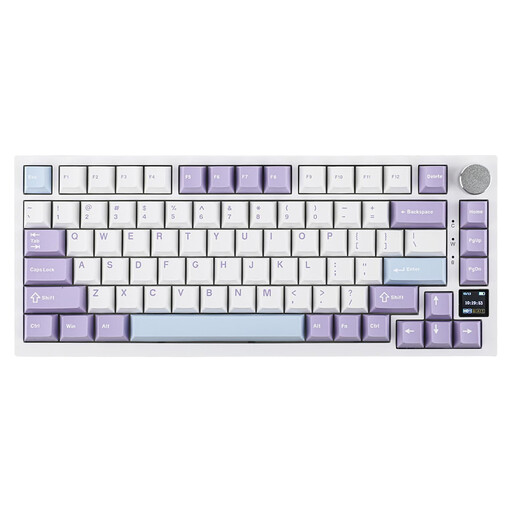
According to the product name, the 75% layout keeps the keyboard compact. Check that the physical QWERTY US layout and stated compatibility suit your needs.
The product name mentions a TFT display, three connection options and compatibility with Win/Mac/PC.
No. A macro changes how things work on your computer, but not necessarily how they work for visitors. For the relevant keyboard criterion, the W3C Web Accessibility Initiative states that web features must be operable through a keyboard interface. Also check that you can move focus out of every component.
Go through the features using a keyboard and check that you can reach, operate and leave them. If you can’t move keyboard focus out of a component, the website itself needs attention; extra keys on your keyboard won’t fix the problem.
Check the connection and requirements for the exact version. According to Perixx, the PERIBOARD-512 uses USB-A; the Keychron V1 8K is wired, and Keychron lists Launcher for key customisation. If you use a managed computer, check in advance whether you’re allowed to install configuration software.
No. Arboportaal describes repetitive hand movements and static strain in screen-based work. As well as the keyboard shape, consider your workspace setup and varying your activities; a manufacturer’s comfort claim does not guarantee an individual outcome.
This depends, among other things, on the organisation responsible and the service provided. DigiToegankelijk states that the Decree on Digital Accessibility for Government applies to the websites of public bodies covered by that decree; a history portal is not automatically a government website just because of its subject matter. Dutch rules for designated products and services under the European Accessibility Act have applied since 28 June 2025, but that does not automatically mean an informational history portal is classed as one of those services. Keyboard operability remains a worthwhile design requirement, regardless of the legal classification.