
Designers with limited access to power sockets
If you don’t want to use an extra power socket for your keyboard while you work, compare battery use, charging and power from your computer.


Start by checking your computer’s connections and power supply. Bluetooth keeps a USB port free, while a wired USB keyboard doesn’t need its own batteries or charging. Then make sure the layout, shortcuts and desk space suit your work. Bear in mind that a rechargeable keyboard will need charging from time to time.
If you don’t want to use an extra power socket for your keyboard while you work, compare battery use, charging and power from your computer.
If you view or edit a design on a computer, tablet or phone, check which connections are supported and how easy it is to switch between devices.
If you want to position your keyboard and mouse side by side, weigh up a compact size against having a number pad and other familiar keys.
First choose between Bluetooth and a USB connection. Then decide whether you’d rather replace batteries, recharge a battery or use a cable.
| What to consider | What to check | Who is this important to? |
|---|---|---|
| No spare power socket | Check how the keyboard is powered and whether your computer has a spare Bluetooth or USB connection. | I don’t want to reserve a power socket for my keyboard, so I’d rather use a suitable connection to my computer. Around 36% of consumers prioritise avoiding the need for an extra power socket. |
| Switching between devices | Check Bluetooth support on each device and how many connections the specific keyboard can handle. | If I switch between my computer, tablet and phone while designing, I want to know whether the keyboard supports those devices. Around 29% of consumers prioritise switching between devices. |
| Layout and desk space | Compare the physical layout, number pad and the keys you use for your work. | I want to position my keyboard and mouse comfortably without losing keys I need. Around 21% of consumers focus most on the layout and workspace. |
| Avoiding batteries or charging | Check whether the keyboard uses replaceable batteries, a rechargeable battery or a wired connection. | If I have a suitable USB port free, I’d rather use a cable than replace batteries or recharge a battery. Around 14% of consumers prioritise avoiding battery replacement and charging. |
A wireless keyboard can do away with a cable while you type, but its batteries will eventually need replacing or its battery will need recharging.
Before buying, check whether the model uses replaceable batteries or a rechargeable battery.
A receiver uses a port on your computer. A wired USB keyboard also connects through your computer, so either option can be inconvenient if all your ports are already in use.
Count your available computer ports separately from your available power sockets, and check whether your computer supports Bluetooth.
A compact keyboard takes up less space, but may not have keys you’d expect on a full-size model, such as a number pad.
Check the layout and shortcuts you use before choosing the smallest size.
For this type of setup, Logitech offers compact Bluetooth models, a backlit keyboard and a wired USB option.
Trust says the Trust Lyra combines a compact keyboard with a choice of Bluetooth or a USB receiver.
The Surface Keyboard, 2nd Edition, is a Bluetooth model with a number pad.
Keychron describes the K2 Max as a mechanical keyboard in a 75% layout, with Bluetooth, 2.4GHz and wired modes.
This selection includes wired keyboards for compact workspaces and wireless models with rechargeable batteries or multiple connection options.
 No image available
A wired option if you’re looking for a compact keyboard and can use a cable at your workstation.
TKL layout without a number pad; QWERTY. Requires a spare USB port.
 No image available
An option if you want a compact layout and the choice of wireless or wired use.
The product information lists Bluetooth, 2.4 GHz and USB-C; the title specifies a US QWERTY layout. The rechargeable battery will need charging.
 No image available
A compact wired option if you have limited desk space and don’t need a number pad.
61 keys and a US QWERTY layout. Requires a USB connection to your computer.
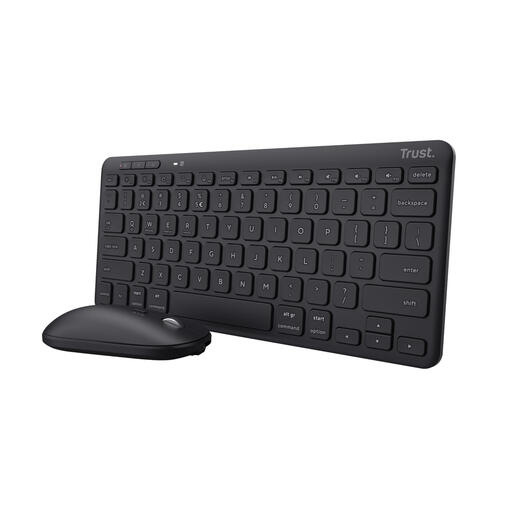 No image available
A compact set for anyone who wants to switch between devices and type without a cable.
Bluetooth and USB receiver; according to the product information, it supports up to three devices. The battery needs recharging. It has a QWERTY US layout and no number pad.
 No image available
A foldable option if you’re looking for a keyboard you can use in different places.
Bluetooth connection and rechargeable battery; it will still need charging.
The wireless models reviewed use batteries or a rechargeable battery rather than their own power socket. Batteries will eventually need replacing and a rechargeable battery will need charging; the wired Logitech K120 gets its power through the computer’s USB connection.
If your laptop supports Bluetooth, you can choose a compatible Bluetooth keyboard to keep a USB port free. A USB receiver and a wired keyboard both need a suitable spare port on your computer.
Take flat batteries to a collection point; according to the Government of the Netherlands, they should not go in the bin. If you buy a new, similar electrical appliance, a retailer may take back your old one under the ‘old-for-new’ scheme.
No. According to the Government of the Netherlands, there is no fixed term for the statutory guarantee in the Netherlands: what matters is what you can reasonably expect from the product. If a product is faulty, the retailer is your point of contact, but normal wear and tear or damage caused by you is not automatically covered.
For employees who work at a screen for more than two hours a day, the Arboportaal (Dutch occupational health and safety portal) states that the screen and keyboard must not be attached to each other. If you use a laptop, it must be possible to use a separate screen or keyboard; this is not a general requirement to buy a particular keyboard model.