When spare sockets are in short supply, both a wired USB keyboard and a wireless model can be suitable. A USB keyboard uses a computer port, while a wireless one will eventually need batteries or recharging. Then choose based on the physical layout and how easy it is to reach the arrow keys, symbols and shortcuts. Check the connection, key layout and power source for the specific version.
Who is this relevant for?
Schema designer with limited connections
You want to type without using an extra socket, so your choice depends on which computer ports are free. CHERRY describes both USB-A and Bluetooth models; Trust lists Bluetooth and a USB receiver for the Lyra.
Frequent coder and schema typist
You use navigation keys, symbols and shortcuts a lot, and want them to be easy to reach. RTINGS discusses the difference between compact keyboards and models with a numeric keypad; Keychron lists a 75% layout and customisable keys for the K3 Pro.
Designer working across multiple devices
You switch between devices such as a computer and a tablet while you work. Logitech, CHERRY and Trust describe models that can switch between multiple devices; this feature is most useful if you actually type on more than one device.
What should you look for when choosing?
If you have few sockets at your workstation, your choice will mainly depend on the computer ports available, the key layout you want and how the keyboard is powered.
Bluetooth with replaceable batteries
Choose this if: your computer supports Bluetooth and you don't want to use a charging cable at your workstation.
Bear in mind: the batteries will eventually need replacing and recycling.
Rechargeable wireless
Choose this if: you want to work wirelessly and can schedule charging through an existing USB connection.
Bear in mind: the battery needs recharging regularly; a USB receiver uses a compatible computer port.
Wired via USB
Choose this if: you have a compatible USB port free and don't mind having a cable on your desk.
Bear in mind: wired typing uses a computer port, but doesn't automatically mean you'll need a separate socket.
| What to consider |
What to look for |
Most relevant for |
| Power and connections |
Check whether your computer has Bluetooth and/or the USB port you need. Find out whether the model uses batteries, a rechargeable battery or USB power. |
With few sockets, I want to know which computer ports are available and how the keyboard is powered. Around 33% of consumers put power and connections first. |
| Key layout for schemas and coding |
Compare the exact physical QWERTY layout and check that your editor supports the shortcuts you want. Decide whether you use a numeric keypad. |
When working on schemas, I want symbols, arrow keys and shortcuts to be easy to reach. Around 27% of consumers prioritise the key layout for coding and navigation. |
| Typing comfort for long sessions |
Consider how the keys feel and how your keyboard and mouse are positioned. Also assess your screen workstation setup as a whole. |
When working at a computer for long periods, I want to choose a typing feel and layout that suit my workstation. Around 20% of consumers put typing comfort first. |
| Switching between devices |
Count the devices you actually use and check the connection, operating system and physical key layout for each one. |
If I type on several work devices, I want to switch between them without having to use a different keyboard each time. Around 20% of consumers give device switching top priority. |
Avoid common buying mistakes
-
Assuming wireless means you'll never need to recharge or replace batteries
A wireless connection doesn't eliminate the need for power. A rechargeable battery needs charging, while replaceable batteries will eventually need changing.
Check how the exact version is powered, and consider where you'll charge it or replace its batteries.
-
Confusing a USB receiver with Bluetooth that doesn't need a receiver
A receiver uses a USB port. A Bluetooth model without a dongle needs your computer to support Bluetooth.
Compare the keyboard's connection with the ports and Bluetooth support available on your computer.
-
Choosing based on compactness alone
A smaller keyboard can save desk space, but may leave out a numeric keypad or keys you use often. RTINGS describes a numeric keypad as useful for data entry.
Think through your usual schema, navigation and data-entry tasks before choosing a size.
-
Mistaking a paid service plan for a replacement for your statutory guarantee
For consumer purchases in the Netherlands, additional commercial cover is separate from your statutory rights. An optional plan is therefore not automatically necessary to claim under your statutory guarantee.
Compare what an additional plan actually offers beyond your existing rights. ACM ConsuWijzer explains the retailer's role in relation to the statutory guarantee.
Brands worth comparing
Logitech
The Pebble Keys 2 K380s is a compact Bluetooth model, while the MX Keys S is a larger wireless keyboard with customisable functions. These models suit different layout requirements.
- Logitech says the K380s can switch between three devices.
- Logitech describes the MX Keys S as having customisable functions.
- Check the physical layout and connection for each model to make sure it suits your computer.
Trust
The compact, rechargeable Lyra combines Bluetooth with a USB receiver.
- Trust specifies two Bluetooth channels and one receiver channel.
- The receiver channel needs a compatible USB port to be free; the battery needs recharging regularly.
CHERRY
The models reviewed offer different connection options: Bluetooth, wireless with a wired fallback, or wired via USB-A.
- CHERRY lists three Bluetooth channels for the KW 7100 MINI BT.
- According to CHERRY, the KW 9200 MINI also supports a wired data channel; the KC 6000 SLIM uses USB-A.
- Check the connection and key layout for each model and version.
Keychron
The K3 Pro is a compact mechanical option for anyone who wants customisable keys for coding.
- Keychron lists a 75% layout, Bluetooth and customisable keys for the K3 Pro.
- According to Keychron, hot-swapping is available only on the RGB Backlight Hot-Swappable version.
Keyboards at Joybuy
This selection includes compact keyboards, wireless models powered by batteries or a rechargeable battery, and a wired model. Check the connection options, power source and physical layout for each version.
 No image available
AJAZZ AK820 MAX 75% mechanical keyboard, tri-mode, US QWERTY
According to the product description, the compact 75% layout retains the arrow and function keys.
The product name lists Bluetooth, 2.4 GHz and wired use, an 8000 mAh battery and Flying Fish switches. The physical layout is US QWERTY.
View at Joybuy
 No image available
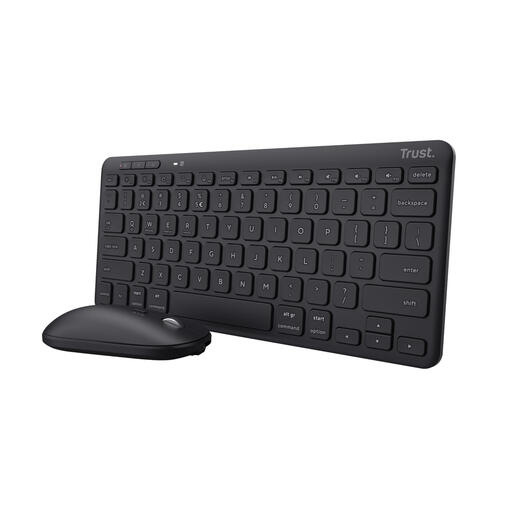
Trust Lyra wireless keyboard and mouse set, compact, US QWERTY
A good fit if you're looking for a compact, rechargeable keyboard with several connection options.
The description lists two Bluetooth channels and a USB receiver for up to three devices, as well as scissor-switch keys. It has no numeric keypad; the battery needs recharging regularly, and the receiver uses a free USB port.
View at Joybuy
 No image available
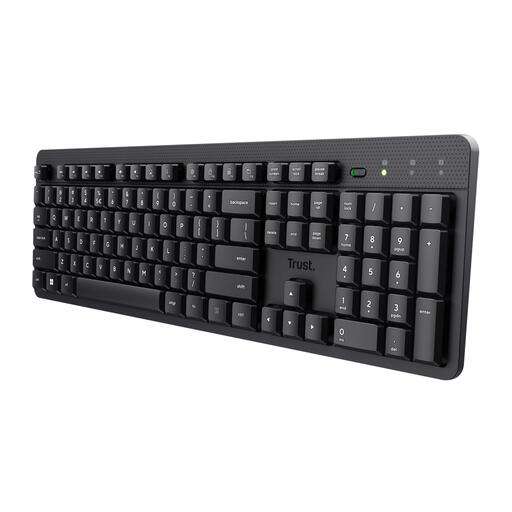
Trust Ody II wireless keyboard, full-size, numeric keypad, US QWERTY
The full-size layout with numeric keypad suits anyone who enters figures and wants to keep those keys.
The product description lists low-profile keys, battery power and a wireless connection via a USB receiver. The receiver uses a computer port.
View at Joybuy
 No image available
Trust Vaiya wireless keyboard, full-size, multi-device, US QWERTY
Consider this model if you want to keep a numeric keypad and switch between devices.
The description lists three Bluetooth channels and a USB receiver for up to four devices, scissor-switch keys and a rechargeable battery. The receiver uses a free USB port; the battery needs recharging regularly.
View at Joybuy
 No image available
AJAZZ AK820 75% wired mechanical keyboard, US QWERTY, Grey White
According to the product description, the compact layout retains the arrow and function keys for navigation.
This wired model uses USB-C and, according to the product name, has a US QWERTY layout. You’ll need a compatible USB-C port free, and the cable will run across your desk.
View at Joybuy
Frequently asked questions
Do you need a spare socket for a wired keyboard?
Not necessarily: according to CHERRY, the CHERRY KC 6000 SLIM needs a USB-A connection to the computer. Check the connection and power source for the exact model; wired doesn't automatically mean you'll need a separate socket.
Can a rechargeable keyboard also be used as a wired keyboard while charging?
Only if the model also supports a wired data channel. CHERRY lists a detachable USB-A-to-USB-C cable for the KW 9200 MINI that supports both data transfer and charging; don't assume this is possible from the charging port alone.
What rules apply in the Netherlands when working at a screen for long periods?
For employees who work at a screen for more than two hours a day, Arboportaal sets out requirements for being able to use the screen and keyboard separately. This information is about the workplace; it doesn't mean every customer is generally required to choose a particular keyboard.
Who should you contact if your keyboard develops a fault?
For consumer purchases in the Netherlands, the retailer is your point of contact for the statutory guarantee if a product breaks through normal use sooner than you could reasonably expect. ACM ConsuWijzer refers to an appropriate remedy at no cost, such as repair or replacement; there isn't automatically the same fixed guarantee period for every keyboard.
What should you do with flat keyboard batteries or an old keyboard?
The Dutch Government says that used household batteries can be handed in at shops and supermarkets that sell batteries. When you buy a new, similar electrical appliance, the shop can, according to the Dutch Government, take your old appliance through the old-for-new scheme.


