
Teachers who want to type quietly
You edit lesson slides while colleagues are working nearby, so a quiet keystroke is a priority. Also check that the keyboard layout matches the one you’re familiar with.


Start with the key feel and layout that suit typing in a shared office and editing lesson slides. Then choose between wired, wireless or split layouts based on your workspace and how you work. Always check the connection and exact keyboard layout. Some manufacturers describe their models as quiet, but the available information does not include comparable sound measurements to help you rank models against one another.
You edit lesson slides while colleagues are working nearby, so a quiet keystroke is a priority. Also check that the keyboard layout matches the one you’re familiar with.
You regularly edit text and slides, and want a familiar layout with keys that are easy to find. The shortcuts available will also depend on your software and keyboard layout.
You work in different places or on different devices, so you want to know in advance whether the cable or receiver will fit and whether you can switch between devices.
A good fit if: you value a keyboard you can move around and a quiet typing experience.
Keep in mind: check the USB receiver and layout. A ‘quiet’ label is not a comparative sound measurement.
A good fit if: you want more desk space and rarely use a separate number pad.
Keep in mind: a TKL layout leaves out the number pad, and you’ll need to be able to connect the cable at your workstation.
A good fit if: you actually switch between devices, such as a work computer and a second device.
Keep in mind: check whether the connection and any configuration software are permitted at your workplace.
A good fit if: you want to try a different hand position for longer typing sessions.
Keep in mind: a different layout may take some getting used to, and does not in itself prove any health benefit.
Don’t compare keyboards on their quietness claims alone. Check the layout, connection and features you’ll actually use when editing slides.
| What to consider | What should you check? | Who is this important for? |
|---|---|---|
| Key noise | Where possible, look for a demonstration and assess the exact version. Manufacturers use their own descriptions of how their keyboards sound. | If colleagues sit nearby, you’ll want to avoid making typing an unnecessary distraction. Around 33% of consumers prioritise a quiet keystroke. |
| Layout and controls | Check the physical keyboard layout and whether the keys you use work with your software. | If you make lots of edits to lesson slides, a familiar layout can make it easier to find text and shortcuts. Around 27% of consumers prioritise this need. |
| Connection | Check the available ports, whether you need a receiver, and whether wireless connections or configuration software are permitted at your workplace. | If you work in different places, you’ll want to know whether you can connect the keyboard there. Around 20% of consumers make connection their main consideration. |
| Typing comfort | Consider the layout, hand position and desk space required, and set up your workspace accordingly. | For longer typing sessions, the way your keyboard and workspace are set up may be a factor. Around 20% of consumers prioritise this aspect of comfort. |
Manufacturers describe their own models as quiet, but those descriptions don’t tell you which model is least audible in the same room.
Think of ‘quiet’ as a product claim. If you can, try the sound and feel of the exact version you’re considering.
The Trust Ody II is available in separate versions: a keyboard on its own and a keyboard-and-mouse set. The product name and box contents determine which one you’re choosing.
Before buying, check the full product name and what’s included.
A set may include a mouse you don’t need, so choose according to what you’re looking for.
The CHERRY STREAM KEYBOARD TKL leaves out the number pad to save space.
Consider whether you often enter numbers using a separate number pad when creating teaching materials.
Trust describes the Ody II as a wireless keyboard with quiet keys and shortcut keys. The wired Primo is a separate version.
The STREAM KEYBOARD TKL is a wired version without a number pad. The STREAM KEYBOARD WIRELESS is a separate wireless model.
The MX Keys S is designed for switching between devices and using programmable keys. The Signature K650 is a separate product range with an integrated palm rest.
The PERIBOARD-512 is a wired model with a split layout and integrated palm rest, for anyone who wants to try this key position.
This selection includes wired keyboards in different layouts and wireless models for use with multiple devices. Check the connection and physical keyboard layout for each version, especially where US-QWERTY is listed.
 Image unavailable
A wired option for anyone who wants a full-size keyboard and number pad while working.
The product name lists a QWERTY layout, plug-and-play functionality and a number pad.
 Image unavailable
An option to consider if you switch between devices and want to check both wireless and wired connection options.
The product name lists Bluetooth, 2.4 GHz and a wired USB-C connection. The layout is US-QWERTY.
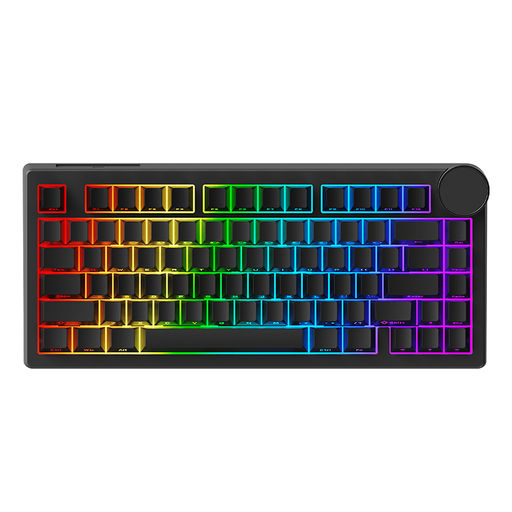 Image unavailable
A compact wired option to consider if you want to keep desk space free.
The product name lists a 75% layout, HE magnetic switches and a US-QWERTY layout; the description mentions a Type-C connection.
 Image unavailable
The product description mentions use with multiple devices and describes the scissor-style keys as quiet.
The description lists a USB receiver, Bluetooth, USB-C charging and connection to up to four devices. The layout is US-QWERTY.
 Image unavailable
A compact wired layout to consider if you have limited desk space.
The product name lists 61 keys and a US-QWERTY layout. The product description mentions RGB lighting.
No, not for standard PowerPoint shortcuts. However, check your software and keyboard layout: Microsoft Support notes that its published shortcuts are based on a US layout.
Check that the required receiver or wireless connection is available and permitted. Trust says the Ody II uses a USB receiver, while Logitech lists device switching for the MX Keys S. These features alone don’t tell you what your organisation’s policy allows.
No. Arboportaal also recommends adjusting furniture to suit your body, varying your work and taking microbreaks. This does not mean that a specific keyboard has been shown to improve your health.
Arboportaal states that if you work at a screen for more than 2 hours a day, the screen and keyboard must not be attached to each other. For laptop use, a separate screen or keyboard must then be available. This is not a recommendation to buy a specific model.
According to the Dutch government, many distance purchases come with a 14-day cooling-off period, although there are exceptions. You’re also entitled to a product that conforms to the agreement. Check who the seller is and which terms and conditions apply to your purchase. Consumer rules may differ when an employer makes the purchase.